Locations:





 Search
Why do some referring providers continue to value interaction?
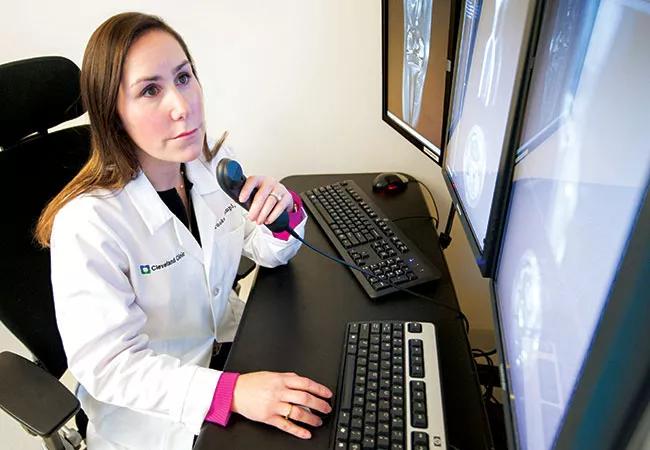
Image content: This image is available to view online.
View image online (https://assets.clevelandclinic.org/transform/cf7e5e71-f8cb-404f-a8a7-09af627ceb3a/650x450-119266_11-14-16_0030_WM_jpg)
650×450-119266_11-14-16_0030_WM
Advertisement
Cleveland Clinic is a non-profit academic medical center. Advertising on our site helps support our mission. We do not endorse non-Cleveland Clinic products or services. Policy
Radiology has increasingly become an electronic and remote practice, with radiologists reviewing images from patients located hours or even states away. Although this remote practice allows for subspecialization and increased coverage, it can erode the traditional interaction between radiologists and referring providers and consequently decrease the perceived value of radiologists in terms of patient care.
Some referring providers continue to make every effort to maintain contact, either by electronic means, phone calls or visits to the reading room. In addition, pediatric radiologists, in particular, value the physician-physician interaction that is often noted as a key factor for selecting the pediatric subspecialty over other areas of radiologic subspecialization.
A survey of pediatric practitioners was conducted to determine what inspires them to seek out interactions with pediatric radiologists even when they have remote access to images, and published the results in the Journal of the American College of Radiology.
An anonymous, voluntary, nine-question multiple-choice survey was created and sent to pediatric practitioners within Cleveland Clinic Children’s. The survey asked respondents for information about their demographics, number of visits to the reading room, reasons and preferences regarding visits, and comfort level with independent review of images.
Of the 320 pediatric general practitioners and specialists surveyed, 93 (29 percent) responded. Specialists were the most frequent visitors to the reading room (47 percent). Among the respondents, 24 percent were most likely to consult the radiologist for a complex case, 18 percent were inclined to visit because of a positive previous experience and 16 percent went to the reading room to clarify an ambiguous statement in a report. The most frequent reasons given by responders for why they chose not to visit the reading room included distance (40 percent) and insufficient time (27 percent). Forty percent said that they would visit the reading room more frequently if the radiologist was in their clinical workspace.
Advertisement
The evolution of radiology into an increasingly electronic field allows for improved subspecialty coverage and patient convenience, with radiologists reading films from varied locales. This change, however, greatly affects the referring provider-radiologist relationship and the perceived value of radiologists. When films were read as hard copy on an alternator with a typewritten dictation in a paper chart, the referring provider often came to the reading room to discuss the case and see the image, which fostered good relations and added to patient care. With the loss of this required interaction, physicians often only enter the reading room on an as-needed basis, either to discuss a challenging case or to ask a specific question. In a survey of radiologists choosing to subspecialize in pediatric radiology, a key reason included physician-physician interaction.
Pediatric radiologists are part of a team of providers and have been trained to participate in not only the diagnosis of pediatric disease but also the treatment. With increased communication, pediatric radiologists can add value and substance to the referring providers’ care. It is imperative that these interactions are developed and nurtured, not only to ensure the well-being of the patient, but also to maintain radiologists’ role in patient care.
Advertisement
Advertisement

Try these moves to relieve butt pain and numbness

Systemic change needed to improve health outcomes for parents and children, say researchers
Rare genetic variant protected siblings against seizures and severe hypoglycemia

Movie has more positive impact than expected, says Head of Adolescent Medicine
Genetic changes are similar between some vascular anomalies and cancers
Expert panel advises a two-tier structure for surgical centers
Our new head of pediatric general and thoracic surgery shares his passion and vision
Basic understanding of condition and treatment is lacking