Locations:





More clinical research should specifically study the very old
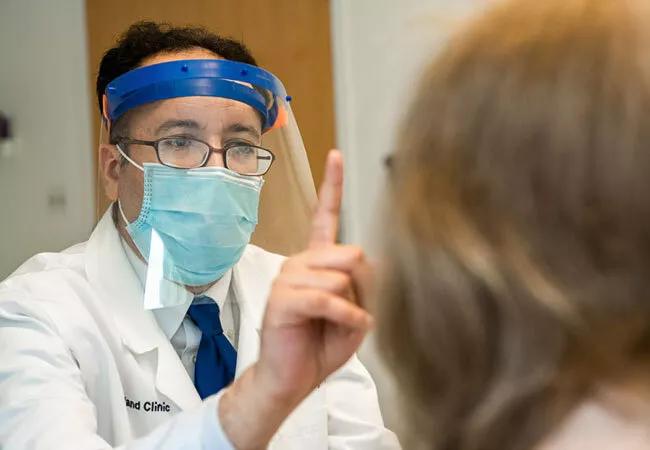
Image content: This image is available to view online.
View image online (https://assets.clevelandclinic.org/transform/babca118-dde2-4e07-beb2-50390ab778ad/21-GER-2224809_CQD_650x450_P_GER_Kilbane_2151645_Dr-Hashmi-with-Patients_180_jpg)
21-GER-2224809_CQD_650x450_P_GER_Kilbane_2151645_Dr Hashmi with Patients_180
Advertisement
Cleveland Clinic is a non-profit academic medical center. Advertising on our site helps support our mission. We do not endorse non-Cleveland Clinic products or services. Policy
Many patients believe the myth that certain health conditions are an inevitable part of getting older. Blood vessels become stiffer, bones and muscles become weaker, cognition and vision become duller, and skin becomes thinner. The truth is that quite a lot can be done to address and adapt for these and other physiological changes, with the right approaches.
Unfortunately, the older the patient, the less scientific literature we have to guide us. While research on adults age 65 and up (the Medicare population) abounds, there’s a dearth of research on those age 80 and up. This discrepancy is perpetuated as follow-up studies strive to match the structure of original studies, grouping participants as “age 65+” for convenience and comparison.
That lack of stratification above age 65 is concerning. Just as medical conditions in 30-year-olds aren’t treated the same as in 15-year-olds, neither should 80-year-olds be treated as 65-year-olds. The health issues of the very old deserve distinct treatment guidelines. As such, the medical community needs more clinical research studying the care of adults age 80 and up.
Between ages 50 and 80, there are 52 different ways the body changes naturally. But those changes often are not accounted for in medication-prescribing practices. Kidneys may clear medications differently, the liver may break them down differently and enzymes may process them differently, making certain medications ineffective, excessively potent or even toxic to an 80-year-old. Adverse effects may vary as well. Prescribing practices lose relevance when they are based on research in much younger cohorts.
Advertisement
Yet even when we do have guidelines fueled by research on the very old, they’re often overlooked or not widely known. For example, the American Diabetes Association has specific guidelines for people over age 80 and for people with diabetes and dementia. While insulin is beneficial for controlling A1C in the general population with type 2 diabetes, decreasing A1C too much in adults above age 80 with diabetes but no history of heart disease or stroke actually increases mortality. Contrary to popular belief, the use of insulin in these patients should be reduced for the best health outcomes.
Also unknown, due to increasing life expectancy, are the long-term effects of medications in the very old. Longer term effects need to be investigated now that people are living longer and living healthier. So do medical procedures in the very old. There may be potentially life-saving or life-extending treatments that we currently don’t offer older adults simply because the treatments haven’t been studied in people age 80 and older.
Geriatricians today address these unknowns by balancing the science of medicine with the art of medicine. We have well-validated scales to define frailty and cognitive impairment. We have key knowledge of physiological changes in older adults. And we use that knowledge to adapt treatments to the needs of each patient.
We strive to simplify medication lists as much as possible, especially if medications are interacting in counterproductive ways. We deprescribe medications based on the American Geriatric Society’s Beers Criteria® for Potentially Inappropriate Medication Use in Older Adults. We may integrate safe alternative therapies that have fewer side effects.
Advertisement
We take a holistic approach, collaborating with team members from pharmacy, physical therapy, nutrition and other specialties, as we advocate for anti-ageism and advance the care of older populations.
Ultimately, we advocate for researchers to safely include older participants in clinical trials and follow them over time. The National Institutes of Health and the National Institute on Aging are proactively requesting that research proposals include specific details about the number of older adults participating and the potential impact of the research on older adults. More funding is now available for the study of health issues affecting older adults, as it should be.
Ardeshir Hashmi, MD, is Section Chief of Cleveland Clinic’s Center for Geriatric Medicine.
Advertisement
Advertisement
Pilot study confirms feasibility of conducting additional research on the novel treatment

Longer hospitalization does not mean a safer, faster recovery for patients age 70+
Structured data helps identify older adults at risk for poor outcomes, defines patients who require more comprehensive assessments


Self-administered tool can be completed in 10 minutes in waiting room
Social prescribing turns leisure activities into good “medicine”
A large geriatric study aims to find the answers

Analysis underscores how telehealth can help pinpoint elder abuse
 Search