Locations:





Paramedic Telehealth Program offers alternative to calling paratransit or 911
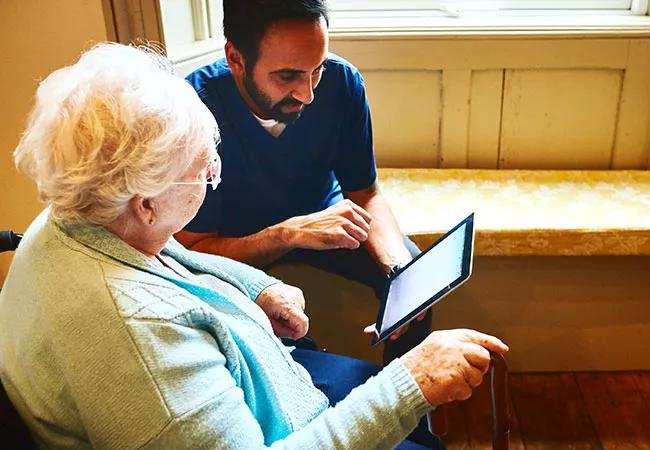
Image content: This image is available to view online.
View image online (https://assets.clevelandclinic.org/transform/4930440d-0f8f-41c5-9e58-9fc24878586f/geriatric-homebound-telehealth-650x450-003_jpg)
geriatric-homebound-telehealth-650×450 (003)
In one workday, physician Jan Bautista, MD, can visit seven homebound patients in Cleveland Clinic’s Medical Care at Home Program. Some days it’s fewer, if the homes are farther apart. With a territory spanning almost 75 miles and a growing population of geriatric patients, the demand is increasing for Dr. Bautista and other Medical Care at Home physicians.
Advertisement
Cleveland Clinic is a non-profit academic medical center. Advertising on our site helps support our mission. We do not endorse non-Cleveland Clinic products or services. Policy
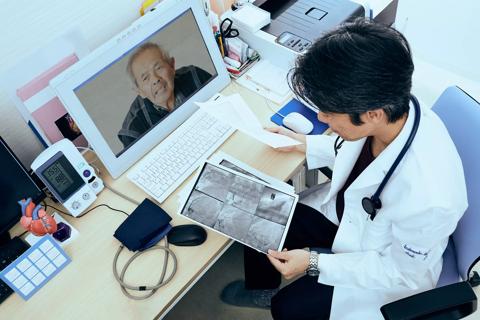
But Cleveland Clinic has developed a way to care for more homebound patients per day — especially those with urgent needs. The Paramedic Telehealth Program sends Cleveland Clinic paramedics out to patient homes, where they, the patient and family use Cleveland Clinic’s Express Care® Online platform to videoconference with a physician. Paramedics provide the tablet computer and internet connection as well as preliminary medical care.
Currently, three paramedics each cover their own territory in Northeast Ohio. Physicians like Dr. Bautista conduct virtual visits from a central office.
“Because the paramedics do the commuting instead of me, I can see one patient while another paramedic is traveling to my next patient,” says Dr. Bautista. “Now I can see up to 12 patients in one day.”
This innovative program is a welcome alternative for homebound seniors, whose urgent care options used to be limited.
“When someone needed a doctor right away, they could go to their doctor’s office for a same-day appointment, or go to an Urgent Care or Express Care location,” says Cleveland Clinic family medicine specialist and geriatrician Ami Hall, DO, who provides telehealth visits. “But that would require scheduling paratransit, which sometimes isn’t available the same day. The only other option was to call 911 and be transported to an emergency department [ED].”
Now, when Medical Care at Home patients need same-day care, the Paramedic Telehealth Program can come to them if another mobile provider isn’t available.
Advertisement
“We provide the right care for these patients, right where they are, keeping them out of the ED and sometimes out of the hospital,” says Dr. Hall.
For example, if a patient has cellulitis, a paramedic can connect the patient with a physician and transmit a photo of the infection. The telehealth physician can prescribe antibiotics. The paramedic can return to the home the next day to check on the patient’s progress, potentially eliminating both an ED visit and overnight observation.
In addition to urgent care calls, the Paramedic Telehealth Program also handles follow-up appointments for patients recently discharged from a hospital or nursing facility. Services soon to be added to the program include administration of IV medication and same-day lab testing.
With a paramedic at the home and a physician on videoconference, the program combines the best of high-tech and high-touch healthcare. Paramedics listen to the patient’s heart and lungs, record pulse and respiration rate and otherwise serve as a physician’s hands and feet.
“Paramedics note a lot of details that wouldn’t be evident if the patient were using Express Care Online by themselves,” says Dr. Hall. “They can see what medical equipment and medications are currently in the home that might be helpful when planning treatment.”
Dr. Bautista remembers one patient with severe COPD who needed urgent care for increasing shortness of breath. The paramedic went to the home, started the patient’s workup and began the virtual visit. He reported that the patient was exhibiting respiratory distress and that her oxygen level was low.
Advertisement
As the patient talked with Dr. Bautista, the paramedic discovered that the tubing on the patient’s respiratory equipment was damaged. He replaced the defective tube, and the patient’s oxygen level returned to baseline and her shortness of breath resolved.
“If we did a virtual visit without the paramedic on site, we might not have noticed that her oxygen concentrator was not functioning correctly,” says Dr. Bautista.
Also, some patients don’t have an internet connection and can’t access Express Care Online themselves, he adds. By sending paramedics and their tablet computers into homes, more patients can enjoy the benefits of virtual visits.
As the elderly population grows, the demand for at-home physician visits will increase, says Dr. Bautista. The Paramedic Telehealth Program, combining virtual-visit convenience with hands-on care, is one way to manage that increasing need.
A complement to this telehealth program is Cleveland Clinic’s new virtualist program. Like a physician-on-call service, virtualist physicians help telehealth nurses, home care providers and Express Care providers better triage patients to prevent unnecessary ED visits.
Advertisement
Advertisement
Pilot study confirms feasibility of conducting additional research on the novel treatment
Longer hospitalization does not mean a safer, faster recovery for patients age 70+
Structured data helps identify older adults at risk for poor outcomes, defines patients who require more comprehensive assessments
Self-administered tool can be completed in 10 minutes in waiting room
Social prescribing turns leisure activities into good “medicine”
A large geriatric study aims to find the answers
Analysis underscores how telehealth can help pinpoint elder abuse
 Search