Locations:





Study supports using the direct thrombin inhibitor
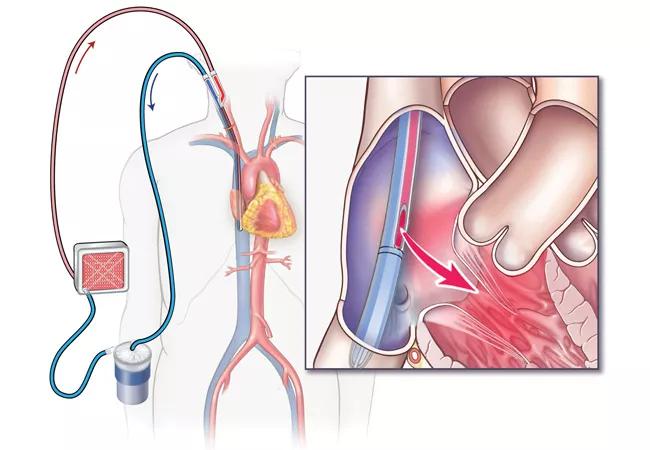
Image content: This image is available to view online.
View image online (https://assets.clevelandclinic.org/transform/91581e39-f933-424e-922d-8b4964d1cae8/20-HVI-1885884-VV-ECMO_650x450_jpg)
20-HVI-1885884-VV-ECMO_650x450
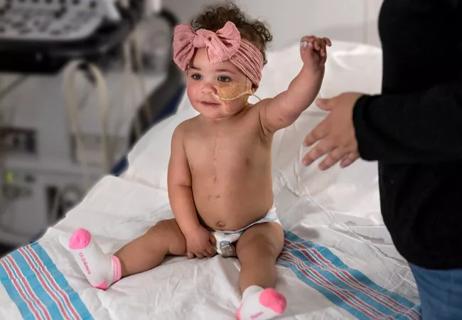
In November 2016, Cleveland Clinic Children’s switched from heparin to bivalirudin as the primary anticoagulant for pediatric extracorporeal membrane oxygenation (ECMO). Now a retrospective analysis of their pediatric EMCO patients (n=32) receiving heparin or bivalirudin between October 2014 and May 2018 showed bivalirudin to be feasible, safe, reliable and cost-effective.
Advertisement
Cleveland Clinic is a non-profit academic medical center. Advertising on our site helps support our mission. We do not endorse non-Cleveland Clinic products or services. Policy
“Bilvairudin has tremendous potential to supplant heparin for several reasons: It binds directly to thrombin, causing more predictable pharmacokinetics and eliminating the need for supplementing low antithrombin levels; it inhibits both circulating and clot-bound thrombin; and it is not associated with heparin-induced thrombocytopenia (HIT),” says Mohammed Hamzah, MD, a pediatric critical care medicine specialist at Cleveland Clinic Children’s and first author of the study.
“Ultimately, despite its higher cost per dose, bivalirudin is less expensive than heparin when the costs for lab work and antithrombin replacement were figured in,” he adds.
Maintaining optimal anticoagulation on ECMO is challenging but mandatory, since excessive anticoagulation can cause bleeding, and inadequate coagulation can cause catastrophic clotting.
Unfractionated heparin has been the universal anticoagulant for pediatric patients on ECMO for decades. Advantages include reversibility, ease of titration and low cost. However, inherent limitations posed by the medication prompted Dr. Hamzah and colleagues to seek an alternative.
“Heparin requires antithrombin III for efficacy, causes platelet activation and dysfunction and only inhibits free thrombin,” he says. “The concentration of antithrombin can be low in patients on ECMO and is usually low in neonates and critically ill children. This often requires infusions of antithrombin, which predisposes the patients to developing heparin resistance.”
“Because bivalirudin is a direct thrombin inhibitor, no cofactor is generally needed. This eliminates the need for antithrombin serum measurements, as well as heparin anti-Xa assays.”
Advertisement
Another concern is thrombocytopenia. Heparin is highly antigenic and can trigger an immune-mediated response, often resulting in HIT. “Bivalirudin does not cause HIT, and the occurrence of thrombocytopenia is extremely low,” he says.
The single-center study is the largest conducted on anticoagulation in pediatric patients and one of the largest in which bivalirudin was used as the primary anticoagulant for ECMO.
The length of time required to reach target anticoagulation was more than twice as fast with bivalirudin than with heparin. No serious thrombotic or hemorrhagic events were seen with bivalirudin. Among patients receiving heparin, three serious thrombosis occurred—two of which caused stroke—and four patients suffered significant bleeding events. Patients on heparin required more than twice the number of blood transfusions.
Mortality was similar in both groups, with an overall mortality rate of 24%. The overall recovery and decannulation rate was 60% — a figure consistent with previous reports from national registries. In addition, 16% of patients who could not be weaned from ECMO were converted to ventricular assist devices and listed for heart transplantation.
The authors provide initiation and titration dosing guidelines in the paper. However, there is a learning curve associated with dosing in patients with renal impairment. “You have to start with a lower dose and increase it continuously over time as renal function improves,” he says.
Although this study reinforced Cleveland Clinic Children’s decision to use bivalirudin for pediatric ECMO, Dr. Hamzah understands it may not sway skeptics. “The results were very good, but the trial was underpowered to reach significance.” He hopes to analyze a larger number of patients in a trial involving six U.S. centers.
Advertisement
“Of the 20 centers I contacted, only three are using bivalrudin, and they are having a great experience,” he says.
The primary stumbling block to wider acceptance appears to be price: The median cost per day for bivalirudin is $303, compared with $6 for heparin. But these are deceptive, he says. Overall, bivalirudin is cheaper.
“When we included the cost of all necessary laboratory testing and thrombate administration, the total cost of heparin therapy came to $1,184 per day, versus $494 for bivalirudin,” he says.
He expects the multicenter trial to be completed by the end of the year. If the results are favorable, a randomized clinical trial (RCT) will follow.
“Most heparin users aren’t willing to switch until they see the results of a RCT,” he says.
Advertisement
Advertisement

Try these moves to relieve butt pain and numbness

Systemic change needed to improve health outcomes for parents and children, say researchers
Rare genetic variant protected siblings against seizures and severe hypoglycemia

Movie has more positive impact than expected, says Head of Adolescent Medicine

Genetic changes are similar between some vascular anomalies and cancers
Expert panel advises a two-tier structure for surgical centers
Our new head of pediatric general and thoracic surgery shares his passion and vision
Basic understanding of condition and treatment is lacking
 Search