Locations:





Revised diagnostic categories lead a number of key developments

Image content: This image is available to view online.
View image online (https://assets.clevelandclinic.org/transform/ba999255-a72b-4409-9894-9cb1f4028ecd/690x380-Rome-Eating-Disorder_jpg)
690×380-Rome-Eating-Disorder
Among the latest revisions to the American Psychiatric Association’s Diagnostic and Statistical Manual of Mental Disorders — as reflected in the DSM-5, released in 2013 — are expanded categories for feeding and eating disorders (see sidebar below).
Advertisement
Cleveland Clinic is a non-profit academic medical center. Advertising on our site helps support our mission. We do not endorse non-Cleveland Clinic products or services. Policy
While earlier DSM versions included anorexia nervosa, bulimia nervosa and the catchall “eating disorder not otherwise specified” (ED-NOS), DSM-5 introduced two new categories — binge eating and avoidant/restrictive food intake disorder (ARFID) — to increase options for actionable diagnoses.
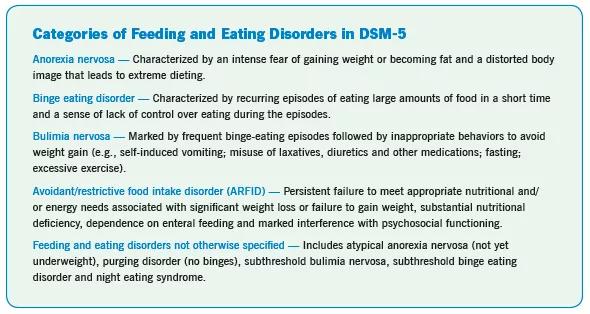
Image content: This image is available to view online.
View image online (https://assets.clevelandclinic.org/transform/603cff32-b2cd-4877-8cb3-7f9b18808948/590x-Inset-Rome-Eating-Disorder_jpg)
“Lumping together all those who did not have anorexia nervosa or bulimia into ED-NOS, or unspecified eating disorders, was not helpful for treatment centers trying to figure out what works best for distinct groups of patients,” explains Ellen Rome, MD, MPH, Head of the Center for Adolescent Medicine at Cleveland Clinic Children’s.
“Some of the same treatments are useful, such as family-based refeeding for children and adolescents who restrict their intake, but we’re still fine-tuning what works,” adds Dr. Rome, who was among the experts on a working group that proposed changes to the criteria for eating disorders in advance of DSM-5. “Having new categories for binge eating and ARFID allows us to look at outcomes for these patients and learn how to improve our quality of care.”
Since the release of DSM-5, Dr. Rome has co-authored several studies and other journal articles that point to the importance of the new categories and the impact on patients and providers. Here are a few examples and insights from each:
Advertisement
Dr. Rome says the centrality of family-based therapy, also known as the Maudsley method — where parents assume an important role in ensuring that their children achieve early and lasting weight restoration — is a relatively recent trend.
“It represents a change from the 1990s, when parents were cut out of the equation. We used to do ‘parentectomies,’” she quips. “But it turns out that kids get better faster if parents are part of the equation.”
One of the Maudsley method’s tenets is family-based refeeding, which can be supported by a pediatrician or dietitian versed in eating disorders. Family-based refeeding has three stages:
“Patients in families that do the Maudsley method correctly — where the kid gains weight in the first month — are most likely to be recovered a year later,” says Dr. Rome.
“Our approach is to help empower parents to feed their kids appropriately and to free families from the eating disorder mindset,” she adds. “We try to help kids and their parents see the child/adolescent as separate from the eating disorder.”
“If a family member, teacher, peer or pediatrician hears alarm bells about an eating disorder, pay attention,” advises Dr. Rome. She says warning signs include:
Advertisement
“The adolescent may not have a disorder at that moment, but weekly or monthly follow-up may be needed to ensure they aren’t developing one,” she notes.
Advertisement
Advertisement

Try these moves to relieve butt pain and numbness

Systemic change needed to improve health outcomes for parents and children, say researchers
Rare genetic variant protected siblings against seizures and severe hypoglycemia

Movie has more positive impact than expected, says Head of Adolescent Medicine

Genetic changes are similar between some vascular anomalies and cancers
Expert panel advises a two-tier structure for surgical centers
Our new head of pediatric general and thoracic surgery shares his passion and vision

Basic understanding of condition and treatment is lacking
 Search