Locations:





Program donates adaptive tricycles to children with chronic conditions and serious injuries
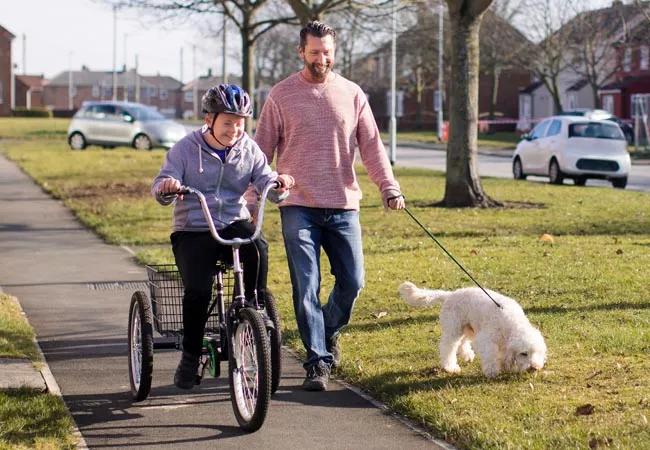
Image content: This image is available to view online.
View image online (https://assets.clevelandclinic.org/transform/905da5d5-81bc-4708-9d13-df86d6e2c1d5/22-CHP-2652658-CQD-Ogonek-Rehab-Tricycle-Grant-650x450-1_jpg)
22-CHP-2652658 CQD- Ogonek – Rehab Tricycle Grant 650×450
The therapy team at Cleveland Clinic Children’s Outpatient Therapy Services relies on an extensive toolbox to help patients increase function, including adaptive tricycles.
Advertisement
Cleveland Clinic is a non-profit academic medical center. Advertising on our site helps support our mission. We do not endorse non-Cleveland Clinic products or services. Policy
“Adaptive tricycles provide children with special needs a way to strengthen their lower and upper extremities, explore their environment and participate in an activity that is beneficial for all children,” says Nathan Ogonek, PT, DPT.
Recognizing the holistic benefits for children with a range of chronic conditions and serious injuries, Dr. Ogonek launched the Chance to Tryke program to provide adaptive tricycles for patients to use at home.
“These tricycles can be a financial burden for parents as they range from $500 to nearly $2,000, depending on adaptations that are needed to accommodate a patient’s postural needs,” says Dr. Ogonek.
In January 2022, Dr. Ogonek received a Caregiver Catalyst Grant from the Cleveland Clinic Philanthropy Institute to purchase 29 adaptive tricycles for patients.
Dr. Ogonek has ordered adaptive tricycles from two companies. They are operated by hand, foot or a combination of the two, depending on the patient’s requirements.
Physical therapists, occupational therapists and speech therapists at Cleveland Clinic Children’s can complete an application, created by Dr. Ogonek, to request a tricycle for a patient. The application asks for a summary of how the patient would benefit from using an adaptive tricycle, as well as detailed measurements to fit them with the right equipment.
“The hope is to get these tricycles to kids who would benefit from them, but are unable to purchase one,” says Dr. Ogonek. “So, there aren’t specific criteria. The program is open to any patient receiving services in our department.”
Advertisement
As a staff pediatrician with Cleveland Clinic Children’s Department of Community Pediatrics, Eva Kubiczek-Love, MD, has a lot of complex care patients and patients with autism who require physical and occupational therapy. She is excited by the Chance to Tryke program’s potential.
“Every healthcare provider’s goal is to have each patient, no matter what underlying conditions they may have, strive to be the best they can be and gain as much independence as possible,” says Dr. Kubiczek-Love. “These tricycles could help my patients ambulate, relieve pain and accomplish milestones.”
Several of her patients plateaued developmentally during the COVID-19 pandemic when some services were put on hold or delayed. Adaptive tricycles could help them regain and improve function.
Dr. Ogonek has witnessed the impact first-hand in his practice. One of his patients with Down syndrome began using a foot-and-hand operated adaptive tricycle during physical therapy and has since graduated to a foot tricycle.
“He learned how to move the trike, which has a reciprocal pattern similar to that used during ambulation,” says Dr. Ogonek. “Now he is more confident moving and going through other activities.”
When the tricycles arrive at Cleveland Clinic Children’s Hospital for Rehabilitation and applicants have been selected, Dr. Ogonek plans to host a build-a-bike day where patients and their families can help put together the tricycles and test them out. He will also follow up with patients to chronicle the success of the program.
Advertisement
In addition, Dr. Ogonek hopes that patients return the adaptive tricycles for others to use when they outgrow them or are done using them, allowing the Chance to Tryke program to reach even more families in need.
“Many of my patients see multiple subspecialists and require therapy services nearly every day, creating a fiscal burden,” says Dr. Kubiczek-Love. “This program allows access to something that is in the dream world for a lot of my families.”
That is just as important as the physical benefits, she adds.
“We look at our patients holistically, with compassion and empathy, not just as a set of nerves and muscles,” says Dr. Kubiczek-Love. “This program addresses their conditions but moves beyond that. It sends the message that the unreachable is reachable.”
Advertisement
Advertisement

Try these moves to relieve butt pain and numbness
Systemic change needed to improve health outcomes for parents and children, say researchers
Rare genetic variant protected siblings against seizures and severe hypoglycemia
Movie has more positive impact than expected, says Head of Adolescent Medicine
Genetic changes are similar between some vascular anomalies and cancers
Expert panel advises a two-tier structure for surgical centers
Our new head of pediatric general and thoracic surgery shares his passion and vision
Basic understanding of condition and treatment is lacking
 Search