Locations:





29 neurological care paths and counting

Image content: This image is available to view online.
View image online (https://assets.clevelandclinic.org/transform/744f0cdb-cb16-40b4-a67f-aac17995096b/carepath-690x380_jpg)
carepath-690×380
Advertisement
Cleveland Clinic is a non-profit academic medical center. Advertising on our site helps support our mission. We do not endorse non-Cleveland Clinic products or services. Policy
The journey from volume-based to value-based care requires clear pathways. That was the idea behind the Neurological Institute’s recent efforts to produce a collection of disease-specific Cleveland Clinic Care Paths.
Now, more than two years and a couple dozen care paths into the initiative, the institute has found that care paths provide more than just a road map to evidence-based and efficient care. The process of developing them is a cultural transformation in itself. “Our caregivers are being engaged across the care continuum to solve problems in multidisciplinary, patient-centered ways that promote value over the volume-based tradition,” says Neurological Institute Chairman Michael T. Modic, MD.
Much more than guidelines
Cleveland Clinic care paths are more than just practice guidelines. They are instead process-based tools designed for integration into the electronic medical record (EMR) to guide clinical work flows and assist providers in making guidelines operational.
Care paths start as evidence- or consensus-based guides developed by multidisciplinary teams of clinical experts for the management of a specific condition (see Figure for sample work flow excerpt). The aim is to standardize care around the best evidence, clearly identify meaningful outcomes of care and identify relevant process metrics.
The care paths are then analyzed for opportunities for practice transformation and efficiencies. “We are using care paths as the organizing principle to align our services to reduce unnecessary variation from the most evidence-based, patient-focused and efficient standard of care,” explains Dr. Modic.
Advertisement
The right provider at the right time
One focus is to match patients to the most appropriate level of clinician for their needs at various stages of care. For instance, initial management of acute back pain without red flags may be best provided by a specialized physical therapist or nurse practitioner rather than a medical spine specialist, who is engaged for more persistent or complicated cases.
Following care process analysis, care paths are piloted for work flow studies and improvements at select Cleveland Clinic health system facilities. Then they are translated into the EMR to guide — and ideally improve — clinical work flows. This is achieved through standardized documentation templates, order sets, and clinical decision-support and predictive analytical tools.
Standardization, measurement — and culture transformation
Embedding care paths in the EMR enables outcomes and process monitoring, such as the ability to generate condition-specific metrics for individual physicians, departments and facilities to drive continuous quality improvement.
“The aim is to standardize and measure care across time, venues and provider types,” says Dr. Modic. “But we are finding that participation in care path development is transforming our teams to work together in new ways that optimize outcomes over cost — in other words, to deliver value-based care.”
29 care paths and counting
As of mid-2014, the Neurological Institute has 29 disease-specific care paths completed or under development, as follows:
Advertisement
Completed
In review and/or piloting
In development
The initiative has since spread to the overall Cleveland Clinic enterprise, with dozens of additional care paths currently in development or completed organization-wide. Next steps include exploring opportunities to make Cleveland Clinic care paths available to outside providers and health systems.
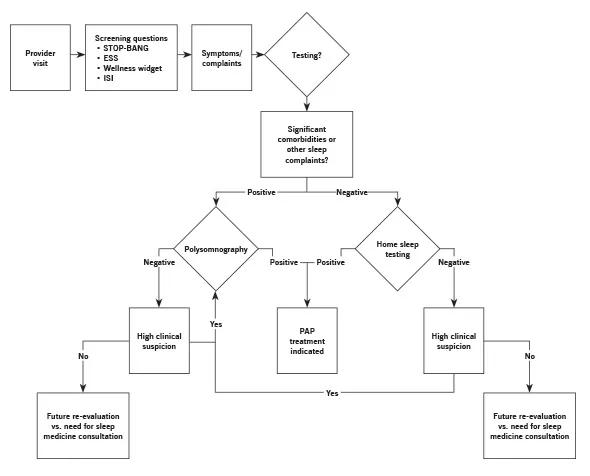
Image content: This image is available to view online.
View image online (https://assets.clevelandclinic.org/transform/af565a83-a07b-4ef9-b167-32bb760d509d/carepath-inset_jpg)
Figure. Excerpt of a work flow from Cleveland Clinic’s Obstructive Sleep Apnea Care Path. This portion focuses on deciding when to use home sleep testing vs. polysomnography.
Advertisement
Advertisement

New study advances understanding of patient-defined goals
Testing options and therapies are expanding for this poorly understood sleep disorder
Real-world claims data and tissue culture studies set the stage for randomized clinical testing
Digital subtraction angiography remains central to assessment of ‘benign’ PMSAH

Cleveland Clinic neuromuscular specialist shares insights on AI in his field and beyond
Findings challenge dogma that microglia are exclusively destructive regardless of location in brain
Neurology is especially well positioned for opportunities to enhance clinical care and medical training
New review distills insights from studies over the past decade
 Search