Locations:





Earliest data are in — and they’re encouraging
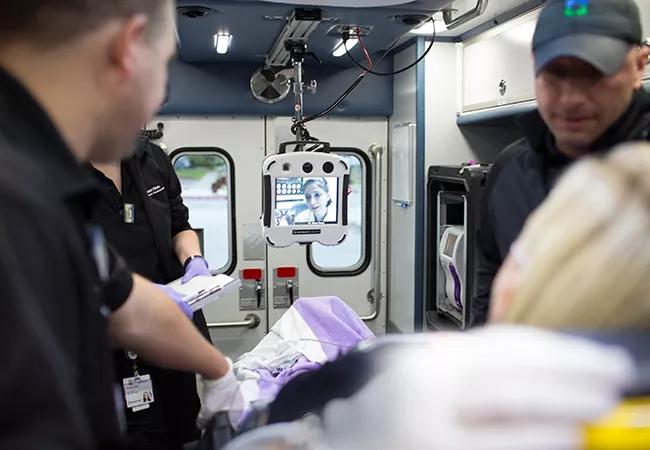
Image content: This image is available to view online.
View image online (https://assets.clevelandclinic.org/transform/ed7b38fc-32ad-4e52-ba80-87050a40dd95/650x450-Mobile-Stroke_jpg)
650×450 Mobile-Stroke
2016 marks the 20th anniversary of the FDA’s approval of tissue plasminogen activator (tPA) for treating acute ischemic stroke. Yet, after two decades, the proportion of patients who arrive at emergency departments in time to receive the benefits of tPA within the crucial three-hour time frame for efficacy has remained at a frustratingly low level of less than 10 percent nationwide, according to best estimates.
Advertisement
Cleveland Clinic is a non-profit academic medical center. Advertising on our site helps support our mission. We do not endorse non-Cleveland Clinic products or services. Policy
But now a new Cleveland Clinic initiative may help improve those odds: a mobile stroke treatment unit (MSTU) equipped with emergency personnel, a CT system, laboratory testing and a telemedicine connection to vascular neurologists (as detailed in this Consult QD post). In a new study published in JAMA Neurology, Cleveland Clinic investigators report that the MSTU has reduced the door-to-treatment time for patients with ischemic stroke by 26 minutes.
“Ischemic stroke treatment has been available for the last 20 years. Getting the treatment to patients quickly has been the challenge,” says the study’s primary author, Ken Uchino, MD, Research Director of Cleveland Clinic’s Cerebrovascular Center.
With the MSTU, Dr. Uchino says, “The goal is to provide thrombolysis more quickly by going to the patient rather than waiting in the hospital.”
What’s more, successful telemedicine-aided evaluations on the MSTU were conducted in 99 out of 100 patients with suspected stroke, facilitating faster diagnosis of patients who do not have ischemic stroke and require other types of care.
The MSTU concept was born in Germany, where the system significantly reduced time to evaluation and thrombolysis. But in the German models, the vascular neurologist also rode on the unit with the team. “Cleveland Clinic’s unit is first to operate without the doctor on board,” Dr. Uchino notes. “You can imagine any number of scenarios where patients stand to benefit from acute access to a stroke specialist via telemedicine, including the suburbs as well as distant locations that may not have a stroke neurologist in the community.”
Advertisement
Another advantage is that the telemedicine component maximizes the vascular neurologist’s time. “As we have it set up, the vascular neurologist who is responsible for the MSTU is also doing other things during the day,” Dr. Uchino explains. “If he or she were to be on the unit, it would be hard to do anything else.”
The prospective observational study included the first 100 people with acute onset of stroke-like symptoms who were evaluated in Cleveland Clinic’s MSTU. A vascular neurologist evaluated the patients via telemedicine, and a neuroradiologist remotely assessed the CT images obtained in the unit.
All but one of the 100 patients were successfully evaluated, in a median duration of 20 minutes. The one failure was due to crew error, and that patient was transported to the nearest emergency department. There were also six telemedicine disconnections, but none lasted longer than 60 seconds or affected clinical care.
Time from door to CT completion was 13 minutes, significantly less than the 18 minutes in a control group of 56 patients brought to the emergency department via ambulance during the same year (P = .003). Among 16 patients confirmed to have ischemic stroke and who received intravenous thrombolysis in the MSTU, the median time from door to treatment was 32 minutes, also significantly shorter than the 58 minutes for the controls (P < .001).
In an editorial accompanying the paper, two stroke specialists from Charité–Universitätsmedizin Berlin write: “Stroke is a predestined disease for telemedicine because symptoms are audiovisually transmittable and computed tomographic images can easily be accessed remotely.”
Advertisement
The editorialists, who pioneered the German MSTU concept with the vascular neurologist on board, do note that “replacing a personal encounter with a telemedicine consultation has its limitations,” pointing out that the study’s “6 video disconnections, albeit not deemed harmful to patient care, sound a note of caution.”
But they go on to conclude the following: “[I]n a time-critical scenario such as stroke, the advantages of fast decisions about thrombolysis or thrombectomy may outweigh the shortcomings. Most patients with stroke faced with the 2 options of no neurologist or an expert telemedicine consultation would clearly prefer the latter.”
Dr. Uchino concurs. “Anything can fail anywhere,” he notes. “There should be contingency plans. If things aren’t workable, we bring the patient to the hospital. Sometimes there are spots where the signal isn’t good, so we move the unit down the street where the signal is better.”
The Cleveland Clinic team is currently studying the cost-benefit ratio of the MSTU in several ways. These include a look at the benefit derived from evaluating patients who are found not to have ischemic stroke but rather other types of stroke or stroke mimics, including cranial hemorrhages, seizures or drug overdoses. Providing treatment for such patients in the MSTU — and transporting them to the appropriate specialized hospitals, thereby avoiding “double transfers” — can also potentially save time and healthcare costs, Dr. Uchino says.
“By making the diagnosis before arriving at the hospital, we think we are able to bring the patient to the right place the first time,” he observes. “That’s another benefit of the MSTU.”
Advertisement
Advertisement

New study advances understanding of patient-defined goals
Testing options and therapies are expanding for this poorly understood sleep disorder
Real-world claims data and tissue culture studies set the stage for randomized clinical testing
Digital subtraction angiography remains central to assessment of ‘benign’ PMSAH

Cleveland Clinic neuromuscular specialist shares insights on AI in his field and beyond
Findings challenge dogma that microglia are exclusively destructive regardless of location in brain
Neurology is especially well positioned for opportunities to enhance clinical care and medical training
New review distills insights from studies over the past decade
 Search