Locations:





Answering a key question as multicomponent operations proliferate
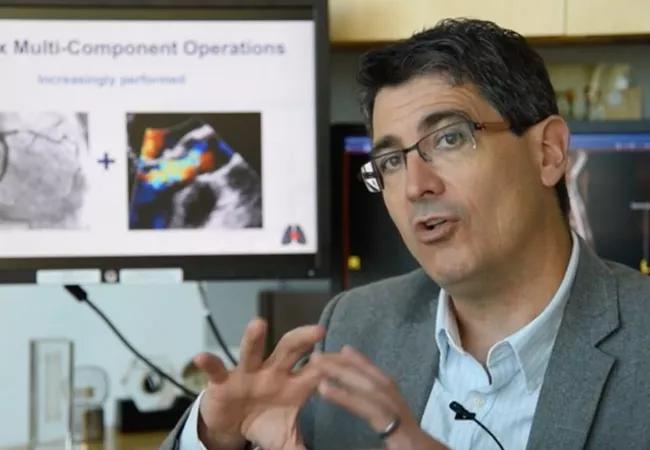
Image content: This image is available to view online.
View image online (https://assets.clevelandclinic.org/transform/80aa2c1e-0c30-4bf2-823f-c73333339885/16-HRT-1239-Roselli-CQD-650x450_jpg)
Dr. Roselli
Experienced cardiovascular surgery centers are seeing more and more patients who require multicomponent operations involving their valves, coronary arteries, arrhythmias and more.
Advertisement
Cleveland Clinic is a non-profit academic medical center. Advertising on our site helps support our mission. We do not endorse non-Cleveland Clinic products or services. Policy
This includes many patients whose clinical picture includes a dilated ascending aorta or an aortic aneurysm associated with these other problems, prompting the question: Does adding aortic replacement to cardiac operations increase surgical risk?
To address this question, a team of cardiothoracic surgeons including Eric E. Roselli, MD, analyzed a series of 14,294 patients undergoing elective cardiac surgery at Cleveland Clinic over a recent five-year period, including 1,677 whose operations included aortic replacement.
Dr. Roselli presented their findings at the recent annual meeting of the American Association for Thoracic Surgery in Baltimore. In this video, he briefly explains the three propensity score matching analyses the team conducted to answer the question, and he shares their findings on the safety and advisability of including aortic replacement in multicomponent operations.
Video content: This video is available to watch online.
View video online (https://www.youtube.com/embed/haYrFaioS84?feature=oembed)
“When we compared those similar groups, we found that there was no difference in death or several of the other complications, but there was a slightly increased risk of stroke in the patients who had aorta replacement, about two-and-a-half percent versus one-and-a-half percent… We wanted to look further at why we thought that stroke risk might be higher in that group of patients undergoing aortic surgery because we know this does involve a complex population of patients… We did another propensity analysis… We broke [patients] up into those who had circulatory arrest… and sure enough we found that the half of those groups who had the circulatory arrest, the risk of death and stroke was a little bit higher. Still well under 5 percent, but nowhere near these remarkable results of 1 percent or less in the other group of patients…”
Advertisement
Advertisement
A sampling of outcome and volume data from our Heart & Vascular Institute
Concomitant AF ablation and LAA occlusion strongly endorsed during elective heart surgery
Large retrospective study supports its addition to BAV repair toolbox at expert centers
Young age, solid tumor, high uptake on PET and KRAS mutation signal risk, suggest need for lobectomy
Surprise findings argue for caution about testosterone use in men at risk for fracture
Residual AR related to severe preoperative AR increases risk of progression, need for reoperation

Findings support emphasis on markers of frailty related to, but not dependent on, age
Provides option for patients previously deemed anatomically unsuitable
 Search