Locations:





New director of our DBS program talks new applications, tech advancements and more
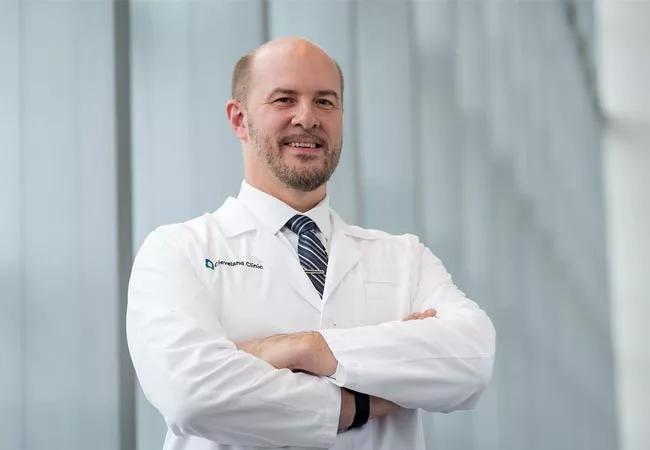
Image content: This image is available to view online.
View image online (https://assets.clevelandclinic.org/transform/c96a6c37-3d6a-4383-bba1-c70bc79936d9/18-NEU-5778-Walter-DBS-650x450_jpg)
18-NEU-5778-Walter-DBS-650×450
Benjamin L. Walter, MD, has returned to Cleveland Clinic to head the Center for Neurological Restoration’s Deep Brain Stimulation Program, having previously practiced as a Cleveland Clinic neurologist from 2004 to 2008, including three years directing the movement disorders fellowship program.
Advertisement
Cleveland Clinic is a non-profit academic medical center. Advertising on our site helps support our mission. We do not endorse non-Cleveland Clinic products or services. Policy
Consult QD caught up with Dr. Walter (shown in photo above), a recognized expert and investigator in movement disorders and the use of deep brain stimulation (DBS), to discuss the state of the field and what to expect next.
A: It’s great to be back with old friends and to meet new colleagues. There’s been a lot of growth during the decade I was away, which is true of the DBS field overall. This area of medicine is exploding, with rapidly developing new technologies and indications for use.
A: Traditionally, DBS has been used for essential tremor, Parkinson disease and dystonia. It’s also FDA-approved for obsessive-compulsive disorder in patients with severe disease who do not respond to conventional behavioral and pharmacologic therapies.
Earlier this year, the FDA approved DBS to treat epilepsy, specifically for adults with focal-onset seizures that have not responded to at least three antiseizure drugs. Cleveland Clinic is among approximately 20 level IV epilepsy centers in the U.S. that will initially use the FDA-approved DBS system for epilepsy beginning in December 2018.
Now the potential benefits of DBS therapy are being investigated in a host of additional conditions. Tourette syndrome is one: I was involved in research recently published in JAMA Neurology (2018;75:353-359) investigating outcomes in 163 patients with Tourette syndrome from the International Tourette Syndrome Deep Brain Stimulation Database and Registry who had undergone DBS. We found dramatic improvements of Tourette symptoms in some cases but also some important adverse effects, the most common being dysarthria and paresthesia. This indication has potential for DBS, but more refinement is needed.
Advertisement
Cleveland Clinic Neurological Institute Chair Andre Machado, MD, PhD, is leading a study to evaluate DBS for rehabilitation following stroke, with a focus on upper extremity motor recovery [see this Consult QD post for more on the study]. He has also delved into DBS for central (or thalamic) pain syndrome [see this post for more] and refractory depression.
Other investigators are looking into applying DBS for tremor related to multiple sclerosis (MS). Not all patients with MS experience tremor, but the disease can involve incredibly violent movements that are highly disabling. Recent research with DBS has been encouraging.
DBS is even being studied as a therapy for alcohol and opioid addictions.
A: The brain is an incredibly complex organ with different functions distributed among many networks. Neurological problems often result from just small alterations in discrete circuits. I liken the situation to a car that won’t move because a brake is stuck. With a complicated machine, a small problem in one area — and a specific fix — can have important ramifications. Likewise, depending on where you place a DBS wire in the brain and how you apply stimulation, very different effects may occur.
A: It’s becoming more complicated — and much more powerful. Segmented leads, also called directional leads, have arrived on the scene, with enhanced ability to steer current independently in horizontal directions at multiple points along a single lead. They allow us to better refine the stimulation parameters toward the target and away from areas that cause side effects. The technology for these devices is advancing rapidly and includes better user interfaces, which is making DBS much more precise and patient-friendly.
Advertisement
Closed-loop stimulation is a paradigm from cardiovascular medicine that’s being investigated for its applicability to DBS. Pioneering work is being done to incorporate sensing mechanisms within DBS devices to respond as needed, in a self-regulating fashion, to changes in symptoms. Ideally, a device will automatically change stimulation parameters if unwanted behaviors or symptoms arise rather than requiring patients to manually make the changes. This technology is likely to be available soon.
Another advance is the development of different stimulation paradigms. The evolution of current features — such as on-or-off stimulation, control of stimulus location, and simple parameters like pulse strength, speed and length — to more-complex stimulation parameters such as burst patterns promises to increase the possibilities for control. These advances also change the way circuits are working in the brain to make devices more energy-efficient. With reduced energy requirements, batteries will last longer, offering another practical improvement for patients.
A: We are at the forefront of evolving technology in DBS. We can offer our patients the newest applications and have the resources of sophisticated neuroimaging as well as expertise in many fields to help further advance the technology. This is an exciting time and place for DBS.
Advertisement
Advertisement

New study advances understanding of patient-defined goals
Testing options and therapies are expanding for this poorly understood sleep disorder
Real-world claims data and tissue culture studies set the stage for randomized clinical testing
Digital subtraction angiography remains central to assessment of ‘benign’ PMSAH

Cleveland Clinic neuromuscular specialist shares insights on AI in his field and beyond
Findings challenge dogma that microglia are exclusively destructive regardless of location in brain
Neurology is especially well positioned for opportunities to enhance clinical care and medical training
New review distills insights from studies over the past decade
 Search