Locations:





Safe return to sports is increasingly the rule, but caveats remain
Image content: This image is available to view online.
View image online (https://assets.clevelandclinic.org/transform/eb9366c3-0939-4cde-9d89-cea5082a9973/690x380-Goodwin_jpg)
690×380-Goodwin
By Ryan C. Goodwin, MD
Advertisement
Cleveland Clinic is a non-profit academic medical center. Advertising on our site helps support our mission. We do not endorse non-Cleveland Clinic products or services. Policy
Spinal fusion surgery remains the gold-standard treatment for progressive idiopathic scoliosis and is best performed in the teenage years. Success requires that fusion occur before the patient returns to full activity, irrespective of the technique used. For the many scoliosis patients who are involved in athletics, this puts a particular premium on judicious return-to-play decision-making.
With the advent of segmental instrumentation — specifically, segmental pedicle screws — safe return to sports and other physical activities has become commonplace among patients with idiopathic scoliosis who undergo spine fusion surgery. It is now routine practice to permit return to many aggressive activities such as contact sports once a solid fusion has occurred.
Because there is no specific imaging modality that will confirm a solid fusion, careful clinical examination and scrutiny of radiographs are essential to ascertain whether a solid fusion has occurred. Once the clinician has determined that a solid fusion is present— typically six months postoperatively in a healthy adolescent — sports and other aggressive activities may be resumed as tolerated. Figure 1 presents images from a representative case.
Though return to sports after spine fusion surgery is more common today than in the past, patients and families still need to have realistic expectations about the postoperative course, including return to sports, before patients undergo the procedure.
Literature suggests that patients whose lowest level of fusion is at T12 or L1 have the highest percentage of full return to sports. As the fusion mass extends distally to L2 and L3, the likelihood of a return to sports decreases. Patients with fusions to L4 and below are unlikely to return to sports or activities requiring significant movement and flexibility.
Advertisement
Sports like soccer, basketball, volleyball, track and swimming are all activities in which an adolescent with a successful fusion for deformity is likely to be able to participate. Activities such as ballet and gymnastics are more difficult to return to following fusion, but there is a high likelihood of return to full activity when the most distal fusion level is T12 or above. Fusion to the lumbar spine significantly decreases rates of return to these activities that require significant flexibility.
True collision sports such as football and rugby should be avoided by all post-fusion patients. Some surgeons advocate permanently excluding ice hockey too, but many others permit participation in this highly aggressive sport after an informed discussion with the patient and family.
Dr. Goodwin is Director of Cleveland Clinic’s Center for Pediatric Orthopaedic Surgery and a member of the Department of Orthopaedic Surgery.
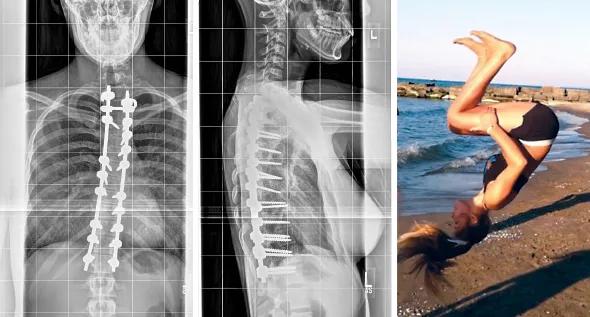
Image content: This image is available to view online.
View image online (https://assets.clevelandclinic.org/transform/14012409-c99b-43c7-9360-cb21ac59adad/590x-Inset-Goodwin_jpg)
Figure 1. Standing posteroanterior (left) and lateral (middle) radiographs in a 15-year-old girl three years after posterior spine fusion for idiopathic scoliosis. She returned to tumbling (right) and gymnastics six months postoperatively.
Advertisement
Advertisement

New study advances understanding of patient-defined goals
Testing options and therapies are expanding for this poorly understood sleep disorder
Real-world claims data and tissue culture studies set the stage for randomized clinical testing
Digital subtraction angiography remains central to assessment of ‘benign’ PMSAH

Cleveland Clinic neuromuscular specialist shares insights on AI in his field and beyond
Findings challenge dogma that microglia are exclusively destructive regardless of location in brain
Neurology is especially well positioned for opportunities to enhance clinical care and medical training
New review distills insights from studies over the past decade
 Search