Locations:





Study shows no difference in peak force, perceived effort or physiologic measures of exertion during strength testing
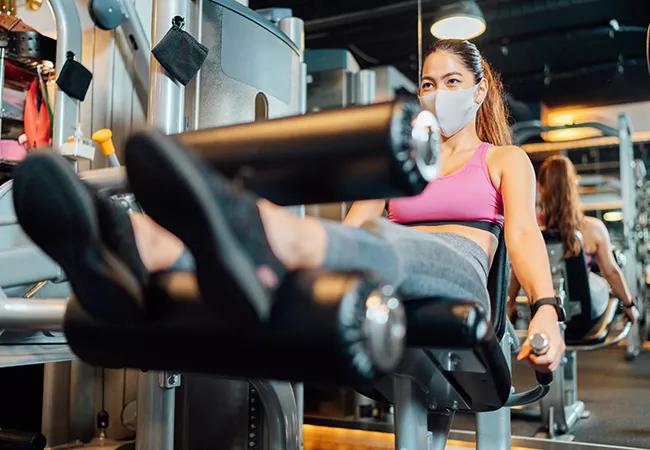
Image content: This image is available to view online.
View image online (https://assets.clevelandclinic.org/transform/8ae90703-baf5-4b4d-b038-b7d75585ca8c/22-ORI-3012965-CQD-650x450-1_jpg)
Female athlete training her legs in gym while wearing protective face mask
Wearing a surgical mask while exercising might feel uncomfortable, but it doesn’t interfere with exercise capacity or present additional safety concerns, according to research from Cleveland Clinic.
Advertisement
Cleveland Clinic is a non-profit academic medical center. Advertising on our site helps support our mission. We do not endorse non-Cleveland Clinic products or services. Policy
Results from two studies conducted by Cleveland Clinic sports medicine specialist Matthew Kampert, DO, and colleagues suggest that public exercise should not be excluded from mask-wearing recommendations to help curb COVID-19 transmission. Rather, incorporating this research into the current Centers for Disease Control and Prevention guidelines for mask use could allow fitness facilities to stay open during pandemic surges by adopting universal mask recommendations for all types of exercise. This remains an urgent issue due to the emergence of COVID-19 variants, says Dr. Kampert.
“Earlier in the pandemic, gyms didn’t know how to handle the COVID-19 situation, so they just closed,” he says. “And then when they re-opened, they tried to impose mask mandates, but people often were noncompliant and the rules often weren’t enforced. Part of the reason there haven’t been stronger recommendations for mask-wearing during exercise is that there hasn’t been research — until now.”
At the 2022 American Medical Society for Sports Medicine meeting, Dr. Kampert presented data from one of his studies, reporting that wearing a surgical mask had no adverse impact on performance of isokinetic strength testing other than perceived discomfort. Those findings were subsequently published in the Journal of Athletic Enhancement.
Dr. Kampert’s research group previously published similar findings from a randomized crossover trial examining the effects of wearing an N95 respirator or cloth mask during peak treadmill exercise.
Advertisement
Some previous studies have reported opposing findings, that wearing a surgical face mask significantly reduced exercise capacity and/or maximal oxygen uptake. But, Dr. Kampert says, all of those studies used spirometry masks (to measure VO2 max) placed on top of surgical masks.
“That double-masking altered the ability of the spirometry system to measure air flow and oxygen consumption (since it wasn’t meant to be used with a surgical mask underneath), as well as created a seal around the surgical mask (which isn’t how a surgical mask is intended to be worn),” he says. “Every study that found a physical limitation beyond increased breathing resistance and discomfort did the study that way. And every one that found none did it our way.”
More recently, Dr. Kampert has written a study protocol to compare exercise capacity under four masking conditions: no mask, a spirometry mask, a surgical mask, and a spirometry mask over a surgical mask.
In Dr. Kampert’s most recently published study of resistance exercise, 20 participants completed testing on two days, once with a surgical mask and once with no mask. For both left and right legs, they performed five repetitions of three sets of knee flexions and extensions with 90 seconds of recovery between repetitions.
Mean oxygen saturation was higher with the surgical mask than without (98.1% vs. 97.6%, P = 0.038), but this difference didn’t achieve the clinical significance threshold of a 3%-4% drop from baseline.
On a 0-10 scale, with higher scores indicating worse symptoms, breathing discomfort was slightly higher with the mask (3.3 with a mask vs. 2.2 without a mask, P = 0.015).
Advertisement
There were no differences in other measures, including peak force, exercise capacity, perceived effort and physiologic measures of exertion.
In the prior study of aerobic exercise, 20 healthy adults performed treadmill exercise testing to peak exhaustion in three masking conditions: no mask, an N95 respirator and a cloth mask with an activated carbon filter.
Use of any mask yielded lower peak VO2 max compared with no mask, but no participant stopped the testing prior to peak exhaustion.
Exercise duration was 591 seconds without a mask compared to 548 seconds with a cloth mask and 545 seconds with an N95 mask (P = 0.047). Perceived breathing resistance occurred only with the masks. On a 0-10 scale, the median subjective responses were 0.0 without a mask versus 7.0 for both N95 and cloth masks (P < 0.001).
Despite the differences, Kampert noted, “each experimental condition resulted in peak exercise values that generally remained within normal limits. Thus, although it is possible that wearing a mask exerted a physical limitation on exercise capacity, the clinical relevance of such a possibility is not supported by these data.”
Advertisement
Advertisement
Biologic approaches, growing implants and more
Study reports zero infections in nearly 300 patients
How to diagnose and treat crystalline arthropathy after knee replacement
Study finds that fracture and infection are rare
Center will coordinate, interpret and archive imaging data for all multicenter trials conducted by the foundation’s Osteoarthritis Clinical Trial Network

Reduced narcotic use is the latest on the list of robotic surgery advantages
Cleveland Clinic specialists offer annual refresher on upper extremity fundamentals
Cleveland Clinic orthopaedic surgeons share their best tips, most challenging cases and biggest misperceptions
 Search