Locations:





Preliminary study finds improved gait and balance vs. traditional PT
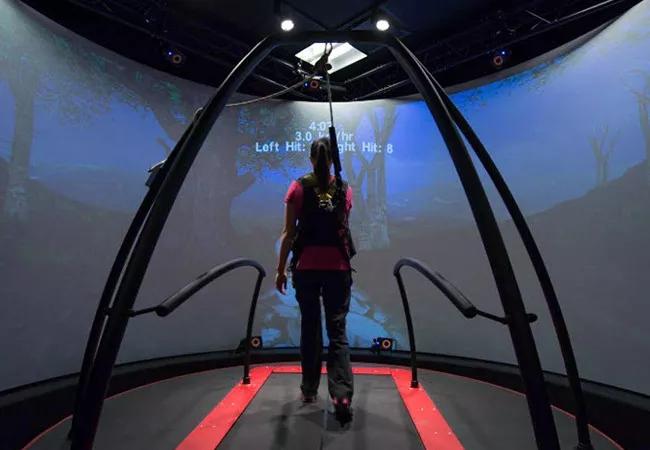
Image content: This image is available to view online.
View image online (https://assets.clevelandclinic.org/transform/bf8ef642-b012-4ee0-879c-3d2270ab3b73/19-NEU-319-Caren-Treadmill-MS-650x450_jpg)
19-NEU-319-Caren-Treadmill-MS-650×450
An immersive virtual reality system used in a physical therapy setting safely improves gait and balance measures in patients with multiple sclerosis (MS), finds a retrospective Cleveland Clinic study recently published in the International Journal of Therapy and Rehabilitation (2018;25:522-528).
Advertisement
Cleveland Clinic is a non-profit academic medical center. Advertising on our site helps support our mission. We do not endorse non-Cleveland Clinic products or services. Policy
The CAREN (Computer Assisted Rehabilitation Environment) system, originally developed for the U.S. military to simulate complex environmental situations, can also be applied to patient populations with conditions that affect mobility, such as MS, Parkinson disease and mild traumatic brain injury.
“We see that patients find the system highly motivating,” says Matthew Streicher, MS, a research engineer in Cleveland Clinic’s Lerner Research Institute and lead author of the study. “It’s gratifying to have our positive impressions confirmed with hard data of improved functional outcomes.”
The CAREN system consists of a platform that moves in six degrees of freedom synchronously with virtual reality images displayed on a 180-degree wrap-around screen (see a short demonstration video here). Patients may have to walk up- or downhill on a curvy pathway or balance on the deck of a boat speeding around a lake. They may simultaneously be instructed to reach out to “catch” butterflies that appear on the screen, further challenging balance. Patients are hooked up to a full-body harness for safety and are closely supervised by a physical therapist.
“Instead of having a patient simply walk a treadmill during physical therapy, we can mix things up in a highly dynamic fashion,” explains study co-author Jay Alberts, PhD, of Cleveland Clinic’s Department of Biomedical Engineering and Department of Physical Medicine & Rehabilitation. “Therapy is not only more applicable to real-world situations; it’s more challenging and engaging.”
Advertisement
The study included 62 individuals with MS treated at Cleveland Clinic’s Mellen Center for Multiple Sclerosis identified from a retrospective chart review. All had to have completed at least three physical therapy (PT) sessions either on the CAREN system (n = 34) or in a traditional setting (n = 28) from September 2013 to February 2016. Traditional PT consisted of gait, stretching, balance and strengthening exercises. PT sessions in both settings lasted about one hour.
Four functional tests were routinely administered during the initial assessment visit and in the final session:
Results were as follows:
No safety issues were reported among patients using the CAREN system, although some patients became mildly dizzy from certain visual displays, which were subsequently avoided.
Advertisement
MS tends to first strike people during the peak of their productive years, according to study co-author Francois Bethoux, MD, Director of Rehabilitation Services at Cleveland Clinic’s Mellen Center. “Difficulty walking is one of the main reasons people with MS stop working, which underscores the importance of effective gait and balance training,” he says.
He notes that this is the first study his team is aware of that reports outcomes of gait and balance training with CAREN supervised by a physical therapist in an outpatient MS rehabilitation clinic. Based on its findings, the research team plans to embark on a prospective, single-blind, randomized trial comparing traditional PT with CAREN in patients with MS.
“Virtual reality has opened up exciting new opportunities for physical therapy,” Dr. Bethoux observes. “Although CAREN may not be a practical option for most rehab clinics, our study suggests a model of gait training that could be applied to less expensive virtual reality systems.”
Advertisement
Advertisement

New study advances understanding of patient-defined goals
Testing options and therapies are expanding for this poorly understood sleep disorder

Real-world claims data and tissue culture studies set the stage for randomized clinical testing
Digital subtraction angiography remains central to assessment of ‘benign’ PMSAH

Cleveland Clinic neuromuscular specialist shares insights on AI in his field and beyond

Findings challenge dogma that microglia are exclusively destructive regardless of location in brain

Neurology is especially well positioned for opportunities to enhance clinical care and medical training

New review distills insights from studies over the past decade
 Search