Locations:





After boost from RADIAL analysis, attention turns to two newer trials
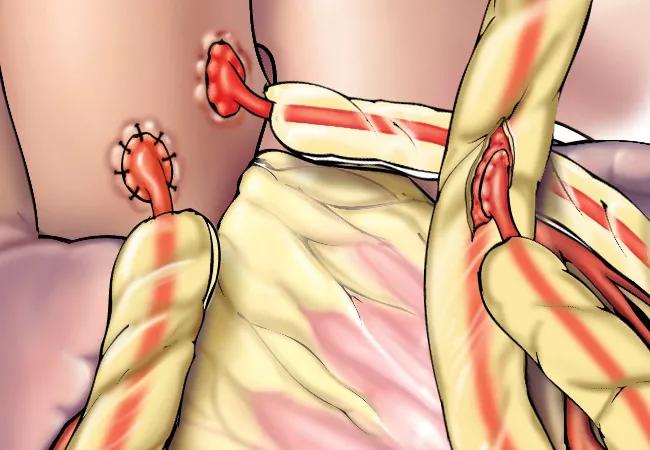
Image content: This image is available to view online.
View image online (https://assets.clevelandclinic.org/transform/d32cf548-c064-4b9d-8ed4-f200223f113e/18-HRT-4691-CABG-arterial-grafts-650x450_jpg)
18-HRT-4691-CABG arterial grafts-650×450
Growing evidence points to the superiority of using radial or internal thoracic artery grafts rather than saphenous vein grafts as second conduits in coronary artery bypass graft surgery (CABG), as multiarterial grafting can be associated with enhanced longevity in appropriately selected patients. Cardiothoracic surgeons at Cleveland Clinic, where CABG was pioneered, are now involved in two trials expected to greatly inform surgical practice on this question.
Advertisement
Cleveland Clinic is a non-profit academic medical center. Advertising on our site helps support our mission. We do not endorse non-Cleveland Clinic products or services. Policy
Despite current guidelines from the Society of Thoracic Surgeons and others encouraging use of multiple arterial grafts for CABG when possible, more than 90 percent of patients in North America continue to receive saphenous vein grafts as second conduits following grafting of the internal thoracic artery (ITA) to the left anterior descending artery (LAD). The latter ITA-to-LAD approach is an enduring gold standard in CABG that was established and popularized by Cleveland Clinic in the 1980s.
A lack of robust randomized trial data regarding clinical benefit has fueled surgeons’ reluctance to embrace multiple arterial grafts, says Cleveland Clinic cardiothoracic surgeon Faisal Bakaeen, MD. He notes that additional factors behind the reluctance include greater technical difficulty, a potential increase in sternal wound complications when harvesting bilateral ITAs, longer operating time with no additional reimbursement, and a greater focus on short- versus long-term outcomes.
“There’s no incentive for surgeons to use multiple arterial grafts,” Dr. Bakaeen explains. “They want to do an expeditious and safe operation and get their patients out of the hospital because that’s what determines how they are ranked and reimbursed. No one tracks the long-term outcomes, but an early sternal wound infection is a definite penalty.”
What’s more, he notes, studies of multiarterial grafting have lacked funding, since there is no proprietary interest behind use of radial arteries or a second ITA graft.
Advertisement
In an attempt to overcome the problem of underpowering in recent trials, the multicenter Radial Artery Database International Alliance (RADIAL) conducted a patient-level meta-analysis of six published randomized trials with at least two years of follow-up comparing radial artery grafts with saphenous vein grafts as second conduits in CABG. The analysis was published in the New England Journal of Medicine on May 31.
After a mean follow-up of 60 months, the incidence of adverse cardiac events was significantly lower (hazard ratio = 0.67; 95% CI, 0.49-0.90; P = .01) in the group that received radial artery grafts to supplement left ITA grafting (n = 534) compared with those given saphenous vein grafts (n = 502).
Use of radial artery grafts was also associated with significantly lower risks of occlusion, myocardial infarction and repeat revascularization, although there was no between-group difference in all-cause mortality.
In subgroup analyses, greater benefit for radial artery grafts with regard to major adverse cardiovascular events was found in several patient groups: those younger than 75 years, women and patients without renal insufficiency.
“I think it’s an important study,” notes Dr. Bakaeen, who wasn’t involved in the analysis. “It adds further evidence that the use of more arterial grafting, such as with the radial artery, can have long-term advantages in patients who are suitable candidates for those kinds of conduits.”
He adds some caveats, however. First, the data from randomized trials aren’t generalizable to all patients. “For example, if it’s an emergency, or if the patient doesn’t have a suitable target for the radial artery or has a disease that precludes taking the radial artery, they would have been excluded from the studies,” Dr. Bakaeen observes.
Advertisement
Moreover, he says, all the centers participating in the trials had considerable expertise in radial artery harvesting and use.
“The bottom line,” he concludes, “is that in a population that conforms to the requirements of a randomized trial, using the radial artery is beneficial, and it’s perhaps more beneficial in certain subgroups.”
At Cleveland Clinic, where multiarterial CABG is the default procedure unless contraindicated, about 20 percent of all CABG patients, and the majority of lower-risk patients undergoing elective CABG, receive multiple arterial grafts.
Those proportions are far above national and international averages despite the fact that Cleveland Clinic receives many of the highest-risk patients from around the country and the world, some of whom have already had one or more prior operations and may not be suitable candidates for multiarterial bypass, Dr. Bakaeen notes.
Cleveland Clinic surgeons are now involved in two randomized clinical trials aimed at providing the data that will be needed if routine surgical practice is to change.
The largest randomized trial to date comparing the radial artery with the saphenous vein as second conduits involves 757 veterans who underwent first-time elective CABG at 11 Veterans Affairs medical centers nationwide.
At one year, there were no significant differences in the primary end point of angiographic graft patency, nor in secondary end points. Those findings were published in JAMA in 2011, with Dr. Bakaeen — who practiced at a VA medical center at the time — as a co-author. Now he is working with his collaborators to prepare the 10-year results for publication.
Advertisement
The other study, Randomization of Single vs. Multiple Arterial Grafts (ROMA), just began in early 2018. It is a prospective, unblinded trial enrolling at least 4,300 patients in 25 international centers, including Cleveland Clinic. The trial is comparing either the radial artery or a second ITA with the saphenous vein as a second conduit for all non-LAD target vessels.
The primary outcome will be a composite of death from any cause, stroke, post-discharge myocardial infarction and/or repeat revascularization. Estimated study completion is March 31, 2028.
“In modern-day practice, surgeons should have an open mind about using more arterial grafting,” observes Dr. Bakaeen. “To get definitive answers, these ongoing studies will help us reach that point.”
Advertisement
Advertisement

A sampling of outcome and volume data from our Heart & Vascular Institute
Concomitant AF ablation and LAA occlusion strongly endorsed during elective heart surgery
Large retrospective study supports its addition to BAV repair toolbox at expert centers
Young age, solid tumor, high uptake on PET and KRAS mutation signal risk, suggest need for lobectomy
Surprise findings argue for caution about testosterone use in men at risk for fracture
Residual AR related to severe preoperative AR increases risk of progression, need for reoperation

Findings support emphasis on markers of frailty related to, but not dependent on, age
Provides option for patients previously deemed anatomically unsuitable
 Search