Locations:





Rare complication of IPAA construction leads to discovery of a new syndrome
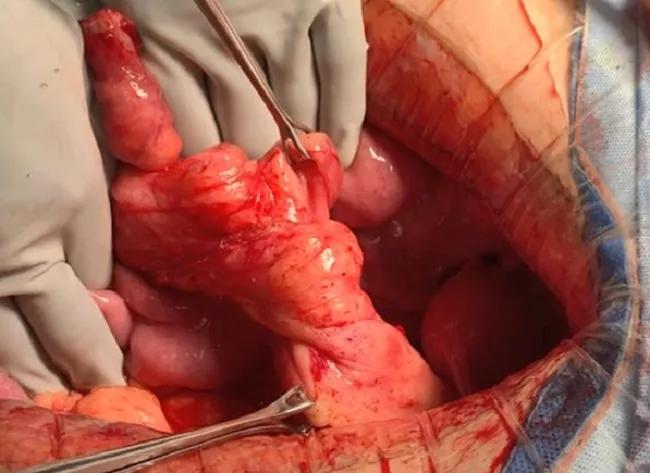
Image content: This image is available to view online.
View image online (https://assets.clevelandclinic.org/transform/ab53cd76-b479-4251-896e-dd07fbb056af/21-DDI-2328961-Twisted-pouch-case-series-surgical-photo-650x450-1_jpg)
21-DDI-2328961 Twisted pouch case series surgical photo 650×450
A 19-year-old woman with slow-transit constipation underwent an ileal pouch-anal anastomosis (IPAA) procedure to construct a J-pouch. During the surgery, which is technically demanding, great care must be taken to ensure that the superior mesenteric axis is straight.
Advertisement
Cleveland Clinic is a non-profit academic medical center. Advertising on our site helps support our mission. We do not endorse non-Cleveland Clinic products or services. Policy
After the IPAA, the patient developed symptoms different than she had previously experienced, including obstructive defecation and severe pelvic pain. A correctly functioning pouch should allow an individual to readily open their bowels without pain.
Initially, the woman sought care at an institution outside Cleveland Clinic, where she was diagnosed with irritable bowel syndrome and treated with opiates. She also underwent two laparotomies, which failed to identify the source of her pain. Eventually, her pouch was disconnected and converted to an ileostomy.
Still in pain and reliant on opioids, she turned to Cleveland Clinic’s Department of Colon and Rectal Surgery and Stefan Holubar, MD, MS, IBD Surgery Section Chief, for a second opinion.
Cleveland Clinic is home to the Pouch Center, which diagnoses and treats a variety of pouch-associated disorders such as pouchitis and Crohn’s disease of the pouch. The center, established in 2002, sees 1,000 patients annually and performs about 500 pouch endoscopies and 200 IPAA surgeries each year. It has the largest experience in IPAA redos nationally and internationally, and the colorectal department has performed more than 5,000 pouches to date.
In a video consultation, Dr. Holubar assessed the patient’s symptoms as suggestive of ischemia and scheduled her for redo pouch surgery.
During the procedure, Dr. Holubar found that the patient’s pouch was twisted 180 degrees. He disconnected the twisted pouch from the anus, untwisted it and hand-sutured the otherwise healthy pouch to the anal canal. A temporary loop ileostomy was closed 3 months later. The surgery resolved the patient’s defecation and pain issues. A year postoperatively, she remains off opioids, is pain-free, and has normal pouch function and a dramatically improved, normal quality of life.
Advertisement
Video content: This video is available to watch online.
View video online (https://www.youtube.com/embed/mbno7Ur8cHM?feature=oembed)
Correction of Twisted Ileal Pouch-Anal Anastomosis (Graphic)
This brief surgical video shows the twisted ileal pouch-anal anastomosis identified by Dr. Holubar during redo pouch surgery.
Curious about documentation of other twisted-pouch cases like his patient’s, Dr. Holubar searched the PubMed medical literature database and got a surprise. “I assumed that someone had recognized this before but found nothing,” he says. “That inspired me to search Cleveland Clinic’s Pouch Registry for similar cases.”
Earlier this year, Dr. Holubar presented his findings at The Crohn’s & Colitis Congress. They underscore the need to be alert for symptoms indicative of the condition, which Dr. Holubar named twisted pouch syndrome (TPS). His review of 25 years of data on more than 5,000 pouch surgeries revealed that 29 patients referred to Cleveland Clinic were ultimately diagnosed with TPS and underwent redo pouch procedures.
Dr. Holubar found that TPS patients had the triad of obstructive symptoms, erratic bowel habits, and abdominal or pelvic pain.
“Ninety-three percent of the patients had some kind of obstructive symptoms, either obstructive defecation or recurrent small bowel obstruction,” he says. “Eighty-seven percent of patients had erratic bowels, with a median of 15 bowel movements per 24 hours, when the normal median should be closer to seven per 24 hours. Eighty-four percent had abdominal and/or pelvic pain that was typically severe and often required chronic opioid therapy.”
Overall, 60% of the patients in the case series were initially diagnosed with pouchitis and had been treated with antibiotics before referral. In addition, 40% had received biologic therapies for what was thought to be an inflammatory complication of the pouch.
Advertisement
In only 30% of cases was it possible to identify TPS based on results of pouchoscopy, pouchogram, computed tomography or magnetic resonance. Therefore, the syndrome is largely an intraoperative diagnosis made during re-diversion or revision/re-do of the IPAA at Cleveland Clinic’s Pouch Center.
“The most shocking thing was that 48% of patients with undiagnosed TPS referred to us had undergone exploratory transabdominal surgery,” says Dr. Holubar. “Presumably, the surgeons didn’t recognize that what they were looking at was a twisted pouch. That really tells you how difficult it is to recognize and diagnose TPS. It’s important to have a really high index of suspicion for it and to look for subtle signs in patients.”
At 52 months median follow-up of patients in the case series, the pouch survival rate after a redo procedure was 89%. That suggests that, in the majority of cases, if TPS is identified, surgery can correct the problem and eliminate symptoms.
“The implications of this research are profound,” says Dr. Holubar. “TPS is completely avoidable if a surgeon is meticulous in constructing a pouch. Familiarity and experience with the pouch procedure are extremely important for good outcomes. The pouch mesentery has to be straight, from the pouch to the duodenum. When the circular stapler closes, it puts torsion on the pouch and imparts a rightward twist, so the surgeon has to take extra care during the anastomosis of the pouch to the anus.”
He also notes that surgeons have a tendency to send patients with symptoms after a pouch procedure back to their gastroenterologist. If there is any suspicion of TPS, however, he recommends referral to a specialized pouch center such as Cleveland Clinic’s so the condition can be promptly diagnosed and appropriately treated.
Advertisement
Advertisement

Strong patient communication can help clinicians choose the best treatment option
ctDNA should be incorporated into care to help stratify risk pre-operatively and for post-operative surveillance

The importance of raising awareness and taking steps to mitigate these occurrences
New research indicates feasibility and helps identify which patients could benefit

Treating a patient after a complicated hernia repair led to surgical complications and chronic pain
Standardized and collaborative care improves liver transplantations

Fewer incisions and more control for surgeons

Caregiver collaboration and patient education remain critical
 Search