Locations:





Subcutaneous ICDs are better suited to some patients than their transvenous counterparts
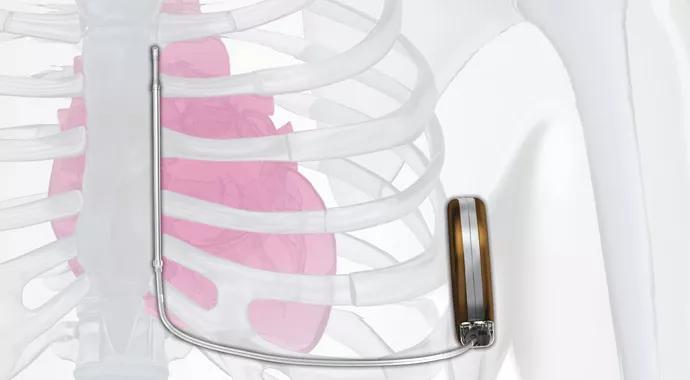
Image content: This image is available to view online.
View image online (https://assets.clevelandclinic.org/transform/c815e099-ce22-4b11-82a3-98648b0a253e/BostonScientificSICDTorso_ICD-690_jpg)
BostonScientificSICDTorso_ICD-690
Subcutaneous implantable cardiac defibrillators (ICDs) are a less-invasive and potentially better alternative to transvenous ICDs for some patients with life-threatening ventricular tachyarrhythmias, particularly those on dialysis or who have infections or venous access issues.
Advertisement
Cleveland Clinic is a non-profit academic medical center. Advertising on our site helps support our mission. We do not endorse non-Cleveland Clinic products or services. Policy
“Implant technology has changed a lot over the years, and so have the data supporting it,” says Bruce Wilkoff, MD, Director of Cardiac Pacing and Tachyarrhythmia Devices in Cleveland Clinic’s Robert and Suzanne Tomsich Department of Cardiovascular Medicine.
Because a subcutaneous ICD lead does not enter the vascular space and is not in direct contact with the heart, arrhythmia detection is accomplished differently than with transvenous ICDs.
Transvenous ICD leads fed directly into the vascular space detect heart rate only from a specific location dictated by the leads’ placement. This method provides limited insight about electrical activity outside the target area. Although it allows for excellent sensitivity in the detection of ventricular tachyarrhythmias, the trade-off can be diminished specificity and frequent inappropriate shocks. Performance is highly dependent on the programming of the device.
“With the subcutaneous ICD, you are looking at a larger view of the heart because the device does not actually touch the heart and performance is less dependent on the programming,” says Dr. Wilkoff.
By using a series of sensing electrodes to record vectors of cardiac electrical conduction and the application of discrimination algorithms, subcutaneous ICDs “wait” until there is certainty that a tachyarrhythmia is detected before shocking a patient’s heart back into rhythm.
“This is a brand-new way of identifying arrhythmias,” Dr. Wilkoff says. “This algorithmic approach may very well be a superior way of going about it.”
Advertisement
Subcutaneous placement obviates the possibility of leads dislodging from the heart. In addition, implanting and explanting electrodes is much easier with a subcutaneous ICD.
A recent randomized trial showed that patients with tachyarrhythmias who have implantable ICDs fare better when the devices are programmed to wait out irregular heartbeats that aren’t sustained.
The study, known as MADIT-RIT (Multicenter Automatic Defibrillator Implantation Trial — Reduce Inappropriate Therapy), demonstrated that ICD therapy results in fewer inappropriate shocks and reduced all-cause mortality when the device is programmed to detect ventricular tachycardia or fibrillation with two strategies: (1) delivering therapy at a heart rate of 200 bpm or higher and (2) using a prolonged delay in therapy at 170 bpm or higher. Both strategies were compared with conventional programming.
During 1.4 years of follow-up, the high rate and delayed therapy programming strategies reduced the risk of a first occurrence of an inappropriate shock by about 80 percent and reduced all-cause mortality by 55 percent.
The study was conducted using transvenous ICDs, but the encouraging results are consistent with the approaches used with subcutaneous ICD technology. Essentially, fewer shocks reduce risk for patients, and the subcutaneous ICD is more reliable at arrhythmia discrimination than are conventionally programmed transvenous ICDs. However, the transvenous ICD technology can further reduce shocks by using anti-tachycardia pacing, which causes no pain, if the ICD is programmed appropriately.
Advertisement
“Recent data collected through the MADIT-RIT trial indicate that it is probably smarter if a device is programmed not to ‘rush’ to shock the heart back into rhythm, and to be sure there is a sustained tachyarrhythmia before treating the rhythm,” Dr. Wilkoff says. “Appropriately programmed transvenous ICDs and subcutaneous ICDs seem to reduce a lot of the mechanisms for inappropriate detection.”
About half the patients who need an ICD could be candidates for subcutaneous devices, Dr. Wilkoff estimates. The other half require a pacing device, which is possible only with a transvenous ICD. The latter group includes patients with cardiac dyssynchrony and congestive heart failure, who need cardiac resynchronization that requires placement of three leads into the heart.
Patients with venous access problems and those on dialysis, in whom additional leads in the veins should be avoided, are good candidates for subcutaneous ICDs.
Subcutaneous ICDs could be a game changer, Dr. Wilkoff believes, although a final conclusion awaits head-to-head comparison between the subcutaneous and transvenous devices. Improvements to first-generation subcutaneous ICDs are expected, including less-bulky designs.
“We don’t know which is the best approach, but we do know there is a group of patients who are not suitable for venous leads, and those patients clearly will benefit from these developments in implant technology,” says Dr. Wilkoff. “On the other hand, some patients need protection from bradycardia or tachycardia with pacing, and traditional ICDs with intelligent programming will be the best solution for those patients.”
Advertisement
Advertisement
A sampling of outcome and volume data from our Heart & Vascular Institute
Concomitant AF ablation and LAA occlusion strongly endorsed during elective heart surgery
Large retrospective study supports its addition to BAV repair toolbox at expert centers
Young age, solid tumor, high uptake on PET and KRAS mutation signal risk, suggest need for lobectomy
Surprise findings argue for caution about testosterone use in men at risk for fracture
Residual AR related to severe preoperative AR increases risk of progression, need for reoperation

Findings support emphasis on markers of frailty related to, but not dependent on, age
Provides option for patients previously deemed anatomically unsuitable
 Search