Locations:





 Search
Two multicenter, NIH-sponsored trials began enrolling patients
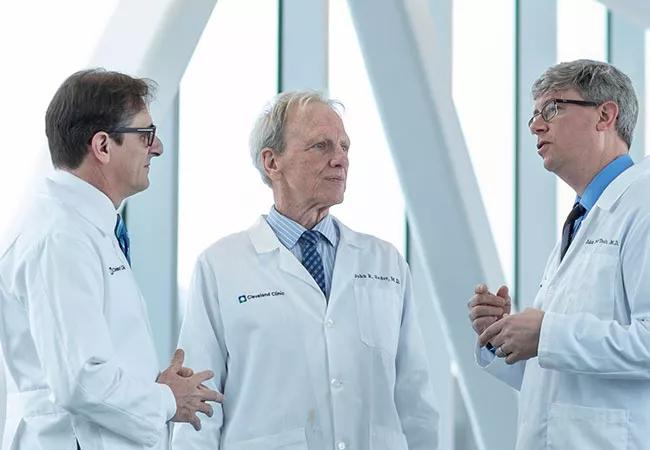
Image content: This image is available to view online.
View image online (https://assets.clevelandclinic.org/transform/042be65e-2858-486c-8a56-79614b6882eb/650x450-Poggio-Sedor-OToole_jpg)
Enrollment for two promising, multicenter kidney disease clinical trials is now underway
Cleveland Clinic began enrolling its first patients in two multicenter, NIH-sponsored studies this year. The trials, both ambitious in their aims to develop personalized strategies to prevent, treat and manage kidney disease, also illustrate the value of partnering with patients and the community for whom the research is most beneficial.
Advertisement
Cleveland Clinic is a non-profit academic medical center. Advertising on our site helps support our mission. We do not endorse non-Cleveland Clinic products or services. Policy
John Sedor, MD; Emilio Poggio, MD and John O’Toole, MD, nephrologists in the Glickman Urological and Kidney Institute, lead the Cleveland Clinic arm of the Kidney Precision Medicine Project (KPMP) as one of a six recruitment sites, in addition to five sites designated to analyze patient tissue and three that serve as central hubs for the study.
The primary goal of the KPMP is to understand and differentiate kidney disease phenotypes at a genetic and molecular level. Taken together with clinical data, the leaders of the initiative hope this information will lead to personalized approaches to diabetes, hypertension and acute and chronic kidney diseases.
“This is where we must improve. Therapeutic development for kidney disease has lagged behind in the last decade or so,” says Dr. Sedor. “There is no one-size-fits-all approach to treating patients with kidney disease,” he says. “We need targeted therapies.”
The strategy is to build a robust repository of patient samples and leverage new research technologies to investigate kidney disease in a patient – or a particular set of patients – in the context of environment, lifestyle and genetics.
In addition to the KPMP study, Dr. Poggio is also an investigator on the APOL1 Long-term Kidney Transplantation Outcomes Network (APOLLO) study. Like the KPMP trial, it also just enrolled its first patient this year. Cleveland Clinic is one of 13 clinical centers in the U.S. that will prospectively enroll living kidney donors and recipients of kidney transplants from donors of African descent. These transplants have an increased risk of carrying APOL1 gene mutations.
Advertisement
“We know the APOL1 genetic variant has origins in West African countries and is associated with chronic and progressive kidney disease,” says Dr. Poggio. “We are examining the implications of the mutations on kidney transplant recipient outcomes.”
This work complements the ongoing basic investigations in Cleveland Clinic Lerner Research Institute to identify the mechanisms by which APOL1 causes progressive kidney diseases in the laboratories of Drs. Sedor, O’Toole and Leslie Bruggeman, PhD, another staff member working in this area. They are all consultants on this project.
Further, Dr. Poggio notes that both the KPMP and APOLLO studies foster patient and community-centered involvement, something he has seldom observed in studies at this scale. There are a council of patients and community members who work alongside the team to develop study protocols, including consent documents. “They come to every meeting, they participate in every phone call,” he says. “It is very helpful for them to be involved in the entire process – from the question to the answer.”
For KPMP, patients are chiefly concerned with shaping safety protocols, which is important as biopsy does have some inherent risk. APOL1 disproportionately affects patients in the African-American community, so having these patients involved in the conversation of protocol development for the trial has been very helpful and important, notes Dr. Poggio.
Dr. O’Toole remarks that both research initiatives illustrate a tipping point in kidney medicine. “The prevalence of large multisite, federally-funded trials like KPMP and APOLLO, in addition to growing patient and community advocacy efforts is undoubtedly proof of this.”
Advertisement
Advertisement

Clinicians should individualize dosing practices based on patient risk factors and preferences
Pioneering and refining the approach in pyeloplasty, nephrectomy and more
Fully-automated process uses preop CT, baseline GFR to estimate post-nephrectomy renal function
Could mean earlier treatment, but also could have negative effects

Unlike earlier pills, new drugs do not cause liver toxicity
Male factors play a role in about half of all infertility cases, yet men often are not evaluated
Surgeons choreograph nearly simultaneous procedures, sharing one robot between two patients

Identifying barriers in the renal genetic assessment of Black patients