Locations:
Search IconSearch

Turning to SEEG for Pediatric Patients with Refractory Epilepsy

Growing experience supports procedure’s safety and efficacy
Lachhwani-690×380

By Deepak Lachhwani, MD, and Jorgé Gonzalez-Martinez, MD, PhD

Advertisement

Cleveland Clinic is a non-profit academic medical center. Advertising on our site helps support our mission. We do not endorse non-Cleveland Clinic products or services. Policy

Stereoelectroencephalography (SEEG) is a methodology for exploring surgical resection strategy in medically refractory patients suspected to have focal epilepsy. SEEG involves the temporary surgical implantation of electrodes that enable simultaneous recording of electrical activity from many parts of the brain at high temporal resolution (~1 ms), which is used to identify the epileptogenic zone.

SEEG involves relatively minimal risk of morbidity and mortality, and its results have aided the planning of surgical resection in appropriate candidates and the decision to avoid resection in patients deemed to have a poor prognosis.

Cleveland Clinic’s SEEG Experience

Our institution has seen a steady growth and acceptance of this methodology based on some distinct merits of SEEG compared with other methods of invasive evaluation, such as subdural grids.

In our recently published series of 28 pediatric patients who underwent SEEG evaluation, 18 of 28 were able to undergo resection, 13 of 18 had improvement in their seizure control and 5 of 18 were seizure-free.

An Illustrative Case

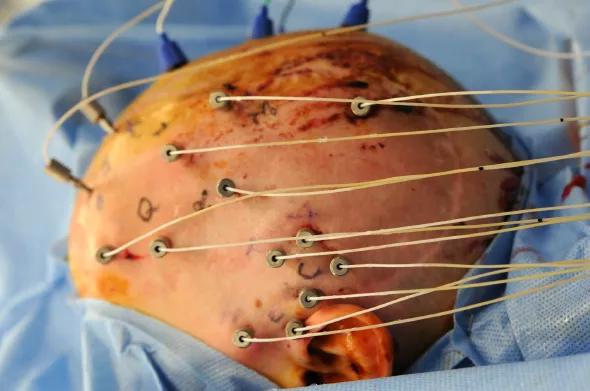
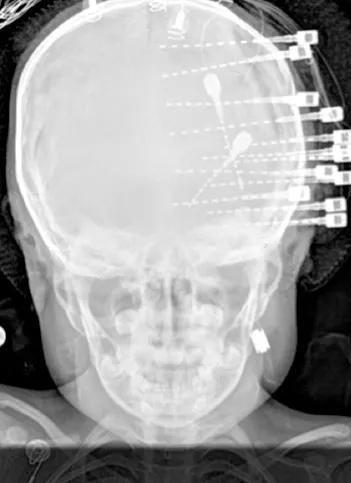
Careful review of patient profiles highlighted that SEEG-related advantages are especially relevant in young patients such as BB, who is featured in Figures 1 and 2. By the age of 2 years 5 months, BB had failed multiple seizure medications and the first attempt at tailored resection (guided by subdural grids) of the presumed seizure focus in her left frontal lobe. Frequent and intense daily seizures caused a significant impairment in her quality of life.

BB’s family arrived at our institution for a second opinion, and we recommended SEEG as the methodology of choice to explore surgical treatment options. At the age of 3 years 4 months, BB became the youngest of our patients to undergo successful SEEG implantation, followed by resection within six weeks. Since surgery, she has remained seizure-free for more than 18 months.

Advertisement
Lachhwani-fig1

Figure 1. Image of patient BB at 3 years 4 months of age. Photo in an operating room showing the implanted SEEG electrodes.
Lachhwani-fig2

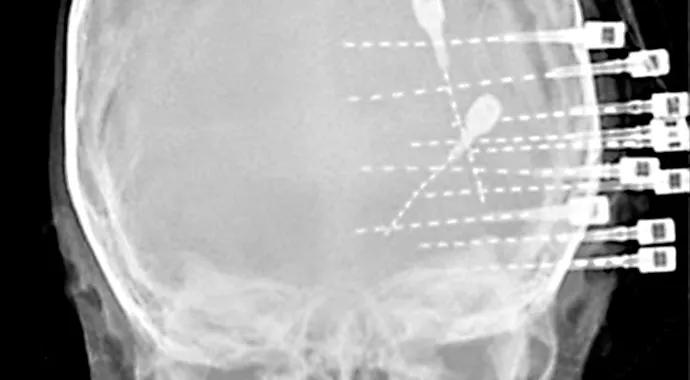
Figure 2. Skull X-ray demonstrating positioning of the SEEG electrodes. BB has remained seizure-free for more than 18 months since her surgery.

SEEG’s Advantages

Our experience with SEEG has provided these insights:

  • SEEG is effective. Invasive recordings are intended for the very specific result of identifying or excluding surgical candidacy. In epilepsy patients with difficult-to-localize epilepsy, sometimes it is necessary to sample widely separated candidate areas within one hemisphere (e.g., the frontal and occipital lobes) or to exclude potential bihemispheric epileptogenicity before offering a tailored resection. SEEG allowed us to offer resection to 64 percent of the patients (18 of 28); poor surgical candidacy was confirmed for the remaining patients due to nonlocalizable or multifocal ictal onset or location of the epileptogenic zone within the eloquent cortex. SEEG allowed us to strategically sample and evaluate depths of cortical gyri and widely separated and even bilateral regions with the help of small burr holes.
  • SEEG is efficient. Exploring surgical candidacy with SEEG methodology does not require a craniotomy. Electrodes are placed by robotic technology with the help of stereoscopic guidance in an angiography suite. This process is completed within two to three hours. Compared to a craniotomy carried out in an operating theater — requiring more than six hours and deployment of many more resources — SEEG stands out as an efficient procedure.
  • SEEG has reduced morbidity. Subdural grid electrode placement requires exposure of the brain surface using a large craniotomy. Placement of SEEG electrodes is performed through small burr holes. Obviating the need for craniotomy reduces blood loss and pain. Young patients are less likely to need aggressive pain control and 24 to 36 hours of recovery in the ICU before transfer to the monitoring unit to initiate seizure recording. These aspects make SEEG a less morbid procedure.
  • SEEG is safe. Only one of the patients in our series experienced complications related to lead implantation, monitoring or lead removal. This was in the form of a cerebrospinal fluid leak that was successfully treated. There were no other serious morbidity or mortality issues.
  • SEEG extends the time to resection, allowing for a more thoughtful informed consent process. In the typical course of invasive evaluation with subdural grids, the patient undergoes a craniotomy for implantation of electrodes based on the preoperative hypothesis of seizure foci. After a variable delay of seven to 10 days during which seizures and cortical mapping data are analyzed, the patient undergoes a second craniotomy for removal of electrodes and resection of the proposed epileptogenic zone. SEEG does not involve a craniotomy at the time of electrode implantation or explanation. The implantation is carried out via small burr holes based on preplanned strategy, and explanation involves a sterile pullout of these electrodes. Resection of the proposed epileptogenic zone is carried out after a minimum delay of six weeks postimplantation to allow the brain to heal from the procedure and to minimize infection risk. The delay to surgery may be perceived as a disadvantage, but the chance to evaluate gathered data without the rush to proceed to resection at the time of a second craniotomy is a definite upside. Moreover, the postimplantation period allows additional time for a more detailed and thoughtful informed consent process, with no time limitations. Patients can return home and then decide regarding surgical intervention.

Advertisement

A Solid Method for Identifying Surgical Candidates

In conclusion, our ongoing experience weighs strongly in favor of SEEG as a safe and effective methodology for identifying young candidates suitable for surgical treatment of refractory epilepsy.

Dr. Lachhwani is a pediatric epileptologist and Chief of Neurology at Cleveland Clinic Abu Dhabi.

Advertisement

Related Articles

16-NEU-2800-Kubu-101058161-650×450
What Do Patients Want from DBS for Parkinson’s Disease?

New study advances understanding of patient-defined goals
photo of a man sleeping at a desk, with a podcast icon overlay
March 15, 2024/Neurosciences/Podcast
Diagnosis and Management of Idiopathic Hypersomnia (Podcast)

Testing options and therapies are expanding for this poorly understood sleep disorder
illustration of an alzheimer brain and a packet of sildenafil pills
March 11, 2024/Neurosciences/Research
Sildenafil as an Alzheimer’s Candidate Drug: Further Support From Insurance Database and Mechanistic Studies

Real-world claims data and tissue culture studies set the stage for randomized clinical testing
brain scan showing perimesencephalic subarachnoid hemorrhage
Study Supports Less-Strict Monitoring for Nonaneurysmal Perimesencephalic SAH Without Hydrocephalus

Digital subtraction angiography remains central to assessment of ‘benign’ PMSAH

illustrated brain with the letters "AI" on a computer circuit board
As AI Tools Emerge, Be Proactive and Engaged to Shape Their Development

Cleveland Clinic neuromuscular specialist shares insights on AI in his field and beyond
histology image of a gray matter lesion in a multiple sclerosis brain
Study Suggests Protective Role for Microglia at Borders of Gray Matter Lesions in Progressive MS

Findings challenge dogma that microglia are exclusively destructive regardless of location in brain
series of digital-looking brain icons with a podcast button overlay on top
March 1, 2024/Neurosciences/Podcast
Harnessing the Power of AI in Medicine (Podcast)

Neurology is especially well positioned for opportunities to enhance clinical care and medical training
illustration of a neuron affected by multiple sclerosis
Clinical Trials in Progressive MS: An Assessment of Advances and Remaining Challenges

New review distills insights from studies over the past decade

Ad