Locations:





NIH-funded clinical study pairs up two innovative techniques
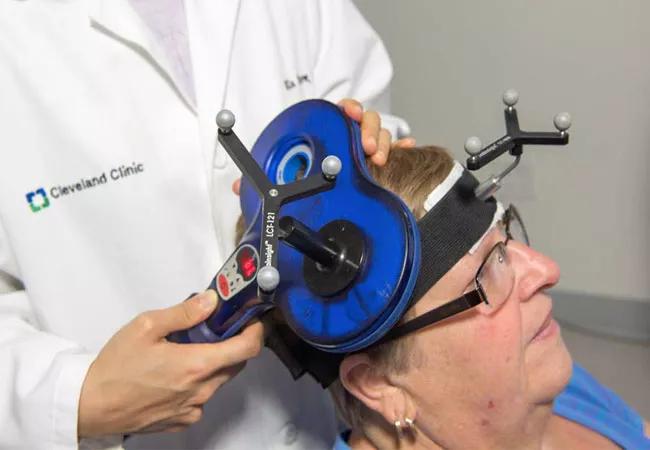
Image content: This image is available to view online.
View image online (https://assets.clevelandclinic.org/transform/6989abfc-35dd-4167-bba4-6772e52a61a6/Post-Stroke-Brain-Stimulation-2_jpg)
Post-Stroke-Brain-Stimulation-2
A Cleveland Clinic-led research team will soon launch the first clinical trial that seeks to treat post-stroke upper limb paralysis by enhancing activity of the uninjured brain hemisphere using noninvasive brain stimulation and neuromuscular stimulation. This distinctive combination therapy approach avoids the need for patients to have significant residual movement of the paretic hand and wrist in order to undergo therapy.
Advertisement
Cleveland Clinic is a non-profit academic medical center. Advertising on our site helps support our mission. We do not endorse non-Cleveland Clinic products or services. Policy
The investigation is made possible by a new five-year, $3.1 million National Institutes of Health grant to a team led by Ela Plow, PhD, PT, of Cleveland Clinic’s Department of Biomedical Engineering and Department of Physical Medicine and Rehabilitation.
“Current brain stimulation techniques target the hemisphere injured by stroke, but unfortunately this method is less effective for patients with more severe paralysis,” says Dr. Plow. “We suspect that targeting the uninjured hemisphere, also referred to as the ‘contralesional hemisphere,’ may be more successful in helping restore upper limb movement and functionality in individuals with very limited arm or hand movement after stroke.”
The clinical trial will assess how such contralesional stimulation — administered noninvasively via repetitive transcranial magnetic stimulation (shown in photo above) — may enhance the effects of a novel rehabilitation therapy known as contralateral controlled functional electrical stimulation (CCFES), developed by trial coinvestigator Jayme Knutson, PhD, of the Department of Physical Medicine and Rehabilitation, MetroHealth System, and Case Western Reserve University School of Medicine, Cleveland.
CCFES applies neuromuscular electrical stimulation to paretic wrist, finger and thumb extensors to make the paretic hand open. The patient controls the intensity of stimulation by wearing a glove equipped with sensors on the unaffected contralateral hand. When the patient opens the unaffected hand, a proportional intensity of stimulation is delivered to open the paretic hand, obviating the need for residual movement of the paretic hand. “This enables stroke patients who have lost the ability to open their hand to take part in functional task practice using their affected arm and hand,” Dr. Knutson explains.
Advertisement
A recent randomized trial showed that CCFES is more effective than conventional neuromuscular electrical stimulation at reducing upper limb motor impairment in patients with severe hand paresis, although patients continued to have functional limitations.
“The goal of this new study is to build on the gains achieved with CCFES in these severely affected patients by augmenting its effects with noninvasive brain stimulation of the contralesional hemisphere, which we have shown to promote motor improvements in this same patient population,” Dr. Plow notes. “We believe that contralesional brain stimulation and CCFES can change the interhemispheric balance and increase the excitability of uncrossed projections from the uninjured hemisphere to the paretic upper limb.”
The investigators plan to enroll 72 patients with upper limb paralysis due to stroke. Participants will be randomized to one of three treatment regimens:
Assessments of participants’ upper limb motor function and neurophysiology will be compared at baseline and 12 weeks.
“In addition to determining whether contralesional stimulation augments the effects of CCFES to yield greater improvement in upper limb function in these severely paralyzed patients, we hope to identify the underlying mechanisms of benefit and define patient factors associated with a positive response to this therapy,” Dr. Plow concludes.
Advertisement
Advertisement
New study advances understanding of patient-defined goals
Testing options and therapies are expanding for this poorly understood sleep disorder
Real-world claims data and tissue culture studies set the stage for randomized clinical testing
Digital subtraction angiography remains central to assessment of ‘benign’ PMSAH

Cleveland Clinic neuromuscular specialist shares insights on AI in his field and beyond
Findings challenge dogma that microglia are exclusively destructive regardless of location in brain
Neurology is especially well positioned for opportunities to enhance clinical care and medical training
New review distills insights from studies over the past decade
 Search