Locations:





Functional capacity and peak-stress RV systolic pressure correlate with mortality, study finds
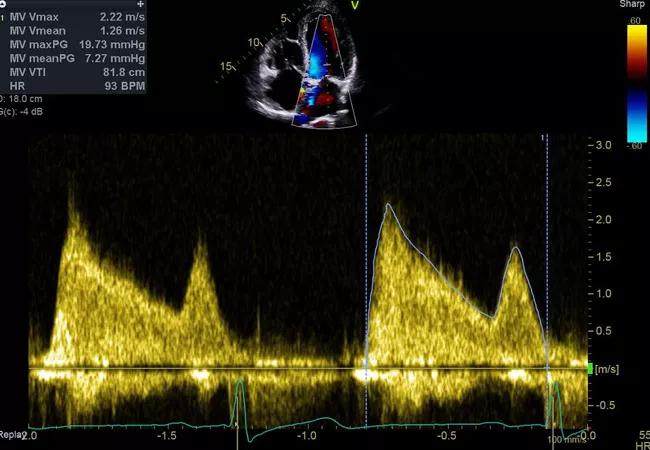
Image content: This image is available to view online.
View image online (https://assets.clevelandclinic.org/transform/8d444ee6-69fd-4527-ab0e-9d78ec1fd4d8/19-HRT-4025-Treadmill-Stress-Echo-CQD-Hero-002_jpg)
19-HRT-4025-Treadmill-Stress-Echo-CQD-Hero (002)
Future guidelines for managing patients with mitral stenosis who are asymptomatic or have atypical symptoms might be improved by incorporating treadmill stress echocardiography results. So suggests a newly published article in Circulation: Cardiovascular Imaging (2019;12:e009062) reporting on an observational cohort study of more than 500 patients with suspected significant mitral stenosis managed at Cleveland Clinic over a recent 11-year period.
Advertisement
Cleveland Clinic is a non-profit academic medical center. Advertising on our site helps support our mission. We do not endorse non-Cleveland Clinic products or services. Policy
Greater mortality was found to be associated with primary nonrheumatic mitral stenosis, lower age- and sex-predicted exercise capacity, and higher peak-stress right ventricular systolic pressure (RVSP), whereas invasive mitral valve procedures were associated with better survival.
“The management of patients with native nonrheumatic mitral stenosis or following mitral valve surgery is controversial and becoming a proportionately larger issue now that we see rheumatic heart disease much less often,” says Milind Desai, MD, corresponding author of the study report and Professor of Medicine at Cleveland Clinic Lerner College of Medicine. “Our analysis indicates that stress echocardiography may offer important prognostic information to help guide management in a variety of patients with mitral stenosis who are asymptomatic or have atypical symptoms.”
The study included 515 consecutive Cleveland Clinic patients with suspected significant MS (based on valvular parameters) who underwent resting and treadmill stress echocardiography as part of a comprehensive evaluation between January 2003 and December 2013. All were either asymptomatic or had atypical symptoms not deemed to be caused by valvular heart disease. Patients were excluded if there had not been a clinical reason to perform stress echo or if they had left ventricular ejection fraction less than 55%, hypertrophic cardiomyopathy or a subaortic membrane.
The study population’s mitral stenosis was categorized as follows:
Advertisement
Overall, 224 patients (44%) underwent an invasive mitral valve procedure, at a median of 54 days after treadmill testing. Across the cohort, 76 deaths (15%) occurred over mean follow-up of 6 + 4 years; 64 of these were due to cardiac causes.
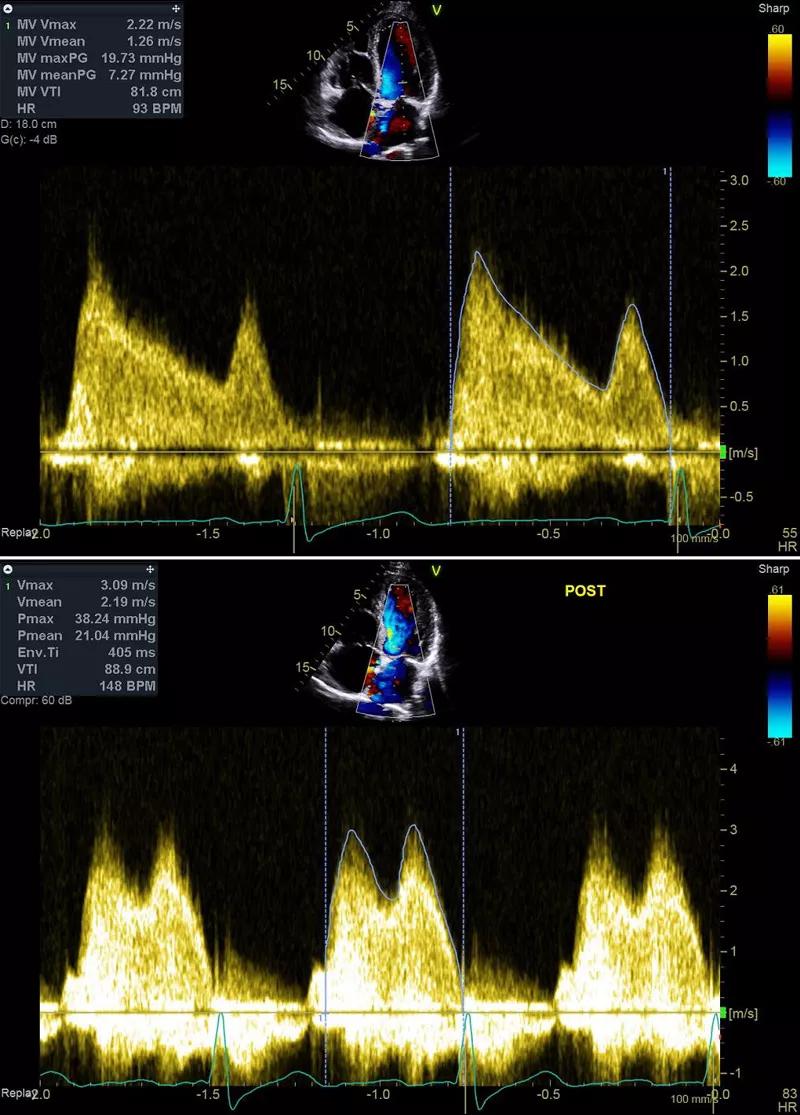
Image content: This image is available to view online.
View image online (https://assets.clevelandclinic.org/transform/89441a02-d2ad-4dc5-aee2-98855c56356c/19-HRT-4025-Treadmill-Stress-Echo-CQD-Inset-002_jpg)
Echocardiograms from a patient with mitral stenosis before (top) and after (bottom) surgical intervention.
Survival analysis revealed that higher long-term mortality was significantly associated with the following:
Spline analysis showed that thresholds of peak-stress RVSP of at least 60 mmHg and achieved age- and sex-predicted METs of less than 85% were associated with increased long-term mortality.
In addition, invasive mitral valve procedures (valvuloplasty or repair/replacement) were associated with significantly lower mortality (HR = 0.67 [0.55-0.81]).
According to the authors, this study is one of the largest to characterize mitral stenosis in the developed world in the modern era and to assess prognosis using echocardiographic and exercise factors. Comparable studies have focused largely on patients with rheumatic mitral stenosis.
Advertisement
“Our findings suggest a role for exercise echocardiography in helping to determine appropriate surgical timing in patients with mitral stenosis who have no symptoms or atypical symptoms,” says co-author A. Marc Gillinov, MD, Cleveland Clinic’s Chair of Thoracic and Cardiovascular Surgery. “Relying solely on patients’ perception of their symptoms can underestimate both the severity of mitral stenosis and the risk of death.”
He adds that although the study identified specific stress performance thresholds that generated significantly different survival curves, it would be premature to recommend these thresholds as criteria for intervention. Although the study was large, it was limited by its observational, single-center nature. The study authors encourage validation of the findings in a multicenter study, preferably with a prospective design.
An accompanying editorial by two clinicians at Morristown Medical Center in New Jersey also argues for more study. The editorialists call the study “an important addition to the evidence base for stress echocardiography in mitral stenosis” that complements prior studies limited to rheumatic mitral stenosis. They conclude that it “provides data supporting but not proving the hypothesis that stress echocardiography results should influence clinical decision-making.”
Advertisement
Advertisement

A sampling of outcome and volume data from our Heart & Vascular Institute
Concomitant AF ablation and LAA occlusion strongly endorsed during elective heart surgery

Large retrospective study supports its addition to BAV repair toolbox at expert centers
Young age, solid tumor, high uptake on PET and KRAS mutation signal risk, suggest need for lobectomy
Surprise findings argue for caution about testosterone use in men at risk for fracture
Residual AR related to severe preoperative AR increases risk of progression, need for reoperation

Findings support emphasis on markers of frailty related to, but not dependent on, age
Provides option for patients previously deemed anatomically unsuitable
 Search