Locations:





How we nearly halved our transfusion rate
Image content: This image is available to view online.
View image online (https://assets.clevelandclinic.org/transform/7b70de65-0d4b-4fc1-a31a-0fca2f632a8c/15-ORT-978-Higuera-Banner-Image-690x380pxl_jpg)
15-ORT-978-Higuera-Banner-Image-690x380pxl
By Joseph Styron, MD, PhD, and Carlos Higuera, MD
Advertisement
Cleveland Clinic is a non-profit academic medical center. Advertising on our site helps support our mission. We do not endorse non-Cleveland Clinic products or services. Policy
Total hip and knee arthroplasty (THA and TKA) are associated with significant intraoperative and postoperative blood loss. Although surgeons use a variety of surgical techniques and products to facilitate hemostasis, blood transfusions are still common. Cleveland Clinic’s Department of Orthopaedic Surgery implemented a preoperative blood management workflow in 2012 to reduce the need for blood transfusions. We report here results from our initial experience with the workflow and the rationale for its development.
Blood transfusions in surgical patients carry significant hospital costs and patient risk. The annual financial burden of blood- and transfusion-related activities for all surgical patients has been reported to range from $1.62 million to $6.03 million per hospital. Moreover, postoperative transfusions are associated with a variety of complications, including infections, wound problems, transfusion reactions, coronary events, increased ventilator time, extended length of stay and in-hospital mortality.
At the beginning of 2012, approximately one-third of Cleveland Clinic’s primary and revision THA and TKA patients received postoperative transfusion of blood products. Researchers at other institutions have reported similar postoperative transfusion rates of 38.5 and 19.3 percent among THA and TKA patients, respectively.
In 2012, a pilot group of high-volume THA and TKA surgeons in our department set out to reduce the requirement for postoperative blood transfusions in their patients by developing a comprehensive preoperative blood management (PBM) workflow. This simple and consistent workflow was based on blood management programs used by other departments at Cleveland Clinic. It involves the active diagnosis and treatment of preoperative anemia and other transfusion risk factors prior to performing a THA or TKA.
Advertisement
Coordinated by two full-time nurses, the workflow was initiated primarily via surgeon referral through a SmartSet (a group of orders and prompts commonly used together to document a specific condition) in the electronic medical record at a patient’s initial office visit. Additionally, the operating room schedule was screened by the blood management team to minimize the possibility of missing an eligible patient.
The workflow process began with patients undergoing a CBC and iron studies (ferritin, iron and total iron binding capacity). Preoperative anemia (defined as hemoglobin concentration ≤ 13 g/dL) triggered an evaluation of the patient’s iron studies and a thorough review of the medical history to identify any possible causes of anemia. Most patients treated had hemoglobin concentrations between 10 and 13 g/dL.
We complemented these strategies with intraoperative use of the antifibrinolytic agent tranexamic acid (TXA), which is administered intravenously or topically depending on the patient’s risk factors. This strategy has been reported to be safe and effective in this setting in a recent retrospective review.
To evaluate the effectiveness of the PBM protocol on decreasing the rate of blood transfusions among THA and TKA patients, we reviewed the records of 553 consecutive patients eligible for screening under the protocol. We then compared them with the records of 330 consecutive patients who underwent surgery before protocol implementation. The two cohorts were statistically similar in terms of demographics and comorbidities.
Advertisement
The protocol was successful at identifying patients most at risk of requiring a blood transfusion, with 17.7 percent of protocol patients undergoing some form of preoperative anemia treatment. Despite a small increase in preoperative hemoglobin as a result of the treatment, these patients still required blood transfusions at much higher rates than did their peers who did not require preoperative treatment (P < .001).
During implementation of the PBM protocol, intraoperative utilization of TXA (either topical or systemic) increased dramatically — from 0.6 percent of patients prior to implementation to 36.9 percent after implementation.
After multivariable analyses (adjusting for patient age, sex, preoperative treatment, type of surgery, length of surgery and postoperative deep venous thrombosis prophylaxis), it was the utilization of intraoperative TXA, not preoperative screening or treatment, that remained a significant predictor of decreased odds for requiring blood transfusion (odds ratio = 0.289, P < .001). Moreover, among patients who did require a transfusion, those treated with TXA required fewer units of blood products than did those not treated with TXA (P < .010).
The overall transfusion rate declined from 33 percent in 2012 to 18 percent or less by late 2013 and early 2014 (Figure). This represented savings of more than $1 million annually across the enterprise.
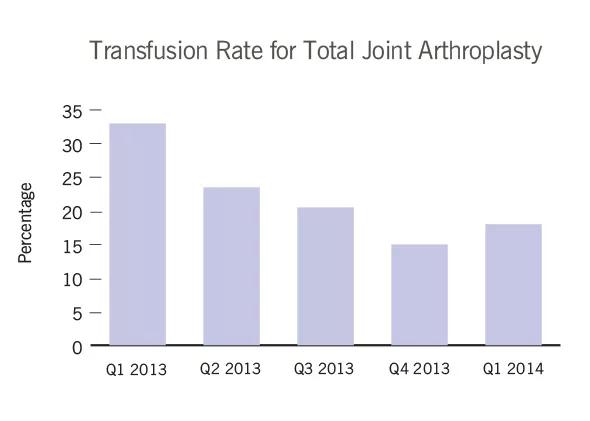
Image content: This image is available to view online.
View image online (https://assets.clevelandclinic.org/transform/68040d41-bfcb-403f-b07e-be5876b73bcd/15-ORT-978-Higuera-Inset-Image-590pxl-width_jpg)
Figure. Post-arthroplasty transfusion rates at Cleveland Clinic’s main campus, by quarter.
Tremendous resources have been allocated to effectively screen patients preoperatively in an effort to reduce use of blood products following THA or TKA. Efforts to reduce transfusion rates are motivated by both patient safety concerns and financial considerations. Each unit of blood transfused has been estimated to cost hospitals between $522 and $1,183 in direct and indirect expenses. In addition, blood transfusions have been associated with increased risk of postoperative infection, poor physical function, increased use of rehabilitation facilities, longer hospital stays and increased mortality.
Advertisement
Our study found that preoperative optimization of patients may not be as effective as intraoperative utilization of TXA at reducing the need for blood transfusion following primary THA or TKA. Overall, this strategy has reduced transfusion rates while facilitating better preoperative screening, promoting more appropriate therapy and lowering overall treatment costs.
For a full supporting bibliography, email Dr. Higuera.
Dr. Styron is a resident in the Department of Orthopaedic Surgery.
Dr. Higuera is a surgeon in the Center for Adult Reconstruction in the Department of Orthopaedic Surgery.
Advertisement
Advertisement
Biologic approaches, growing implants and more

Study reports zero infections in nearly 300 patients

How to diagnose and treat crystalline arthropathy after knee replacement
Study finds that fracture and infection are rare
Center will coordinate, interpret and archive imaging data for all multicenter trials conducted by the foundation’s Osteoarthritis Clinical Trial Network

Reduced narcotic use is the latest on the list of robotic surgery advantages
Cleveland Clinic specialists offer annual refresher on upper extremity fundamentals
Cleveland Clinic orthopaedic surgeons share their best tips, most challenging cases and biggest misperceptions
 Search