Locations:





Nurses discuss patient needs four times daily
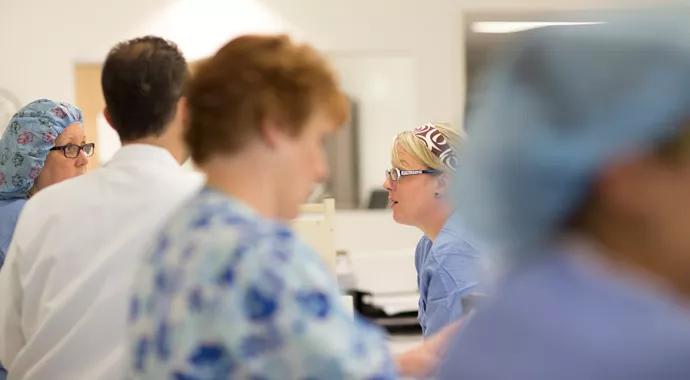
Image content: This image is available to view online.
View image online (https://assets.clevelandclinic.org/transform/b1de213f-246d-45b7-92f7-c21cfe0cf4b1/touchpoint_690x380_jpg)
touchpoint_690x380
Like many healthcare organizations, the nurses at Marymount Hospital rely on quick morning huddles to hand-off patients during a shift change. But the 322-bed community hospital, which is part of the Cleveland Clinic health system, wanted another method to share information among all nursing staff on its unit several times a day. A year ago, Marymount Hospital implemented the “Touch Points” initiative. Now, staff gathers at the nurses’ station at 11 a.m., 3 p.m., 11 p.m. and 3 a.m. to discuss what tasks need to be completed, who is responsible for those tasks, special patient issues, discharges, transfers and admissions.
Advertisement
Cleveland Clinic is a non-profit academic medical center. Advertising on our site helps support our mission. We do not endorse non-Cleveland Clinic products or services. Policy
“Touch Points is a strategic move to improve caregiver-to-caregiver communication while focusing on patient-centered care,” says Donna Koterba, BSN, RN, Director of Nursing, Medical-Surgical and Behavioral Health at Marymount Hospital. The charge nurse gathers all members of the team, including RNs, PCNAs and LPNs, for 10 to 15-minute meetings. “Since you get full participation, everyone feels like a valued member of the team,” says Koterba.
There are multiple benefits to Touch Points, including the following:
Advertisement
The overarching benefit of Touch Points is enhanced communication. “When communication improves, then patient satisfaction scores and quality metrics will improve, too,” says Koterba. “At Marymount Hospital, our objective is to improve our patients’ experience, with the goal of reaching 90 percent or better satisfaction rates.” Having nurses meet four times daily during Touch Points to coordinate patient care is helping the community hospital move toward this goal.
Photo credit © Russell Lee
Advertisement
Advertisement
Nurses play key role in comprehensive lifetime treatment program
Customized bots improve speed, efficiency by streamlining daily clinical, clerical tasks
Nurses play pivotal role in patients’ ability to recover in the comfort of their own homes
New protocol reduces costs, increases patient and caregiver satisfaction
Advocating for patient safety is imperative in fast-paced surgical settings
M-Power program improves the perinatal experience for people who have survived abuse

Advice for those pursuing a WOC nursing career

Veteran nurse shares his experience as a caregiver and community volunteer
 Search