Locations:





BITS and other innovations enhance OT interventions
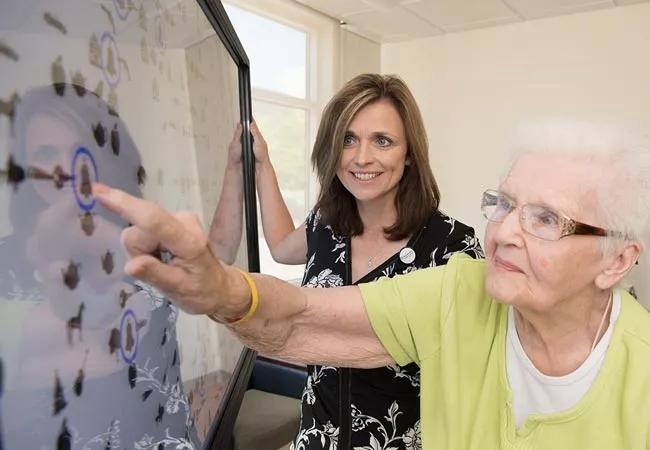
Image content: This image is available to view online.
View image online (https://assets.clevelandclinic.org/transform/81b73a5f-6057-4814-b7bb-d6eee91b3e6c/BITS-650x450_jpg)
BITS-650×450
Leading-edge technologies adopted by occupational therapy (OT) teams at Cleveland Clinic inpatient rehabilitation hospitals are streamlining rehabilitation care and providing creative ways to meet patient needs. A few of the new tools are profiled below.
Advertisement
Cleveland Clinic is a non-profit academic medical center. Advertising on our site helps support our mission. We do not endorse non-Cleveland Clinic products or services. Policy
Last fall, three Cleveland Clinic rehabilitation hospitals adopted the Bioness Integrated Therapy System (BITS™), a multiprogram tool that aids patient assessment, therapy, and monitoring with a user-friendly, large-screen computer interface.
The new system, which is being used for patients with physical or cognitive impairment, was obtained as part of a joint venture between Cleveland Clinic and rehabilitation services provider Select Medical.
BITS consists of an interactive, large-display touch screen that offers engaging therapy-directed activities designed to assess and enhance patients’ coordination, perception, visual and auditory processing, physical endurance, attention, memory and reaction time.
Multiple therapy categories (e.g., visual scanning, visual pursuit, cognitive skills) are covered by a variety of BITS activities, each with a range of skill levels to accommodate varying abilities and progression speeds.
Mary Stoffiere, MA, CCC-SLP, Regional Director of Rehabilitation (shown above with a patient), describes one BITS activity used for patients with a right-sided stroke, who tend to ignore anything on the left side of their body or visual field. The activity requires patients to scan their entire visual field and tap on targets (as in the photo below), promoting visual detection, scanning, and sustained attention.
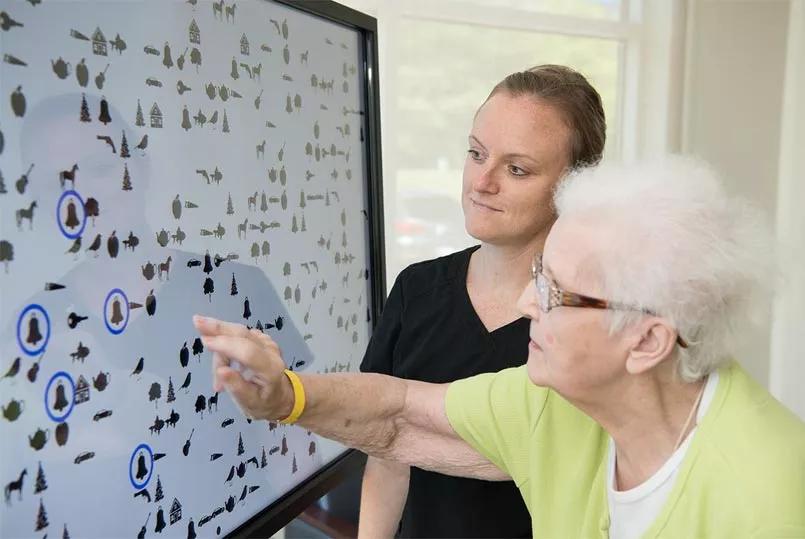
Image content: This image is available to view online.
View image online (https://assets.clevelandclinic.org/transform/f5b4ab72-0de8-4cf5-a4af-5a12ce684b22/BITS-Inset_jpg)
Other activities may require drawing trails by linking increasing numbers, tapping pictures on a rotating wheel, or recreating a sequence of letters that were shown a minute before.
Advertisement
“The beauty of the system is that what are essentially rote exercises can be practiced as often as desired and in new and interesting ways,” Stoffiere explains.
George J. Choma, PT, C/NDT, Director of Rehabilitation at Cleveland Clinic Rehabilitation Hospital, Avon, directed his hospital’s rollout of BITS last year. He’s observed benefits beyond skill-building, noting that the system is often used by small groups of patients with similar needs. As patients take turns with an activity, they cheer each other on.
“Working as a group not only stimulates patients to try harder but turns therapy into a social activity as well,” Choma notes. “Family members also want to play, and we see patients having fun competing against their grandchildren.”
He says BITS is often used for patients who have two OT sessions daily: a morning session with BITS and an afternoon session dedicated to practicing self-care skills. “The earlier BITS session often enhances patients’ functional activities practiced later in the day,” Choma explains.
The system can also conduct baseline assessments and monitor patient progress. OTs especially appreciate having a single tool with so many capabilities, Choma says, as it allows them to dramatically reduce the time needed to set up and conduct a therapy session.
Choma acknowledges that accessing the newest technology takes extra resources. He emphasizes that the best high-tech tools are not merely higher-cost versions of conventional therapies. “Packaging therapy with cutting-edge technology adds excitement for patients and families, as well as for therapists,” he says. “An engaging, interactive system like BITS raises cognitive therapy to a new level.”
Advertisement
It also appears to help improve patient outcomes. Choma notes that the Functional Independence Measure (FIM) change from admission to discharge at his rehabilitation hospital rose to 27.45 in the first quarter of 2018. This change ranks close to the 70th percentile nationally. “We attribute much of the improvement to the incorporation of BITS into our plan of care,” he says.
Other new tools have been adopted as needs have arisen for individual patient care. Choma recalls a recent patient with locked-in syndrome (see this earlier Consult QD post) who presented multiple new challenges to the team.
To enhance communication for this quadriplegic patient, therapists employed multiple augmented communication devices. One that operated by detecting eye movements on a computer screen proved unsuccessful, as the patient quickly fatigued and developed nystagmus when attempting to use it.
They next tried an EMG-assisted device worn on a working eyebrow muscle that was connected to an iPad. This proved more successful for brief episodes of communication while the patient was hospitalized — and held the promise of continued progress following discharge.
“We like to think patients will get immediately better when given a new tool, but like learning any difficult skill, continuous practice and refinement may be needed,” says Choma. “We involve family members as much as possible so gains can continue when patients go home.”
The OT team also found the patient a power wheelchair that operated by controls connected to a head array. Because he had some neck movement, the patient could activate the controls with head pressure. By discharge, he was able to motor himself through the hospital hallways.
Advertisement
Choma and Stoffiere agree that as new technology continuously develops and becomes available, it’s incumbent on OTs to bring the best solutions to their patients.
“OTs love a challenge,” says Stoffiere. “They’re trained to problem-solve, so seeking out new tools is natural for them.”
Advertisement
Advertisement
New study advances understanding of patient-defined goals
Testing options and therapies are expanding for this poorly understood sleep disorder
Real-world claims data and tissue culture studies set the stage for randomized clinical testing
Digital subtraction angiography remains central to assessment of ‘benign’ PMSAH

Cleveland Clinic neuromuscular specialist shares insights on AI in his field and beyond
Findings challenge dogma that microglia are exclusively destructive regardless of location in brain
Neurology is especially well positioned for opportunities to enhance clinical care and medical training
New review distills insights from studies over the past decade
 Search