Locations:





Early results with ‘HeRe We Arts’ spur testing in a randomized trial
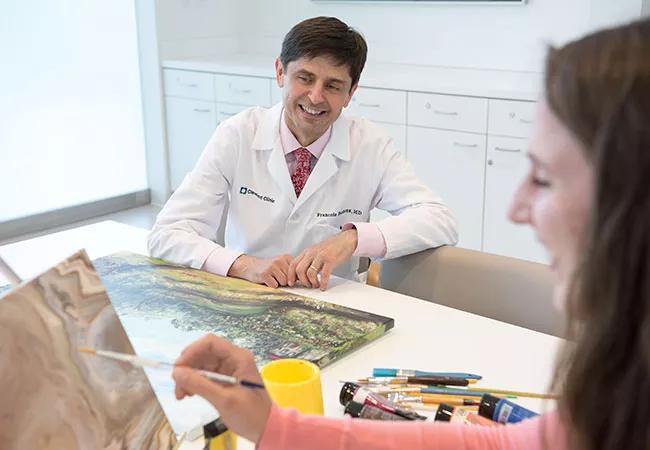
Image content: This image is available to view online.
View image online (https://assets.clevelandclinic.org/transform/bcaad999-fe5a-4ef6-9848-e24ca73117c6/19-NEU-3817-arts-and-medicine-650x450_jpg)
AMI-Tuck-1642295 06-25-19
Therapeutic use of the arts can be a component of the comprehensive management of various chronic diseases, including multiple sclerosis (MS), but it is not considered or offered as often as it could be. That’s a key takeaway from a course at the 2019 annual meeting of the Consortium of Multiple Sclerosis Centers, held recently in Seattle.
Advertisement
Cleveland Clinic is a non-profit academic medical center. Advertising on our site helps support our mission. We do not endorse non-Cleveland Clinic products or services. Policy
The course, moderated by Francois Bethoux, MD, highlighted a Cleveland Clinic-developed therapeutic arts program called “Health, Resilience and Well-being through the Arts” (HeRe We Arts™) designed to expose patients with a variety of chronic illnesses to various types of artistic activities in order to promote their general health and wellness.
The HeRe We Arts program is in keeping with a long-standing Cleveland Clinic commitment to incorporating the arts into healthcare as a path to healing, says Dr. Bethoux, Medical Director of Cleveland Clinic’s Arts & Medicine Institute (AMI) and Director of Rehabilitation Services at its Mellen Center for Multiple Sclerosis Treatment and Research.
Along with a history of displaying art in Cleveland Clinic hospitals, the AMI — now in its 10th year of existence — has conducted more than 25 research studies, including six randomized clinical trials.
HeRe We Arts, which was made possible by the support of AMI Executive Director Maria Jukic, JD, is based on research done by AMI Research Program Manager Lisa Gallagher, MA, MT-BC, along with Dr. Bethoux and colleagues. They developed it as a course-like program divided into modules presented weekly over eight weeks. During the course, patients are given a menu of art activities that can be adapted to their individual physical or cognitive abilities.
“People with chronic illnesses may say, ‘I used to play piano or do visual arts, but now it’s more difficult, so I gave it up altogether,’” explains Dr. Bethoux, shown in the photo above during an art therapy session. “We introduce them to an art activity they can do, have them take it home and practice the activity for a week, and then have them come back and get exposed to something else the next week. Our hope is that they will identify at least one activity they can continue to benefit from after the program is over.”
Advertisement
The eight weekly modules cover the following:
“Very few clinicians, hospital administrators or legislators will say we shouldn’t use art as a means of health promotion,” notes Dr. Bethoux, “but they will also ask for evidence to support its use and justify funding.” Although there is a large body of evidence on the benefits of therapeutic arts in other patient populations, he says, few studies have been conducted specifically in people with MS, and those that have been tend to be small and uncontrolled.
In a literature review recently published in US Neurology (2017;13:82-89), he and his AMI colleague Lisa Gallagher, who is a music therapist, identified five art therapy studies, six music therapy studies and two dance and movement studies involving people with MS. The programs varied widely in content and execution, were offered to patients at every stage of the disease, and were delivered in inpatient, outpatient, group and individual settings. Taken together, these studies indicate that therapeutic arts can help reduce pain and anxiety, improve coping skills, reduce stress and promote relaxation, provide an opportunity for self-expression, and release and enhance self-esteem.
“In particular, we found that therapeutic art can be useful in promoting self-efficacy, emotional well-being and motor control in people with MS,” says Dr. Bethoux.
Advertisement
In addition, an uncontrolled study of the HeRe We Arts program in 36 subjects with chronic illnesses — 22% of whom had MS — found that subjects self-reported statistically significant improvements in well-being, happiness, leisure time and resilience/coping after the end of the program. A manuscript of the study is currently in review.
“The changes in this study were relatively small but provided enough of a signal to continue the program and begin planning a randomized controlled study,” Dr. Bethoux reports.
In fact, his colleague Lisa Gallagher recently received funding from the National Endowment for the Arts to conduct a randomized trial of HeRe We Arts in patients with MS and a variety of other chronic health conditions, with a focus on individuals in underserved neighborhoods. The study will compare the HeRe We Arts program with an eight-week non-arts-based health education program.
“Our goal is to develop HeRe We Arts as an evidence-based intervention that has benefit for people with chronic conditions and can be easily offered on a large scale in a variety of community settings,” Gallagher says.
Advertisement
Advertisement

New study advances understanding of patient-defined goals
Testing options and therapies are expanding for this poorly understood sleep disorder
Real-world claims data and tissue culture studies set the stage for randomized clinical testing
Digital subtraction angiography remains central to assessment of ‘benign’ PMSAH

Cleveland Clinic neuromuscular specialist shares insights on AI in his field and beyond
Findings challenge dogma that microglia are exclusively destructive regardless of location in brain

Neurology is especially well positioned for opportunities to enhance clinical care and medical training
New review distills insights from studies over the past decade
 Search