Locations:





Nursing leadership in the transformation of healthcare
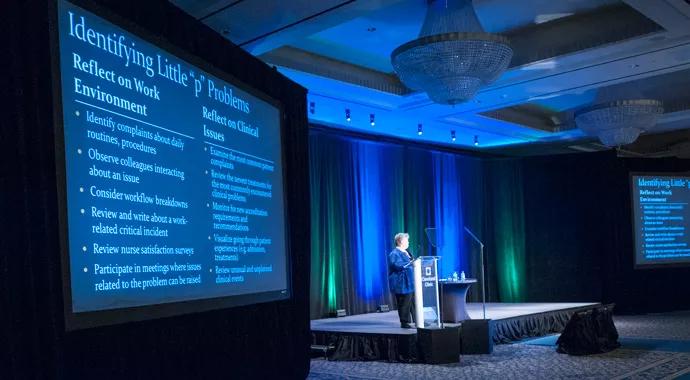
Image content: This image is available to view online.
View image online (https://assets.clevelandclinic.org/transform/3da6f7b4-cbef-432b-af4b-d2c1d6e20dad/690x380_jpg)
690×380
Each year, in July, Cleveland Clinic Nursing holds our annual Nursing Leadership Summit. This Summit brings together the roughly 450 nurse leaders throughout our health system in an open, interactive and educational forum. It focuses on strategic planning and often includes guest presenters, table work, break-out sessions, brainstorming, idea generation, presentations, video highlights and open discussion.
Advertisement
Cleveland Clinic is a non-profit academic medical center. Advertising on our site helps support our mission. We do not endorse non-Cleveland Clinic products or services. Policy
We use this platform to evaluate the progress we’ve made in our outlined strategic themes, alter or modify our strategic direction and determine the appropriate steps for future strategic planning and action. We also revisit our strengths, weaknesses, opportunities and threats, take a deeper look at how we are living our mission to deliver world-class care to our patients, and establish measurable benchmarks for our continued forward movements.
Our 2014 Nursing Leadership Summit was focused on an area of nursing leadership that is imperative to today’s healthcare landscape: “The voice of the nurse in the transformation of healthcare.”
Industry experts have said it, and we all know it to be true – nurses have the potential to lead the transformation of healthcare.
In The Future of Nursing: Leading Change, Advancing Health, the Institute of Medicine specifically recognizes the need for strong and capable nursing leadership to successfully realize the vision for transforming healthcare. This includes producing leaders at every level of the system and accepting key leadership positions in policy, politics, organizations and practice.
The question is, how? What can and should nurse leaders be doing to lead the transformation?
Nurse leaders need to ensure the voice of nursing is heard – from involvement in political events and community activism to interactions with public officials.
As printed in a 2007 manuscript in The Online Journal of Issues in Nursing, everyone, key stakeholders and the general public included, should have common knowledge of how nurses are affecting local, regional and national changes in health policy. Nurses should be seen as advocates, educators and partners in these changes and viewed as helpful resources for those seeking advice, clarity and trustworthy information.
Advertisement
Often, nurses are the first caregivers to clearly see how the system is or is not meeting patient needs. We are privy to the impact of policy on patients and also the need for policy changes to address health-related issues.
For all these reasons and more, it’s important that nurses have a seat at the decision-making table. However, without the proper skills and knowledge, it can be challenging to achieve success in policy identification, development and implementation. We have to venture beyond our practice setting, into a much less familiar world.
To help guide our nursing leaders, we invited Rebecca M. Patton, the past, two-term President of the American Nurses Association, to join us for our 2014 Nursing Leadership Summit.
As ANA President, Patton met frequently with key policy leaders, including President Obama and his staff as the healthcare reform bill was developed, debated and passed. Her latest work, Nurses Making Policy From Bedside to Boardroom, is available for pre-order and is set to publish next month.
The book is written to help graduate-level nursing students and nurse leaders develop the health policy skills needed to advocate for patients from the bedside to the larger political arena. It examines the pivotal role of nurses’ involvement in health policy, and describes the steps for facilitating policy change.
Feel free to watch the below video highlight, featuring a selection of Patton’s key messages and recommendations from our Summit.
Video content: This video is available to watch online.
View video online (//www.youtube.com/embed/j57iVXZQ_n8?rel=0&wmode=transparent)
As you can see from the video, Patton offered our team a wealth of information and knowledge on how we could become advocates in the political arena. And, the 2014 Summit marked a significant step forward in our collective effort to actively find and share our voices in healthcare transformation as we launched a new Cleveland Clinic Nursing Legislative Committee.
Advertisement
The response and interest in the new committee has been phenomenal. Leaving the Summit, approximately 150 nursing leaders confirmed committee membership.
The Legislative Committee is focused on education, analysis and influence of political and practical issues that impact the nursing profession and delivery of healthcare. Its primary objective is to understand political processes to ensure the voice of nursing is influential, heard and creates an educated and informed workforce on political agendas.
More than 50 nurses attended the committee’s first meeting in early September. To date, the committee has developed a charter, established a future meeting and planning schedule, and identified the need for involvement from key stakeholders such as Cleveland Clinic’s government relations team, local legislators, influential speakers and more.
Becoming an advocate encompasses everything from delivering important public policy information to fellow caregivers on issues relevant to nursing and healthcare to informing, engaging and influencing legislators on nursing agendas and professional practice standards, changes and healthcare issues.
As the country’s most trusted profession and the largest healthcare provider group, if we successfully influence future healthcare policy and present nursing’s perspective on issues – there is no doubt in my mind we will drive healthcare transformation.
Advertisement
Advertisement
Nurses play key role in comprehensive lifetime treatment program
Customized bots improve speed, efficiency by streamlining daily clinical, clerical tasks
Nurses play pivotal role in patients’ ability to recover in the comfort of their own homes
New protocol reduces costs, increases patient and caregiver satisfaction

Advocating for patient safety is imperative in fast-paced surgical settings

M-Power program improves the perinatal experience for people who have survived abuse

Advice for those pursuing a WOC nursing career

Veteran nurse shares his experience as a caregiver and community volunteer
 Search