Locations:





How a site visit helped Parkview Heart Institute expand its vascular services and improve operations
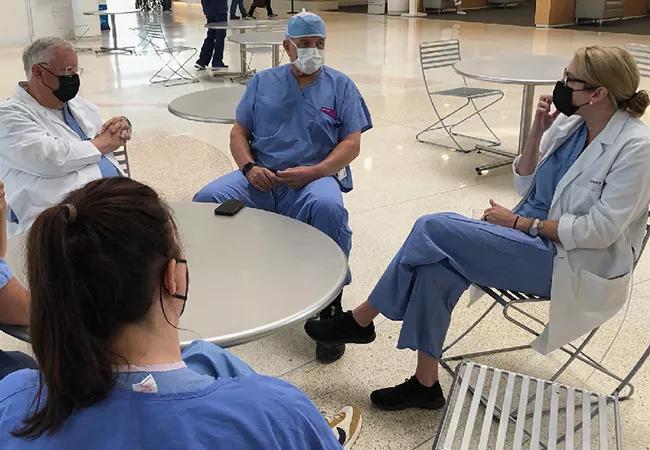
Image content: This image is available to view online.
View image online (https://assets.clevelandclinic.org/transform/32f8ffba-74f8-441b-a6d7-2cf9db385012/22-HVI-3255077-CQD-650x450-1_jpg)
22-HVI-3255077 CQD 650×450
Hospitals are continually expanding service offerings and developing their programs. A comprehensive strategy is critical to this process. The ability to forecast growth and its impact on personnel, space and resource requirements demands in-depth assessment and planning, as well as the capability to transition rapidly when needed. This was the case for Parkview Heart Institute (PHI) — a hospital in Fort Wayne, Indiana, that has had an alliance relationship with Cleveland Clinic’s Heart, Vascular & Thoracic Institute (HVTI) since August 2019 — as PHI embarked on an expansion of its vascular program and growth of its vein clinic.
Advertisement
Cleveland Clinic is a non-profit academic medical center. Advertising on our site helps support our mission. We do not endorse non-Cleveland Clinic products or services. Policy
Parkview Heart Institute serves the cardiovascular needs of patients in northeast Indiana and northwest Ohio, providing high-quality, safe, patient-centric care that aligns well with HVTI’s consistent focus on exceptional outcomes, continuous quality and process improvement, and innovation. The leadership at PHI recognized a steady increase in patient appointments for consultation and office-based procedures in the vein clinic, as well as a need to swiftly revise their strategy to address the increase in patient visits. It was clear that this would be another project on which the PHI team should work collaboratively with Cleveland Clinic.
When a hospital or health system enters an affiliation or alliance relationship with Cleveland Clinic’s HVTI, one of the many benefits is the opportunity to make in-person site visits to Cleveland Clinic. During a site visit, team members from the affiliate or alliance hospital have a chance to better understand Cleveland Clinic’s clinical and business operations and management, observe processes in real time, and experience Cleveland Clinic team collaboration in person. These visits foster professional collaboration, learning and the sharing of best practices to optimize patient outcomes.
Site visits are tailored to the specific objectives outlined by participants, offering significant value through in-person meetings with key stakeholders, observation time and dedicated time for customized Q&A. Visits are typically multifaceted and comprehensive (see Table), making the experience maximally beneficial for affiliate and alliance organizations, as illustrated in the following case study.
Advertisement
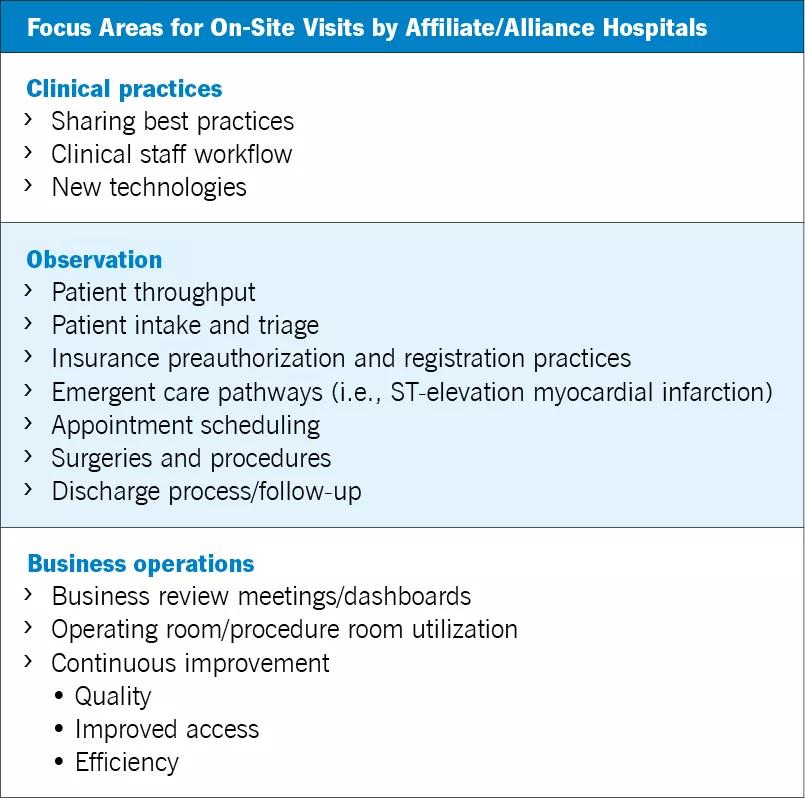
Image content: This image is available to view online.
View image online (https://assets.clevelandclinic.org/transform/9d31f29d-af78-4f48-a989-5b0093f81a77/805x-Affiliate-Chart_jpg)
Parkview Heart Institute’s leadership discussed expansion of its vein clinic program with the HVTI Advisory Services team. A site visit was recommended, and planning immediately got underway. Five members of the PHI vein clinic team traveled to Cleveland in June 2022 to participate in a two-day visit that included time at Cleveland Clinic regional ambulatory vein center facilities. As the PHI vein clinic team was looking to procure new space and optimize its utilization, they requested the site visit to observe and share clinical best practices as well as strategies for effective patient scheduling, timely insurance authorization, optimization of patient throughput and maximization of resources for efficient caregiver workflow.
Most of the Parkview team spent their first day at Cleveland Clinic’s East Side Vein Center, where they observed clinic-based procedures with vascular surgeon George Anton, MD, as well as outpatient throughput and office workflow. To get the most out of the experience, an advanced practice provider (APP) from PHI shadowed a Cleveland Clinic APP and observed and interacted with vascular surgeon Kathleen Boyle, DO, at the West Side Vein Center. The APP also worked with the office staff to gain better understanding of the center’s scheduling and insurance pre-authorization processes.
“Our office-based models were designed to provide an integrated opportunity to schedule patient visits simultaneously with vascular lab imaging and assessment within the same office,” explains Dr. Anton. “This provides a seamless care pathway allowing physician, nurse and vascular technologist to participate in the preoperative assessment and planning, interventional/surgical procedure and postoperative evaluation. Taking all of this into consideration up front allows our care to be delivered in a timely and efficient way, with increased attention to care accessibility, patient safety and overall patient satisfaction.”
Advertisement
The group was then hosted by Sean Lyden, MD, Chair of the Department of Vascular Surgery, for a tour of the department on Cleveland Clinic’s main campus. Dr. Lyden stressed the importance of multidisciplinary input from all caregivers in ensuring patient well-being, achieving the best possible outcome and maximizing patient satisfaction.
“We were thrilled to host the Parkview team,” Dr. Lyden says. “Our goal is to share our processes with affiliate and alliance hospitals. We enjoy working collaboratively across our Heart, Vascular & Thoracic Institute — among vascular surgery, vascular medicine, cardiology and cardiac surgery — to provide optimal outcomes for our patients. We have integrated the vascular lab into our care of patients and work collaboratively in our vein centers with our ultrasound technicians to understand the pathology of the patient’s venous disease and customize treatment plans.”
The second day began with the entire PHI team observing a hospital-based procedure at Cleveland Clinic Hillcrest Hospital. Dr. Anton and PHI cardiothoracic surgeon David Sowden, MD, had a chance to discuss a case — including surgical approach, situational awareness and patient/caregiver safety — and debrief successes and opportunities afterward.
“We discussed how the pre-procedural diagnostic vascular lab assessment is a critical step that provides the best opportunity to match a technology with a patient’s specific anatomy in an unbiased fashion,” Dr. Anton says. “We also explored how we work as a team with the patient to develop a shared mental model that we all comfortably agree upon.”
Advertisement
The remainder of the day was spent at the West Side Vein Center with Douglas Joseph, DO, Director of the Vascular Medicine Outpatient Department, discussing vein clinic design to enhance the patient experience.
“The Cleveland Clinic experience/partnership has assisted our vein clinic in focusing on the patient experience among our team,” says PHI nurse practitioner Amber Glessner, who shadowed a Cleveland Clinic counterpart during the visit. “We took back the ‘working as a unit’ theory to ensure that all team members function together and consider everyone’s contributions to reach the common goal of enhancing the patient’s experience.”
“The site visit to Cleveland Clinic exceeded our expectations,” says PHI’s Dr. Sowden. “We learned things that we can take back and put into clinical practice, such as the office pre-procedure timeout, as well as ideas for more efficient patient throughput. It gave us a good gauge of our program, including the things we do well and where we have some opportunities.
“The Cleveland Clinic team made us feel welcome,” Dr. Sowden continues. “They listened to and offered solutions for issues we were experiencing in our practice. We have implemented into our daily routines many of the practices we learned during the visit. Since our visit we have noticed an improvement in quality and patient safety, which translates to overall better care for our patients. Our office is working more efficiently than ever before thanks to the staff at Cleveland Clinic.”
Advertisement
For information on affiliation or alliance opportunities with Cleveland Clinic’s Heart, Vascular & Thoracic Institute, email Amanda Lesesky at leseska@ccf.org.
Advertisement
A sampling of outcome and volume data from our Heart & Vascular Institute
Concomitant AF ablation and LAA occlusion strongly endorsed during elective heart surgery
Large retrospective study supports its addition to BAV repair toolbox at expert centers
Young age, solid tumor, high uptake on PET and KRAS mutation signal risk, suggest need for lobectomy
Surprise findings argue for caution about testosterone use in men at risk for fracture
Residual AR related to severe preoperative AR increases risk of progression, need for reoperation
Findings support emphasis on markers of frailty related to, but not dependent on, age
Provides option for patients previously deemed anatomically unsuitable
 Search