Locations:





Authoring books, chapters and journal articles: Why it’s worth it

Image content: This image is available to view online.
View image online (https://assets.clevelandclinic.org/transform/3c181cf6-a744-4dab-8f61-58abd3af4104/17-NUR-845-Albert_Hero-Image_650x450pxl_jpg)
17-NUR-845-Albert_Hero-Image_650x450pxl
Critical care nurse Nancy Albert’s first experience as an author was enough to get her hooked. Writing her 1994 article on laser angioplasty and intracoronary stents was hard work, but seeing her words in print and knowing they could help educate readers gave her a personal boost.
Advertisement
Cleveland Clinic is a non-profit academic medical center. Advertising on our site helps support our mission. We do not endorse non-Cleveland Clinic products or services. Policy
Nearly 25 years and 280 publications later, Albert, PhD, CCNS, CHFN, NE-BC, now Cleveland Clinic’s Associate Chief Nursing Officer, Research and Innovation, is helping other nurses feel that same enthusiasm. The Zielony Institute also encourages and supports writing by all of its nursing staff.
“Writing for publication is very satisfying,” says Dr. Albert. “First, when I write, I spend a lot of time reading other papers, so I learn a lot on the topic. Second, writing is often a team sport. I love working with others to bring a paper to life. It is fun to get others’ perspectives, as input always makes a paper better. Finally, writing is a little like a jigsaw puzzle: You need to fit the right words onto the blank page. It often involves shuffling, revising and reworking to get the perfect fit. It is a challenge, and when it all works together, it is very rewarding.”
Nurses at all levels can and should publish, Dr. Albert says. It’s not just for those with advanced degrees.
As new knowledge emerges in medicine, basic science, social sciences and other areas, nurses can help others understand how findings affect high-quality patient care, she says.
“At Cleveland Clinic, all nurses have the opportunity to be innovative, make changes in our workplace, conduct research, and implement evidence-based practices and continuous improvement projects — all of which can be published,” Dr. Albert says.
Publishing opportunities for nurses include:
Newsletter articles. Most nursing associations produce newsletters for their members. Nurses can contribute brief articles about best practices or guideline recommendations, for example.
Advertisement
Journal articles. Many journals publish new research study results and implications. Others publish review papers (summaries of existing research), and articles on best practices and quality initiatives. “Choose the right journal for your article,” Dr. Albert advises. “Understand what the journal likes to publish and follow its author guidelines. Do not submit a review paper to a journal that primarily publishes new research, for example.”
Books or book chapters. Generally book editors invite known experts to write about a certain topic.
“The steps to publishing are simple, even though the process may be time-consuming and feel like a marathon,” she says.
Once an author submits a manuscript to a journal or book publisher, an editor will assign two or more experts to review it. These reviewers are looking for novel content, accurate writing, use of primary references, flow of content, use of figures and tables, formatting — all elements that make a manuscript easy to read and understand.
The editor will review feedback and determine if the manuscript will be accepted for publication, need revisions or be rejected.
“Only 2 percent of manuscripts are accepted upon first review,” Dr. Albert notes. “Authors should expect to receive feedback, rewrite and resubmit.”
If a manuscript is rejected, authors can use feedback to make revisions before submitting the manuscript to another journal.
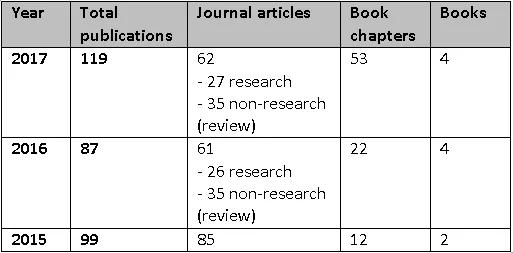
Image content: This image is available to view online.
View image online (https://assets.clevelandclinic.org/transform/4d124f9e-6ff1-4989-a99a-d12e6dfeba6c/graph_png)
Table: Number of publications by Cleveland Clinic nurses
Writing articles and books takes time — lots of it. Yet Cleveland Clinic nurses authored 119 publications in 2017 alone (see table). And 27 papers (involving Cleveland Clinic nurse principal and coauthors) were original research (see graph).
Advertisement
Besides relying on their own drive and perseverance, these nurses have benefited from organizational support. Cleveland Clinic offers nurse authors:
Time. “Just as for education and quality efforts, leaders make time for nurses to write up their work,” says Albert. “We have found it best to mentor nurses in writing in three- to four-hour blocks of time rather than multiple short increments of time. In many cases, nurses will come in before their shift or on their days off to keep their publishing projects moving forward.”
Mentors. Cleveland Clinic offers mentoring by experienced authors from its Office of Nursing Research and Innovation. Anyone can make a request for support.
Funding. Cleveland Clinic recently introduced a publishing grant to help nurses fund writing time that replaces or supplements their regular work hours.
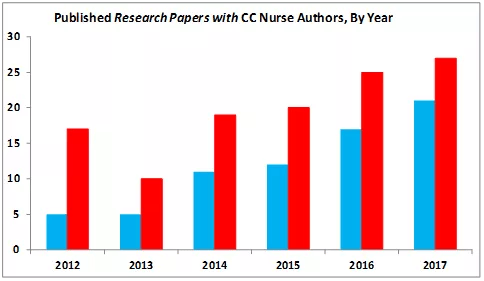
Image content: This image is available to view online.
View image online (https://assets.clevelandclinic.org/transform/0e1a6697-453c-4c05-8212-4911e90a1b21/pub-papers_png)
Graph: Blue = First authors; Red = Co-authors
Publishing benefits more than the nurse authors and their readers, contends Albert. Disseminating high quality knowledge advances the science of nursing practice and strengthens an entire nursing organization.
“Sharing knowledge through publishing helps nurses better understand the importance of constantly learning and growing in our profession,” Dr. Albert says.
Advertisement
Advertisement

Nurses play key role in comprehensive lifetime treatment program
Customized bots improve speed, efficiency by streamlining daily clinical, clerical tasks

Nurses play pivotal role in patients’ ability to recover in the comfort of their own homes
New protocol reduces costs, increases patient and caregiver satisfaction

Advocating for patient safety is imperative in fast-paced surgical settings

M-Power program improves the perinatal experience for people who have survived abuse

Advice for those pursuing a WOC nursing career

Veteran nurse shares his experience as a caregiver and community volunteer
 Search