Locations:





Bacteria may play a role in disease
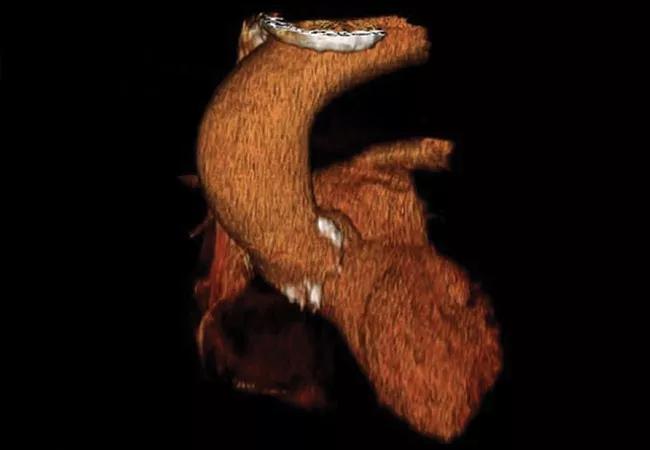
Image content: This image is available to view online.
View image online (https://assets.clevelandclinic.org/transform/aa0578f5-3881-4ecc-8e3d-efd620000b4a/18-HRT-5549-thoracicAortAneur-650x450_jpg)
18-HRT-5549-thoracicAortAneur-650×450
Noninfectious aortitis is usually result of primary systemic large-vessel vasculitis (LVV) such as giant cell arteritis (GCA) or Takayasu’s arteritis (TAK).
Advertisement
Cleveland Clinic is a non-profit academic medical center. Advertising on our site helps support our mission. We do not endorse non-Cleveland Clinic products or services. Policy
But inflammation of the aorta may also present as “clinically isolated aortitis” (CIA), a noninfectious vasculitis restricted to the proximal thoracic aorta. About 17 percent of patients with CIA develop feature of systemic disease, most often GCA.
Researchers do not yet know whether common conditions exist within CIA- and GCA-affected aortas that contribute to inflammatory aneurysms or how aortitis specimens compare with those from noninflammatory thoracic aortic aneurysms.
Recently, however, a group of investigators compared the microbial communities within the aortas of patients with CIA and GCA with microbial communities in noninflammatory aortic aneurysm controls. They also analyzed microbiomes of temporal arteries (TA) from a parallel study and compared with those from aortic aneurysms.
“Changes in the body’s microbiome might trigger inflammation that can then affect how genes express themselves,” says Alexandra Villa-Forte, MD, MPH, staff in the Department of Rheumatic and Immunologic Diseases, who presented the research at the International Vasculitis & ANCA Workshop 2019. “We know that microbes in our gut or elsewhere in the body may play a role in the development of a wide range of diseases such as inflammatory bowel disease, type 2 diabetes mellitus, obesity and cardiovascular disease. So it makes sense to look into their role in vasculitides.”
The authors obtained 220 aorta samples from prospectively enrolled patients undergoing thoracic aorta aneurysm surgery. They selected 49 patients based on the ability to match for age, gender and race (12 CIA, 14 GCA and 23 noninflammatory aneurysm controls).
Advertisement
The researchers collected biopsies under surgically aseptic conditions. Those samples were then snap frozen (-80 oC), deidentified and processed in a blinded fashion.
The investigators then performed taxonomic classification of bacterial sequences to the genus level and also calculated relative abundances. They used principal coordinate analysis (PCoA/DESeq2) to analyze microbiome differential abundances and used PICRUSt to predict functional profiling.
While microbial beta and alpha diversity differed between the aortitis cases and controls, no significant differences were noted between microbial communities in CIA and GCA.
Overall microbiomes of aortas differed significantly from those of TAs, in both control and GCA groups (P = 0.0002).
“Contrary to previous beliefs, we found that thoracic aortic aneurysms are not sterile,” says Charis Eng, MD, PhD, Chair of Cleveland Clinic’s Genomic Medicine Institute. “That is hopefully the first step in understanding whether microbes play a role in the pathogenesis of aortitis or noninflammatory aneurysms. We saw an important clue: that the microbiome of aortitis significantly differed from that of TA in GCA.”
Advertisement
Advertisement

Treatment strategies require understanding of pathomechanisms
Education, prevention strategies and monitoring serves this at-risk group
Treatment for scleroderma can sometimes cause esophageal symptoms

Lupus Clinic providers collaborate to advance treatment and understanding

Older Psoriasis Patients May Experience Quicker Transition
Cleveland Clinic’s Rheumatic Lung Disease program treats patients with complex conditions

Symptoms complement one another

E-coaching program is tailored for those with the disease
 Search