Locations:





Founders of our pediatric neurology program reflect on the past and future
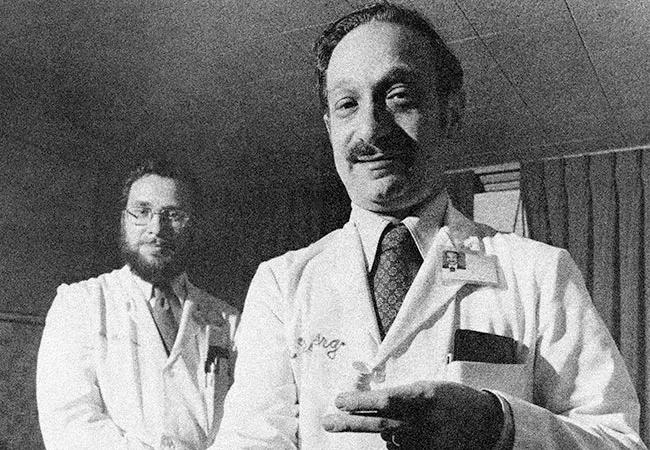
Image content: This image is available to view online.
View image online (https://assets.clevelandclinic.org/transform/3e3b3e5c-3b3f-4be3-8d7f-d9ae2ab3d32c/18-NEU-4988-Retouched-Rothner-Erenberg-Lifetime-Achievement_650x450_jpg)
18-NEU-4988-Retouched-Rothner-Erenberg-Lifetime-Achievement_650x450
This month, longtime Cleveland Clinic pediatric neurologist Gerald Erenberg, MD, received the 2018 Roger and Mary Brumback Memorial Lifetime Achievement Award from the Child Neurology Society (CNS) at the CNS annual meeting in Chicago. The prestigious award recognizes lifelong commitment to child neurology, patient care and humanism in medicine. Dr. Erenberg, who began practicing in 1971, specialized in neurodevelopment and neurobehavioral issues early in his career. Later, he developed an interest in Tourette syndrome, a disorder that became his sole focus at the end of his career. He practiced until 2014.
Advertisement
Cleveland Clinic is a non-profit academic medical center. Advertising on our site helps support our mission. We do not endorse non-Cleveland Clinic products or services. Policy
Dr. Erenberg is the second Cleveland Clinic pediatric neurologist to be honored with the lifetime achievement award from the CNS. A. David Rothner, MD, Chairman Emeritus of the Section of Child Neurology, received it in 2013. Dr. Rothner began his pediatric residency in 1965 and joined Cleveland Clinic in 1973 to help launch the health system’s child neurology program that year as one of the first in the nation. Early on, he specialized in epilepsy. Today, his specialties are headaches and neurofibromatosis.
Together, Drs. Rothner and Erenberg (shown above in the late 1970s, with Dr. Erenberg in the foreground) helped build Cleveland Clinic’s pediatric neurosciences program into a world leader. Consult QD caught up with them before the CNS annual meeting to discuss how their field has changed over their long careers.
Dr. Erenberg: For me, it’s the fact that Cleveland Clinic’s staff in child neurology has grown so much. Dr. Rothner and I were able to be the two fathers of what became a much larger department. I also take special pride in the role I played in the field of Tourette syndrome. When I first became interested in this in the 1970s, no one had heard about it. Now everybody has.
Dr. Rothner: Another achievement is the development of a pediatric neurology fellowship program at Cleveland Clinic. We’ve trained over 60 fellows who are child neurologists from Boston to Seattle and points in between. They are good human beings and good doctors.
Dr. Erenberg: The biggest change has been in the ability to make diagnoses, largely because of advances in genetics. This has loomed especially large in child neurology. Each year as we learn more about genetics, more children with a condition that previously couldn’t be diagnosed are being diagnosed with a genetic disorder. Now we have the ability to actually offer families the name of their child’s problem.
Advertisement
Dr. Rothner: Treatment has advanced enormously, too. In 1973, child neurology was looked upon as a specialty where you could make diagnoses but not be able to treat them. Now we’re going into the era of drugs created based on chemistry. You see what’s wrong with a patient based on his or her condition, and you can help develop medication to treat it. We are a specialty making more and more sophisticated diagnoses, and we are better able to treat them.
Dr. Erenberg: Without question, the most important advancement has been the ability to see inside the body. CT and MRI revolutionized the practice of all medicine, including neurology. And those tools have not yet reached their ultimate potential. They are constantly being improved so that not only do we see what the brain looks like, but we increasingly can actually see connections — which parts of the brain connect to each other, and which parts “light up” when you’re doing a task. We’re going to learn tremendous amounts about how the brain works from emerging imaging technologies.
Dr. Erenberg: To succeed these days, you need to subspecialize. Pick an area of child neurology where you want to develop special expertise, and get further training if necessary. You’ll find this rewarding in terms of your professional life but also for your financial future because you’ll be much more likely to get jobs. As the boomer generation retires, this is a good time to be entering the field. You will have your choice of jobs, but you’ll often be expected to have some special interest.
Advertisement
Dr. Rothner: I don’t think our program would have been so successful had we not been able to recruit Dr. Erenberg. He’s a tremendous human being and pediatric neurologist. And he’s extremely organized: I’d come up with a harebrained idea, and he’d refine it and put it into action — and it would work.
Dr. Erenberg: It’s been a good run. I would do it all again.
Advertisement
Advertisement

New study advances understanding of patient-defined goals
Testing options and therapies are expanding for this poorly understood sleep disorder
Real-world claims data and tissue culture studies set the stage for randomized clinical testing
Digital subtraction angiography remains central to assessment of ‘benign’ PMSAH

Cleveland Clinic neuromuscular specialist shares insights on AI in his field and beyond
Findings challenge dogma that microglia are exclusively destructive regardless of location in brain

Neurology is especially well positioned for opportunities to enhance clinical care and medical training
New review distills insights from studies over the past decade
 Search