Locations:





Caring for others and making a difference keeps nurses coming back
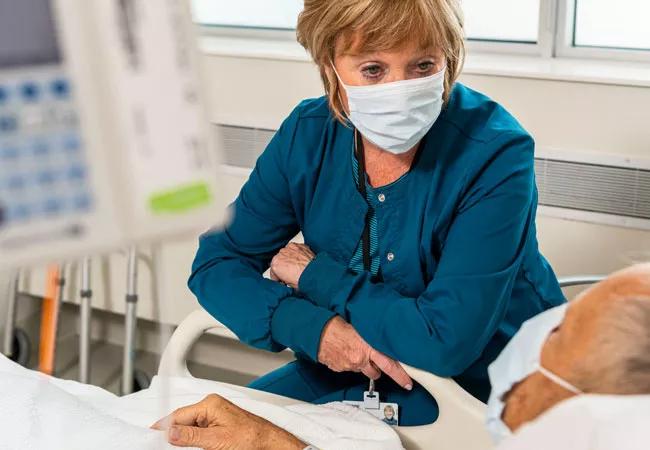
Image content: This image is available to view online.
View image online (https://assets.clevelandclinic.org/transform/711fc6d9-003c-48ad-9ea7-1f57125f52ed/21-NUR-2347056-The-Heart-of-Nursing_650x450_jpg)
The heart of nursing
Cleveland Clinic nurse Maria Higgins, BSN, RN, NE-BC, vividly recalls her first day working as an aide at a hospital as part of a high school career program. She was awestruck as she observed nurses performing their work with such competence and professionalism, and she wondered if she had what it took to be a nurse herself one day.
Advertisement
Cleveland Clinic is a non-profit academic medical center. Advertising on our site helps support our mission. We do not endorse non-Cleveland Clinic products or services. Policy
“It seemed like they did everything with ease, and I was just so unsure,” says Higgins.
On that first day, Higgins watched a nurse change a dressing on a pressure injury and got woozy. “I saw stars and had to take some deep breaths,” she says.
She was never deterred. Now a nursing operations manager (NOM) at Cleveland Clinic Lutheran Hospital, Higgins says that nothing — not even a global pandemic — has hindered her commitment to the calling. Despite some of the most demanding conditions in recent history, nursing remains a career that many regard as an expression of who they are. The work satisfies their yearning to care for others; their wish to use their technical, problem-solving and critical thinking skills; and their need to make a positive impact on the world.
“I feel like that desire to help comes from inside me,” says Jeanne O’Toole, MA, BS, RN. “It is a deep passion for caring.”
O’Toole retired seven years ago from full-time work as a nurse manager in surgical recovery at Cleveland Clinic Hillcrest Hospital. Nearly a year into the pandemic, in January 2021, she felt the urge to help patients and caregivers in whatever way she could. She returned to Hillcrest Hospital, where she works about 10 hours a week supporting patients by listening to their concerns, helping them understand medical conditions and care plans, and communicating with their families. One of the most satisfying aspects of the work, O’Toole says, is helping older adult patients who may be confused about why they’re in the hospital.
Advertisement
“When you empathize with someone, it really improves their health,” she says. “They feel they’ve been understood.”
Like many nurses, O’Toole says she considers the work more a calling than a job. “You need a deep respect for people,” she says. “I don’t know how you do it without that.”
Jennifer Spurlin, MSN, RN, NE-BC, describes her passion for nursing in similar terms.
“I’ve always wanted to be a nurse, ever since I was young,” says Spurlin. “I started at the age of 17 as a nurse’s aide in an assisted living home. Most of the patients had Alzheimer’s disease. I would go there after school and make them dinner, sit and talk with them, and get them ready for bed. That was so enjoyable, just sparking up a conversation and listening to what they could remember or what they thought the future would be like.”
Like Higgins, Spurlin is a NOM at Lutheran Hospital, a position that brings with it the satisfaction of supporting fellow caregivers in meeting patients’ needs. “I absolutely love working in a hospital setting,” she says.
As NOMs, Spurlin and Higgins have experienced the pressures the pandemic has placed on nursing. In the beginning, as researchers worked to better understand the virus, care management policies and procedures evolved and could be a source of frustration for nurses trying to deliver best care. Over the course of the pandemic, the focus shifted to meeting the challenges of a shrinking pool of caregivers as some retired, became sick themselves or left to tend to the needs of family members. But Spurlin embraces the challenge of creative problem solving.
Advertisement
“Thinking outside the box and considering the bigger picture is just what we do,” she says. “That’s why we do what we do.”
Higgins agrees. Several years before the outbreak of COVID-19, she and Spurlin were among a group of Cleveland Clinic caregivers who attended a disaster preparedness training course presented by the Federal Emergency Management Agency. Participants discussed the potential emergence of a superbug and what it would mean for healthcare delivery. People from all over the United States discussed a crisis stemming from a communicable virus, and they role-played for an entire week, Higgins says.
“Having that experience and education gave me a better perspective when COVID-19 came along, and in turn I was able to better serve our nurses,” she says. In spite of the difficulties of the pandemic, Higgins regards this as a good time to be a nurse. As always, she says, there are ups and downs. “There have been moments when I’ve had to find strength and inner peace to keep going because we know that we are doing this for the greater good, to take care of our patients,” she says. Spurlin hopes that young nurses just starting out continue to feed their own passion for nursing work even if the current situation seems difficult. “Yes, these are challenging times, but everything fluctuates,” she says. “Healthcare is ever evolving. It changes rapidly.”
A group of float nurses Higgins manages includes seven nursing students, with whom the conversation often turns to successfully pushing through the challenges presented by the pandemic. She leads with her positivity. Higgins says her focus is on professional development. She tells the students, “Every time there’s a challenge, you learn and grow from it, and it makes you a stronger nurse. Five years from now, you’re going to be able to do other amazing things because you went through a challenging time right now.”
Advertisement
Advertisement
Nurses play key role in comprehensive lifetime treatment program
Customized bots improve speed, efficiency by streamlining daily clinical, clerical tasks
Nurses play pivotal role in patients’ ability to recover in the comfort of their own homes
New protocol reduces costs, increases patient and caregiver satisfaction
Advocating for patient safety is imperative in fast-paced surgical settings
M-Power program improves the perinatal experience for people who have survived abuse

Advice for those pursuing a WOC nursing career

Veteran nurse shares his experience as a caregiver and community volunteer
 Search