Locations:





Patient and environmental factors can influence learning
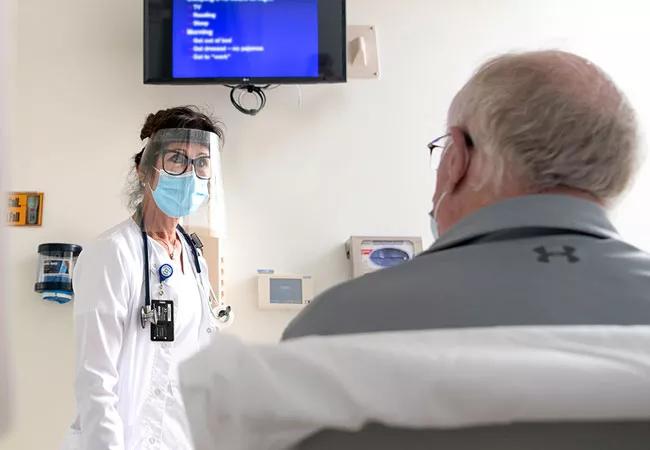
Image content: This image is available to view online.
View image online (https://assets.clevelandclinic.org/transform/eff42a06-01c7-48e9-b540-59524a31ef10/21-NRR-2412514-Patient-Education-CQD_650x450_jpg)
Patient education
Educating hospitalized patients about self-care has profound implications for their long-term ability to manage chronic conditions, and a variety of factors can influence how well they incorporate new knowledge into their lives. Jacqueline Nowlin, DNP, MBA, RN, NEA-BC, Chief Nursing Officer of Cleveland Clinic South Pointe Hospital, studied the effects of distractions on patients’ learning process, as internal and external distractions can influence attentiveness when viewing educational videos.
“Patient education is such a critical part of what we do as nurses,” says Dr. Nowlin. “We can help patients on their journey to wellness and help them to understand self-care expectations and to manage their chronic conditions.”
Advertisement
Cleveland Clinic is a non-profit academic medical center. Advertising on our site helps support our mission. We do not endorse non-Cleveland Clinic products or services. Policy
When serving as a nursing director at Cleveland Clinic Avon Hospital at Richard E. Jacobs Campus, Dr. Nowlin completed a research study to determine the level of distraction patients with decompensated heart failure experienced when viewing educational videos. Optimization of patient learning may be based on how attentive patients are during the education process. This study assessed the frequency and type of internal and external distractions that patients experienced when viewing video education in a hospital setting. Attentiveness was evaluated by determining the change in self-care behavior knowledge scores from before and after video education.
“There are so many things going on in a hospital setting, yet we are trying to provide patients with important information,” says Dr. Nowlin. “I wondered how internal and external distractions impacted a patient’s ability to retain information soon after the educational process was completed.”
External distractions included medical equipment alarms, hallway conversations, environmental lights or noises (thunder, lightning, the sounds of cart wheels, overhead codes), and more. Internal distractions included patient pain, fatigue, nausea and shortness of breath.
In total, 60 patients participated during their stay at a community hospital. Before and after viewing a 13-minute video on heart failure self-care skills on smart TVs in their hospital rooms, they completed a 20-item assessment tool on heart failure self-care behavior knowledge. The knowledge tool was created years before the video was developed; thus, the video education and knowledge tool’s themes did not match perfectly.
Advertisement
Dr. Nowlin and Beverly Will, MSN, ACCNS-AG, a clinical nurse specialist at Avon Hospital, observed patients while they watched the video and recorded the types and frequency of distractions.
Among patients who were enrolled, heart failure self-care knowledge scores improved from the pre-video to the post-video assessment, which indicated that patients were attentive when viewing the educational video. Although selfcare behavior knowledge scores were not associated with distraction frequency, researchers learned that (1) non-fatigue-related internal distractions were associated with lower pre-video self-care knowledge scores, and (2) external distractions in the form of non-nursing healthcare professionals entering the patient’s room during video viewing tended to be associated with lower post-video self-care knowledge scores.
Dr. Nowlin says that additional studies are warranted because the population was treated at a small community nonteaching hospital with private rooms and less noise and other distractions.
Despite the limitations, she notes some key takeaways.
“When nurses provide video education, we need to be aware of the surroundings, the patient’s condition and the timing of the education. Did the patient empty their bladder prior to watching the video? Did they take a medication that might make them tired?” says Dr. Nowlin. “In addition, we can modify the environment to minimize external distractions. For example, we can place a sign on the patient’s door that lets others know that video education is in progress and that distractions are discouraged. We need to make sure we are promoting a quiet, restful environment conducive to learning.”
Advertisement
Advertisement

Nurses play key role in comprehensive lifetime treatment program
Customized bots improve speed, efficiency by streamlining daily clinical, clerical tasks

Nurses play pivotal role in patients’ ability to recover in the comfort of their own homes

New protocol reduces costs, increases patient and caregiver satisfaction

Advocating for patient safety is imperative in fast-paced surgical settings

M-Power program improves the perinatal experience for people who have survived abuse

Advice for those pursuing a WOC nursing career

Veteran nurse shares his experience as a caregiver and community volunteer
 Search