Locations:





Why this new alternative is gaining ground
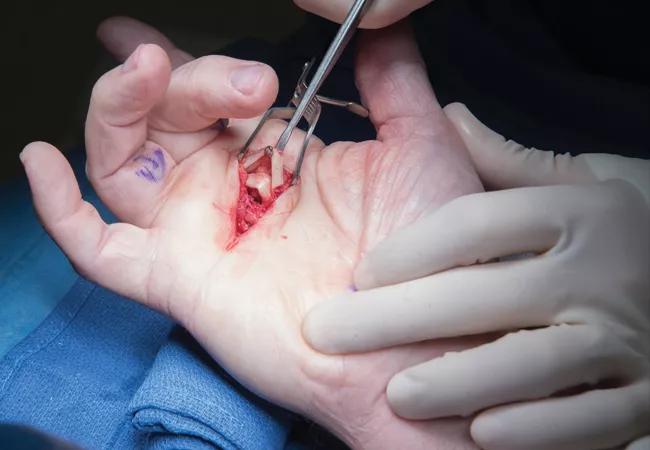
Image content: This image is available to view online.
View image online (https://assets.clevelandclinic.org/transform/98629933-d3c3-4e56-994f-1f7e50c474d7/18-ORT-1985-Seitz-Hero-Image-650x450pxl_jpg)
18-ORT-1985-Seitz-Hero-Image-650x450pxl
Advertisement
Cleveland Clinic is a non-profit academic medical center. Advertising on our site helps support our mission. We do not endorse non-Cleveland Clinic products or services. Policy
The common and universally accepted practice of hand surgery consists of applying a forearm or arm tourniquet to allow for a bloodless surgical field. The operative site is often injected with local anesthetic and sedation is needed to offset the pain generated by the applied tourniquet. Recently, Donald Lalonde, MD, and others have championed the idea of injecting lidocaine with epinephrine as an alternative to a tourniquet and sedation. This is known as the WALANT (wide awake local anesthesia no tourniquet) technique.
WALANT can be applied during both routine and, with experience, complex procedures in the upper limb. Surgical cases can be accomplished in the office setting when appropriate and patients can actively participate in the procedure when needed (especially helpful during tendon repairs and transfers). Monitoring the patient is not indicated and eliminating operating room and anesthesia costs significantly diminishes the overall cost of care. Patients may leave immediately after the surgical procedure, without the negative side effects and inconveniences of sedation.
WALANT is performed by injecting 1 percent lidocaine with 1:100,000 epinephrine into the planned area of incision and surgical dissection. Often, 8.4 percent bicarbonate is added to diminish the discomfort of the injection. Bupivicaine and ropivicaine are avoided, given their higher potential for cardiotoxicity. For shorter cases, it is recommended that two or three patients be injected prior to taking the first patient in for surgery to allow time for the epinephrine to reach maximal vasoconstriction (26 minutes on average). One percent lidocaine with 1:100,000 epinephrine provides up to four hours of local anesthesia and vasoconstriction.
Advertisement
The safety of local epinephrine injections into the hand has been debated for decades but is now proven to be safe. Thousands of fingers have been injected with the above agents without digital necrosis or other concerns. A secondary layer of protection is phentolamine rescue for digits that remain white. However, the reported incidents of needing phentolamine rescue are essentially zero. Regarding safe dosing of lidocaine with epinephrine, it is recommended to follow the 7 mg/kg maximum. This allows for safely injecting 50 cc of 1 percent lidocaine with 1:100,000 epinephrine into the average 70 kg patient.
Learning to incorporate WALANT into your own surgical practice should occur in a stepwise fashion. Trigger finger release is the most common initial procedure to learn the technique and gain confidence in using epinephrine in the digits. Initially, these cases can be performed in the operating room setting with the fallback of anesthesia and tourniquet use. As confidence builds, other common procedures can be attempted; e.g., carpal tunnel release or de Quervains, with eventual application into office-based procedural rooms.
Flexor tendon repair is the procedure that achieves the most clinical benefit from application of WALANT.
Patients can actively flex the digit immediately following repair. This allows surgeons to scrutinize the repair site for gapping. It also provides an opportunity to evaluate the bulk of the repair and any “hanging up” on the remaining digital pulleys. Plus, the patient’s having direct visualization of their digit flexing and extending improves the recovery process.
Advertisement
Evaluating the repair and correcting any deficiencies prior to closure is a game changer in hand surgery.
WALANT is a technique I have slowly begun to incorporate into my own surgical practice. I look forward to expanding our use of WALANT to take advantage of the convenience, cost savings, and improved outcomes for tendon repairs and transfers. I also anticipate WALANT being incorporated into bundled care plans for common hand and wrist procedures. I owe a debt of gratitude to Dr. Donald Lalonde for being a great educator and promoter of WALANT; much of this article derives from his lectures and papers on the subject.
Dr. Maschke is an orthopaedic surgeon whose special interests are hand, wrist, elbow and peripheral nerve surgeries.
Advertisement
Advertisement
Biologic approaches, growing implants and more

Study reports zero infections in nearly 300 patients
How to diagnose and treat crystalline arthropathy after knee replacement
Study finds that fracture and infection are rare
Center will coordinate, interpret and archive imaging data for all multicenter trials conducted by the foundation’s Osteoarthritis Clinical Trial Network

Reduced narcotic use is the latest on the list of robotic surgery advantages
Cleveland Clinic specialists offer annual refresher on upper extremity fundamentals
Cleveland Clinic orthopaedic surgeons share their best tips, most challenging cases and biggest misperceptions
 Search