Locations:





Data points from Cleveland Clinic’s 5,646 visits over four years

Image content: This image is available to view online.
View image online (https://assets.clevelandclinic.org/transform/cfe39d25-c55f-4419-b893-833cc02bcc88/19-NEU-218-teleneurology-650x450_jpg)
19-NEU-218-teleneurology-650×450
1.4 million miles. That’s the amount of travel projected to have been avoided by 3,958 patients across 5,646 virtual visits during the first four years of outpatient subspecialty teleneurology offerings by Cleveland Clinic’s Neurological Institute.
Advertisement
Cleveland Clinic is a non-profit academic medical center. Advertising on our site helps support our mission. We do not endorse non-Cleveland Clinic products or services. Policy
The figure comes from a May 6 plenary presentation at the American Academy of Neurology’s 2019 annual meeting by Cleveland Clinic neurologist Marisa McGinley, DO. Key data from the presentation are captured in the graphic below.
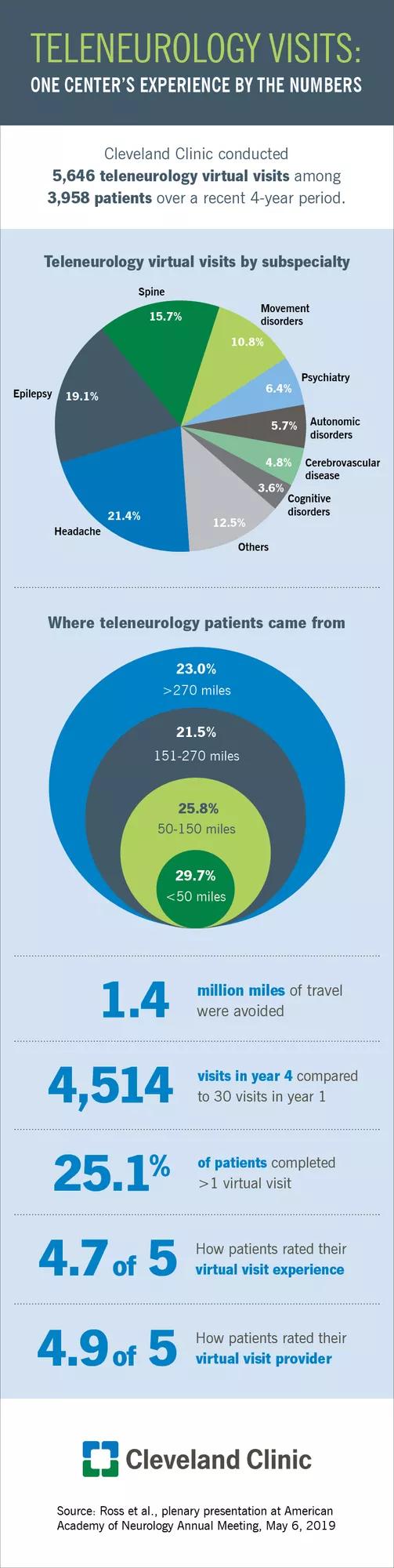
Image content: This image is available to view online.
View image online (https://assets.clevelandclinic.org/transform/c471ab85-3d43-4fb2-8641-4f7ce9126771/19-NEU-218-Teleneurology-Study-Results_jpg)
“Teleneurology has been well described in the setting of acute stroke care, but its use in outpatient care has been limited,” says Dr. McGinley. “At-home virtual visits have the potential to enhance patient access to subspecialized neurological care. We’ve recognized this for several years at Cleveland Clinic, which has allowed us to present data and observations from our experience with outpatient subspecialty teleneurology services over a four-year period, which is the largest experience reported to date. Our findings support the feasibility of implementing such services and the high patient satisfaction levels that can result.”
More than a quarter of patients completed more than one virtual visit, and patients rated their virtual visit experience 4.7 out of 5 stars. They rated their virtual visit provider even better at 4.9 out of 5 stars. Around 20 percent of the visits were for headache, another 20 percent were for epilepsy, around 16 percent for spine and 11 percent for movement disorders. Other subspecialties included psychiatry, autonomic disorders, cerebrovascular disease and cognitive disorders. Almost a quarter of patients live a distance of over 270 miles away from Cleveland Clinic.
Dr. McGinley says her group’s next research steps include a closer focus on the value of teleneurology virtual visits to patients and the healthcare system.
Advertisement
Advertisement

New study advances understanding of patient-defined goals
Testing options and therapies are expanding for this poorly understood sleep disorder
Real-world claims data and tissue culture studies set the stage for randomized clinical testing
Digital subtraction angiography remains central to assessment of ‘benign’ PMSAH

Cleveland Clinic neuromuscular specialist shares insights on AI in his field and beyond

Findings challenge dogma that microglia are exclusively destructive regardless of location in brain

Neurology is especially well positioned for opportunities to enhance clinical care and medical training
New review distills insights from studies over the past decade
 Search