Locations:





Study signals potential for enhanced patient monitoring
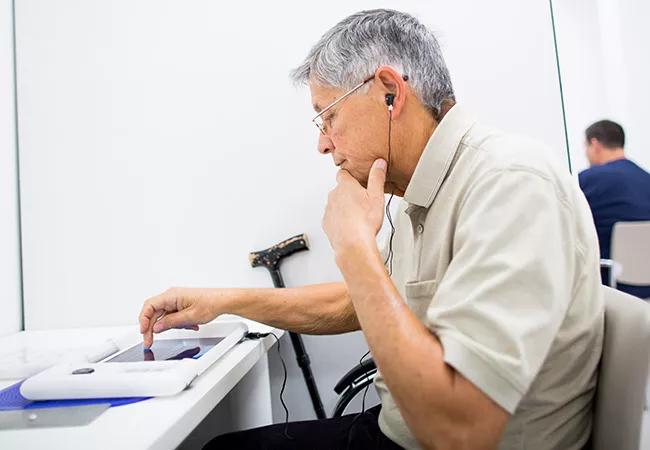
Image content: This image is available to view online.
View image online (https://assets.clevelandclinic.org/transform/0f10604a-b667-4103-afde-d917421904c3/19-NEU-181-MS-Ipad-Test_jpg)
19-NEU-181-MS-Ipad-Test
Comprehensive assessment of patients with multiple sclerosis (MS) using technology-enabled neuroperformance testing is feasible in routine practice and correlates with quantitative MRI metrics and physical disability-related patient-reported outcomes. So reported Cleveland Clinic researchers in a platform presentation March 1 at the ACTRIMS Forum 2019 in Dallas.
Advertisement
Cleveland Clinic is a non-profit academic medical center. Advertising on our site helps support our mission. We do not endorse non-Cleveland Clinic products or services. Policy
“Patients with MS are affected in such a wide range of functional domains that we need to be highly comprehensive in our assessments, which often isn’t feasible in clinical practice because comprehensive assessment is time-consuming,” observes the presentation’s senior author, Marisa McGinley, DO, of Cleveland Clinic’s Mellen Center for Multiple Sclerosis Treatment and Research. “We have shown that administering neuroperformance tests using a suite of iPad® apps at every outpatient visit is achievable and promises real value in informing clinical practice.”
The presentation featured findings from a large cohort study conducted at Cleveland Clinic using the Multiple Sclerosis Performance Test (MSPT), a suite of iPad apps designed to efficiently collect patient-reported outcomes (PROs) and results on quantitative neuroperformance tests. The neuroperformance tests are modeled after the Multiple Sclerosis Functional Composite-4, with measures of the following:
The PROs captured are from the Quality of Life in Neurological Disorders (Neuro-QoL), Patient-Reported Outcomes Measurement Information System (PROMIS) and Patient Determined Disease Steps (PDDS) instruments.
“The MSPT is a Cleveland Clinic-developed tool designed for patient self-administration or administration with minimal supervision at all outpatient visits in our MS clinic,” explains Dr. McGinley. Data are scored instantaneously and transferred wirelessly into the electronic medical record, to inform care at the patient’s current visit, and (in de-identified form) into a research database.
Advertisement
The tool has been used routinely for MS care at Cleveland Clinic since 2015 and has been adopted by several additional U.S. and European centers as part of the multicenter MS PATHS collaboration for MS care and research.
The present study aimed to analyze associations between neuroperformance test measures and PROs collected via the MSPT and quantitative MRI metrics among 976 patients who completed the MSPT between December 2015 and December 2017 as part of routine clinical care.
Brain MRIs were obtained within three months of each patient’s completion of the MSPT and analyzed through a fully automated method to calculate the following:
Spearman correlations and linear regression models were used to correlate neuroperformance components of the MSPT with PROs and MRI metrics, with significance levels set at P < .001.
Key findings included the following:
“These findings suggest that comprehensive quantitative assessment of patients with MS may enable better detection of disease worsening and determination of response to treatment,” Dr. McGinley observes. “The regression models illustrated how much the various assessment components — MRI, physical performance and patient-reported outcomes — all factor into the ability to understand what’s going on with a patient and perhaps predict what to expect — and how best to respond.”
Advertisement
She adds that because PROs have not routinely been used in clinical practice, “these findings are noteworthy in highlighting how strong the correlations were between neuroperformance measures and patient-reported outcomes.”
The study’s demonstration of the feasibility of data collection for such comprehensive assessment in “an all-comers clinical cohort” is another notable contribution, she says.
The researchers have now amassed one to two years of MSPT data for many patients, so their next step is a longitudinal study to look at correlations — and outcomes — over several years.
“We aim to identify patients with clinical changes over time and evaluate how those changes correlate with changes in PROs, neuroperformance test measures and quantitative MRI metrics overs time,” Dr. McGinley explains. “We can also begin to get a better indication of what clinically meaningful changes in these various metrics may be, with the ultimate aim of better-informed clinical practice.”
She concludes: “The fact that we saw such strong correlations in just these cross-sectional data has made us eager to complete longitudinal studies.”
Advertisement
Advertisement

New study advances understanding of patient-defined goals
Testing options and therapies are expanding for this poorly understood sleep disorder
Real-world claims data and tissue culture studies set the stage for randomized clinical testing
Digital subtraction angiography remains central to assessment of ‘benign’ PMSAH

Cleveland Clinic neuromuscular specialist shares insights on AI in his field and beyond

Findings challenge dogma that microglia are exclusively destructive regardless of location in brain

Neurology is especially well positioned for opportunities to enhance clinical care and medical training

New review distills insights from studies over the past decade
 Search