Locations:





Minority Stroke Program focuses on outreach to racial and ethnic minority communities
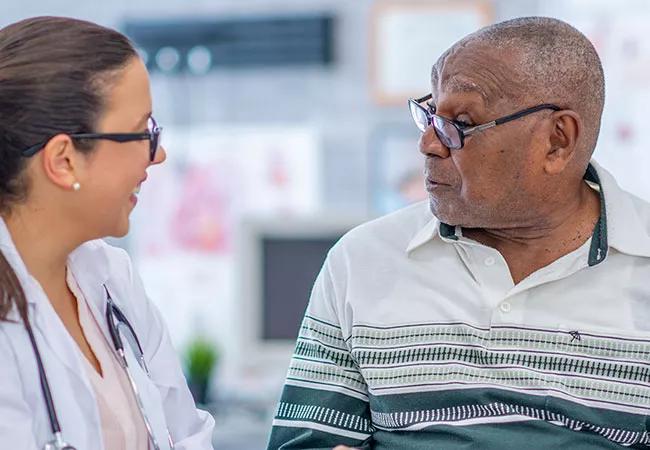
Image content: This image is available to view online.
View image online (https://assets.clevelandclinic.org/transform/0168ab7c-27eb-4deb-93cf-e22d407cbc8c/minority-stroke-program-650x450-1_jpg)
minority-stroke-program-650×450
This month marks the first anniversary of Cleveland Clinic’s Minority Stroke Program, which focuses on preventing and treating stroke in racial and ethnic minorities. The program is spearheaded by Gwendolyn Lynch, MD, a vascular neurologist and neuro-intensivist in Cleveland Clinic’s Cerebrovascular Center.
Advertisement
Cleveland Clinic is a non-profit academic medical center. Advertising on our site helps support our mission. We do not endorse non-Cleveland Clinic products or services. Policy
“I have a strong interest in reaching out to minority communities because I know the rate of initial and recurrent stroke and related complications is much higher in minority populations,” she says. “The risk of stroke in minorities can be up to 2.5 times higher than that in the general population.”
Dr. Lynch designed the Minority Stroke Program in conjunction with Charles Modlin, MD, MBA, Director of the Minority Men’s Health Center, and M. Shazam Hussain, MD, Director of the Cerebrovascular Center. Located on Cleveland Clinic’s main campus, the program is offered as needed.
The Minority Stroke Program is staffed by four physicians who have received fellowship training in stroke and are board-certified stroke professionals. “A unique aspect of the program is that we have physicians who are trained to address the higher rates of stroke in minority populations and the associated risk factors,” says Dr. Lynch. “Unfortunately, it’s not a popular area of expertise, and education goes a long way.”
Most of the program’s patients have already had a stroke, though the physicians also consult with people who are at risk for stroke. While the overall components of a Minority Stroke Program appointment resemble those offered to all patients, they are tailored to minorities. Appointments focus on the following:
Advertisement
Image content: This image is available to view online.
View image online (https://assets.clevelandclinic.org/transform/bb9e4403-d7e9-413a-bb3a-8bc9f46669c5/BE-FAST-from-ccf-website-780x1024_jpg)
“Our goal is to optimize care for these patients, provide education and work with patients and their families to spread the message to their community so we can broaden stroke awareness,” Dr. Lynch explains.
This last goal — community awareness — is paramount to the Minority Stroke Program. The program employs a community liaison who reaches out to a variety of groups, from elementary schools to senior citizen centers. Recently, Cleveland Clinic’s neurology residents were also trained in cultural sensitivity/competency and to participate in community outreach.
Dr. Lynch says there are a small number of stroke programs aimed specifically at minorities across the country. She offers a few pointers for neurology peers considering creating a similar program.
First, find a mentor or coach to help guide you in setting up the program. “Dr. Modlin was very helpful in that regard, given his experience with Cleveland Clinic’s Minority Men’s Health Center,” Dr. Lynch notes.
Second, pinpoint groups within your healthcare system who can help identify potential patients. “We reach out to minority patients through the inpatient stroke service and the neurointensive care service, our stroke clinic and the general neurology patient population, as well as other community resources and connections Cleveland Clinic has established over the years,” she says.
Third, identify key stakeholders in the community who will “recognize the program’s value and give it a seal of approval.” Dr. Lynch notes that the Minority Stroke Program held a Health Disparities 2020 Conference in January, attended by more than 70 healthcare professionals. At the conference, program leaders established a relationship with Cleveland Clinic’s Stephanie Tubbs Jones Health Center, which provides preventive care and chronic disease treatment to patients in East Cleveland, many of whom are minorities. Dr. Lynch hopes to launch a stroke clinic at this health center and other Cleveland Clinic facilities.
Advertisement
Finally, have a sizeable group of providers offering care. “No person is an island,” she says. “I’m grateful we have a dedicated group of stroke specialists and house staff who are trained and interested in doing this work.”
Ultimately, it’s all about “the work,” Dr. Lynch emphasizes: “If we are able to increase the awareness of our patients, and the minority community about stroke prevention and risk factors, we believe we can make a huge dent in lowering rates of both first-time and recurrent stroke and thereby save and improve lives.”
Patients and providers in Northeast Ohio interested in more information about the Minority Stroke Program can call 216.636.5860.
Advertisement
Advertisement

New study advances understanding of patient-defined goals
Testing options and therapies are expanding for this poorly understood sleep disorder
Real-world claims data and tissue culture studies set the stage for randomized clinical testing
Digital subtraction angiography remains central to assessment of ‘benign’ PMSAH

Cleveland Clinic neuromuscular specialist shares insights on AI in his field and beyond
Findings challenge dogma that microglia are exclusively destructive regardless of location in brain

Neurology is especially well positioned for opportunities to enhance clinical care and medical training

New review distills insights from studies over the past decade
 Search