Locations:





Perceval IDE trial establishes a broader role in aortic stenosis care
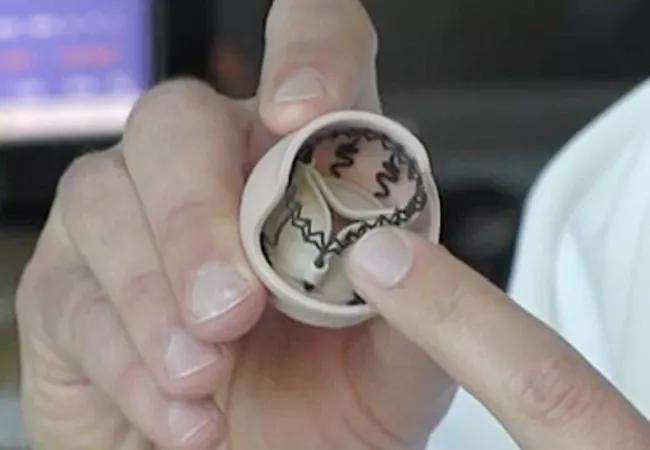
Image content: This image is available to view online.
View image online (https://assets.clevelandclinic.org/transform/bf84391c-0f9a-416c-a937-227aa9adda9f/16-HRT-412-PercevalValve-CQD-650x450_jpg)
Perceval Valve
Lower-than-predicted stroke and mortality rates and an excellent effectiveness profile at one year support the growing use of the first sutureless, self-expanding aortic bioprosthesis available in the U.S. for patients with aortic stenosis. So reported investigators with the multicenter Perceval IDE trial in a late-breaking presentation at the American Association for Thoracic Surgery (AATS) meeting in Boston on May 2.
Advertisement
Cleveland Clinic is a non-profit academic medical center. Advertising on our site helps support our mission. We do not endorse non-Cleveland Clinic products or services. Policy
“We were impressed at how easy the sutureless valve was to implant, and how safe and effective it was,” says Rakesh Suri, MD, DPhil, Chair of Thoracic and Cardiovascular Surgery and Chief of Staff at Cleveland Clinic Abu Dhabi, who is also on staff in the Department of Thoracic and Cardiovascular Surgery at Cleveland Clinic’s main campus in Ohio and Professor of Surgery at Cleveland Clinic Lerner College of Medicine.
Dr. Suri was principal investigator of Perceval IDE, the world’s first prospective study of the Perceval sutureless aortic valve in patients at low surgical risk. Prior studies had been conducted on high-risk patients, with good outcomes.
As a bovine pericardial sutureless device, the Perceval valve was designed to shorten operative time — and thus the time that the heart must be stopped. While it is approved in Europe for a high-risk population, the FDA approved the Perceval valve in January 2016 for U.S. patients with aortic stenosis requiring aortic valve replacement (AVR) without mandating a specific population.
Dr. Suri and colleagues presciently seized the opportunity a decade in advance. “We designed this trial 10 years ago, when we imagined what the need would be after a sutureless valve was approved,” he explains. “We saw a potential market in patients who do not want or need their valve replaced through an open-chest procedure.”
The trial was a prospective, single-arm investigation approved under an FDA investigational device exemption to assess the safety and efficacy of the Perceval valve in low-risk patients with severe aortic stenosis requiring AVR.
Advertisement
A total of 300 patients underwent attempted Perceval valve implantation for AVR at 18 U.S. centers between June 2013 and January 2015. Mean age was 76.1 (± 10) years, and median Society of Thoracic Surgeons predicted mortality risk was 2.7 percent.
Among the 289 patients who had successful Perceval implantation, 5.9 percent had a bicuspid aortic valve and 1.7 percent had undergone previous AVR.
Patients were evaluated clinically and via transthoracic echocardiography at discharge/30 days, at three to six months, and at 12 months. Primary end points were safety (mortality and morbidity) and effectiveness (defined by clinical status and hemodynamic improvement) at 12 months.
AVR was performed minimally invasively in 27.3 percent of patients and with a concomitant cardiac procedure in 37.0 percent. Outcomes included the following:
New permanent pacemaker implantation was performed in 30 patients (11.1 percent) within 30 days of sutureless valve placement, among whom only 7 patients (2.8 percent) had third-degree heart block. “While this pacemaker rate was slightly higher than expected initially, we are reassured by a trend suggesting declining incidence of pacemaker need as implanter experience increases,” Dr. Suri says.
Advertisement
Now that the Perceval valve has been shown to be safe and effective in low-risk patients, Dr. Suri envisions a host of potential applications for this sutureless prosthesis.
“Low-risk patients are a population for whom the valve is ideally suited,” he says. “This valve is analogous to the gold-standard sutured device, so it’s excellent for patients who would be reliant on a more traditional prosthesis for long-term symptom relief. This includes younger patients and those with bicuspid valves, which usually develop stenosis early.”
He says other potential candidates include the very elderly and patients with a calcified aorta, since the valve may be collapsed and slipped through the ribs with a mini-thoracotomy.
Patients at medium and high surgical risk requiring concomitant procedures may also benefit. “We suspect that using a sutureless valve shortens the time spent on cardiopulmonary bypass and improves outcomes for these patients,” Dr. Suri notes, “although the reduction in clamp time has yet to be objectively confirmed in a rigorous randomized trial.”
With safety and efficacy issues in high- and low-risk populations addressed, and the Perceval valve already widely adopted in the U.S. and Europe, Dr. Suri is not planning additional clinical trials of the prosthesis.
Nevertheless, he looks forward to results of the large PERSIST trial. This prospective, 60-center international study is randomizing at least 1,200 patients to the Perceval valve or to a standard stented biological aortic valve. Dr. Suri’s colleague, Eric Roselli, MD, is overseeing Cleveland Clinic’s participation in the trial. While PERSIST will not be completed until 2023, primary outcome results — freedom from major adverse cardiac and cerebrovascular events one year after AVR — are expected in early 2019.
Advertisement
Advertisement

A sampling of outcome and volume data from our Heart & Vascular Institute
Concomitant AF ablation and LAA occlusion strongly endorsed during elective heart surgery
Large retrospective study supports its addition to BAV repair toolbox at expert centers
Young age, solid tumor, high uptake on PET and KRAS mutation signal risk, suggest need for lobectomy
Surprise findings argue for caution about testosterone use in men at risk for fracture
Residual AR related to severe preoperative AR increases risk of progression, need for reoperation

Findings support emphasis on markers of frailty related to, but not dependent on, age
Provides option for patients previously deemed anatomically unsuitable
 Search