Locations:





Nurse researcher leads charge to improve transfers
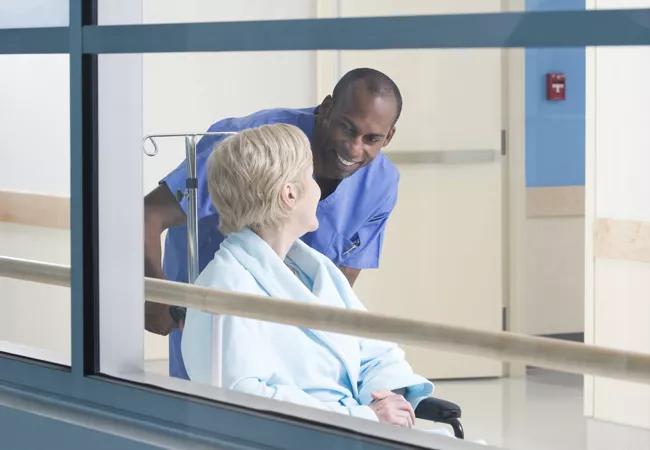
Image content: This image is available to view online.
View image online (https://assets.clevelandclinic.org/transform/ef14bf29-cef2-42e5-bc9e-b58fab4919c6/transport_650x450_jpg)
transport_650x450
“Hospital occupancy has been in the mid to high 60 percent range for the last 25 years,” says Mark McClelland, DNP, RN, CPHQ, a nurse scientist in Cleveland Clinic’s Office of Nursing Research and Innovation. “Despite a moderate occupancy rate, crowded conditions affect patient flow and efficiency.” Crowding and chronic delays in moving patients can lead to poor quality pain care, delays in medication delivery and testing, more medication and medical errors and complications, and higher mortality. (Horwitz et al. Ann Emerg Med. 2009;53:701-710 and Bernstein SL, et al. Acad Emerg Med. 2009;16:1-10)
Advertisement
Cleveland Clinic is a non-profit academic medical center. Advertising on our site helps support our mission. We do not endorse non-Cleveland Clinic products or services. Policy
In 2010, Dr. McClelland and colleagues began development of a survey to enable stakeholders to assess and influence attitudes, values, beliefs and practices about patient transitions and improve patient flow. Among those supporting the research were Nancy M. Albert, PhD, CCNS, CHFN, CCRN, NE-BC, FAHA, FCCM, FAAN, Associate Chief Nursing Officer for the Office of Nursing Research and Innovation at Cleveland Clinic, and Jesse M. Pines, Director of the Office for Clinical Practice Innovation and a Professor of Emergency Medicine in the George Washington (GW) University School of Medicine and Health Sciences.
The research team realized that a study of transitions – the transfer of patients between locations within a hospital – required an examination of the hospital’s culture. “Units are largely interconnected, therefore ineffective and inefficient transitions create ripple effects throughout the entire hospital,” says Dr. McClelland. “There’s a growing regulatory focus in care and patient flow by both The Joint Commission and the Centers for Medicare & Medicaid Services.”
Dr. McClelland adds that an important component to patient safety is identifying and eliminating hospital silos and creating an overall “teamness” among the entire facility staff. But first, you must understand the hospital culture – a hospital’s shared assumptions about how it operates and solves problems.
A methodical approach was used to create their Hospital Culture of Transitions Survey. First, a 10-member multidisciplinary technical expert panel developed survey content. The panel pondered this question: What attitudes, customs, values, beliefs and shared practices would facilitate or hinder high-quality transitions in care?
Advertisement
During an all-day meeting, the panel narrowed down and grouped factors related to transition into eight primary categories:
Next, survey statements were created based on categories. For example, one statement related to workload was, “The level of my workload prevents me from completing effective and timely patient transitions in care to other units.” Respondents used a Likert-type scale to indicate their level of agreement or disagreement.
Then, 28 multidisciplinary healthcare clinicians participated in a Delphi panel to clarify and improve survey statements. Their input helped to refine the survey and to discard statements that were unclear or unimportant. The revised survey was reviewed by 12 staff of a mid-size hospital for timing, flow, user friendliness and appropriateness of the response categories.
As a final step to ensure the survey was sound, the research team sent it to 13 hospitals across the United States and received back 492 usable surveys. Factor analysis – a method for describing variability among observed, correlated variables – was used to ensure that the survey was both reliable (would yield the same result over and over again) and valid (accurately reflected the concept of hospital culture related to patient flow or transitions).
The final result was the creation of the current, 23-item survey.
“The Hospital Culture of Transitions Survey is a psychometrically sound and practical instrument for assessing culture related to patient flow,” says Dr. McClelland. “It assesses patient flow at the unit and hospital level and can provide new knowledge to hospital leaders and clinicians about staff attitudes, beliefs, customs, values and shared practices related to patient flow.” He adds that the instrument results may prompt interventions that enhance patient transitions and improve patient care.
Advertisement
Dr. McClelland says the research team would like to conduct further translational studies and develop scoring and norm referencing. In addition, researchers want to disseminate the survey for use. The Hospital Culture of Transitions Survey is available on the GW School of Medicine & Health Sciences Urgent Matters website, along with a recording of a webinar Dr. McClelland delivered in February on the survey development.
Advertisement
Advertisement

Nurses play key role in comprehensive lifetime treatment program
Customized bots improve speed, efficiency by streamlining daily clinical, clerical tasks

Nurses play pivotal role in patients’ ability to recover in the comfort of their own homes
New protocol reduces costs, increases patient and caregiver satisfaction

Advocating for patient safety is imperative in fast-paced surgical settings

M-Power program improves the perinatal experience for people who have survived abuse

Advice for those pursuing a WOC nursing career

Veteran nurse shares his experience as a caregiver and community volunteer
 Search