Locations:





Intentional culture of safety extends outcome gains to both novice and late-career surgeons
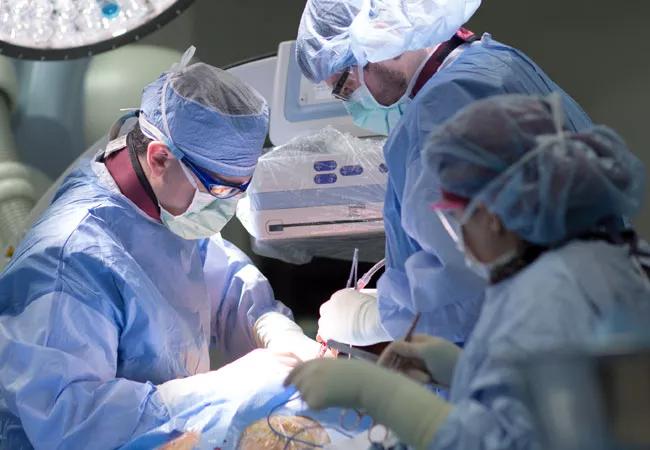
Image content: This image is available to view online.
View image online (https://assets.clevelandclinic.org/transform/f202631d-d897-4de6-abe4-ab8f68361146/23-HVI-3868208-cardiac-surgery-650x450-1_jpg)
23-HVI-3868208-cardiac-surgery-650×450
An analysis of nearly seven decades of reoperative cardiac surgery data at Cleveland Clinic shows that enhanced training and quality improvements plus long-term institutional experience have resulted in a culture of safety translating to improved outcomes for complex patients operated on by both early- and late-career surgeons.
Advertisement
Cleveland Clinic is a non-profit academic medical center. Advertising on our site helps support our mission. We do not endorse non-Cleveland Clinic products or services. Policy
The findings, based on the cumulative experience of 36 primary cardiac surgeons from 1951 to 2020, were presented at the 2023 annual meeting of the American Association for Thoracic Surgery and published online in the Journal of Thoracic and Cardiovascular Surgery. They reveal that as surgeon experience increased ― up to at least age 75 ― patients’ hospital mortality associated with reoperations decreased.
“We found that no single identifiable change or quality improvement initiative is what made the difference,” says Eugene Blackstone, MD, Director of Research, Cardiovascular Outcomes Registries and Research, in Cleveland Clinic’s Heart, Vascular & Thoracic Institute, who presented the results. “A huge case volume, working together on challenging cases and being immediately available to assist colleagues encountering difficulties are all factors that help surgeons of all ages keep patients with complex cases out of trouble perioperatively.”
The analysis was prompted by observations by other researchers of U-shaped mortality curves for complex cardiac surgery cases, with heightened mortality for early-career surgeons at one end and late-career surgeons at the other. “Such observations raise questions about optimal training of novice surgeons in complex cases and about whether senior surgeons should shift their practice toward lower-complexity cases as they age,” explains Dr. Blackstone. “We wanted to see whether concerted efforts to develop and sustain a culture of cardiac surgery safety over time, like what has been undertaken at Cleveland Clinic in recent decades, can mitigate the early- and late-career mortality rises seen in other reports.”
Advertisement
The investigators extracted information about 160,338 total cardiac surgeries, including 127,467 primary procedures and 32,871 reoperations, from Cleveland Clinic’s Cardiovascular Information Registry, a prospective database. In addition to the quantitative data, publications about Cleveland Clinic’s institutional cardiac surgical experience were reviewed.
The goal was to determine how risk-adjusted hospital mortality after cardiac reoperations — used as a proxy for complex cardiac surgery cases in general — was affected by surgeon experience and age, in the context of cumulative institutional experience. Hospital death was analyzed with a novel hybrid parametric/nonparametric machine learning model that used a time-varying coefficient method with six variables:
All variables were adjusted for 19 patient characteristics and 27 surgical components.
Analysis of the Cleveland Clinic experience revealed 1,470 hospital deaths following cardiac reoperations from 1951 to 2020, or a 4.47% incidence. The researchers noted the start of a downward trend in mortality in the late 1970s. By 1999, when approximately 14,000 cardiac reoperations had been performed, the hospital death rate had dropped exponentially and leveled off at 1.2%.
Advertisement
Looking at surgeon experience, the investigators found that hospital deaths decreased rapidly over a surgeon’s first 750 reoperations and then gradually decreased with increasing experience, to < 1% after approximately 4,000 reoperations. From 1990 to 2020, the mortality curve for early-career surgeons who joined the staff got progressively lower with each passing decade.
“We address the early mortality curve with an extended mentorship model,” notes co-investigator Lars Svensson, MD, PhD, Chair of Cleveland Clinic’s Heart, Vascular & Thoracic Institute. In contrast to the common practice of starting early-career surgeons on less-complex cases, prospective staff surgeons start with complex cases in conjunction with a senior surgeon before operating independently on routine cases. “The two surgeons jointly develop the surgical plan, and the senior surgeon assists during critical portions of the operation,” Dr. Svensson explains.
Cardiac surgeons and cardiologists also are encouraged to work in teams under 14 “Umbrellas of Excellence” and 54 subcenters. The result is a concentration of expertise among specific surgeons in areas such as aortic valve, mitral valve, coronary artery bypass grafting, heart failure and aorta surgery.
Of the older surgeons represented in the study, eight were performing cardiac procedures in their 60s and two continued operating in their 70s. Juxtaposing early-stage mortality and advancing age revealed that the older a surgeon was at the time of a cardiac reoperation, the lower the risk-adjusted hospital mortality, up to approximately 16,000 total such institutional procedures or 4,000 per surgeon.
Advertisement
“Performance on many neurocognitive tests declines with age, but crystallized intelligence tends to improve,” Dr. Blackstone observes. “That is, wisdom comes from experience with avoiding pitfalls, taking more meticulous steps during critical parts of operations, and having in mind a bailout plan if things go wrong.”
The researchers identified several changes introduced over the decades as contributors to the improved safety of complex cardiac operations at Cleveland Clinic, including:
“This report represents a single-institution experience, but Cleveland Clinic has the busiest cardiac surgery program on the continent, and we believe what we’ve accomplished is scalable,” Dr. Svensson observes. “Our patients are protected by the cumulative institutional experience and the availability of expert surgeons who have created and sustain a culture that mitigates adverse events.”
Advertisement
Advertisement

A sampling of outcome and volume data from our Heart & Vascular Institute
Concomitant AF ablation and LAA occlusion strongly endorsed during elective heart surgery
Large retrospective study supports its addition to BAV repair toolbox at expert centers
Young age, solid tumor, high uptake on PET and KRAS mutation signal risk, suggest need for lobectomy
Surprise findings argue for caution about testosterone use in men at risk for fracture
Residual AR related to severe preoperative AR increases risk of progression, need for reoperation

Findings support emphasis on markers of frailty related to, but not dependent on, age
Provides option for patients previously deemed anatomically unsuitable
 Search