Locations:





2.5-day October CME event offers a comprehensive look at a seldom-seen defect
A slate of U.S. and international experts in congenital heart disease (CHD) will converge on Cleveland this fall to share the latest developments in CHD care and comprehensively explore a rare congenital defect that seldom receives such detailed educational focus: congenitally corrected transposition of the great arteries (CCTGA).
Advertisement
Cleveland Clinic is a non-profit academic medical center. Advertising on our site helps support our mission. We do not endorse non-Cleveland Clinic products or services. Policy
It all happens at Cleveland Clinic’s 4th Annual Advances in Pediatric and Congenital Heart Summit, a 2.5-day CME-certified course held Thursday, Oct. 17, through midday Saturday, Oct. 19, at the InterContinental Hotel & Conference Center on Cleveland Clinic’s main campus.
“The first day, we’ll cover a variety of topics relevant to congenital heart disease in general, including the appropriate use of various imaging modalities, genetic considerations and management of patients — from the fetus to the competitive adult athlete,” says course co-director Hani Najm, MD, Chair of Pediatric and Congenital Heart Surgery at Cleveland Clinic. “For the next day and a half, we’ll focus on our main topic of the summit, CCTGA, a rare but important defect with diagnostic and management challenges for which we’ll review longstanding surgical approaches and introduce new, innovative surgical solutions.”
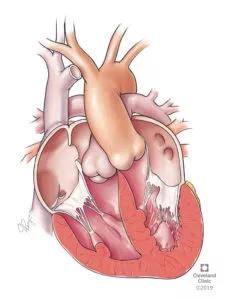
Image content: This image is available to view online.
View image online (https://assets.clevelandclinic.org/transform/b1ea504c-0378-4815-804a-47480701bb89/19-HRT-333-Najm-Saarel-CHD-CQD-Inset-232x300_jpg)
Anatomic illustration of congenitally corrected transposition of the great arteries.
The latter focus gives this year’s installment of the summit its title, “Congenitally Corrected Transposition of the Great Arteries: Management and Outcomes from Infancy to Adulthood.” At its most basic, CCTGA involves reversal of the heart’s ventricles and their attached valves (see illustration), but the term encompasses a variety of morphological forms that result in a range of outcomes from patients being asymptomatic to needing transplantation.
The summit kicks off with a talk by Robert Anderson, MD, PhD, Emeritus Professor at University College London. As the premier world expert on the structure and development of normal and congenitally malformed hearts, Dr. Anderson will deliver several presentations during the summit, covering common congenital cardiac anatomy as well as the complex morphological variations of CCTGA and how they influence management.
Advertisement
Virtually all course content will be delivered in well-focused presentations of 15 minutes by approximately 50 expert faculty (see list here) from Cleveland Clinic and other leading U.S. and international centers.
Participants can expect to come away with a solid understanding of a complex congenital heart disorder and how to manage it. Sessions devoted to CCTGA include:
Other summit highlights include the following:
Advertisement
“Congenital heart disease affects such a variety of specialties, so in addition to cardiologists and cardiothoracic surgeons, this summit will be highly relevant to many anesthesiologists, critical care specialists, pediatricians, OB-GYNs, perfusionists and other healthcare providers,” notes course co-director Elizabeth (Tess) Saarel, MD, Chair of Pediatric Cardiology, Cleveland Clinic Children’s.
Visit ccfcme.org/pediatricheart19 for more details and registration. Early-bird rates end Sept. 6.
This activity has been approved for AMA PRA Category 1 Credit™.
Advertisement
Advertisement
A sampling of outcome and volume data from our Heart & Vascular Institute
Concomitant AF ablation and LAA occlusion strongly endorsed during elective heart surgery
Large retrospective study supports its addition to BAV repair toolbox at expert centers
Young age, solid tumor, high uptake on PET and KRAS mutation signal risk, suggest need for lobectomy
Surprise findings argue for caution about testosterone use in men at risk for fracture
Residual AR related to severe preoperative AR increases risk of progression, need for reoperation

Findings support emphasis on markers of frailty related to, but not dependent on, age
Provides option for patients previously deemed anatomically unsuitable
 Search