Locations:





Results presented at VIVA 17 pave way for DETOUR II pivotal trial
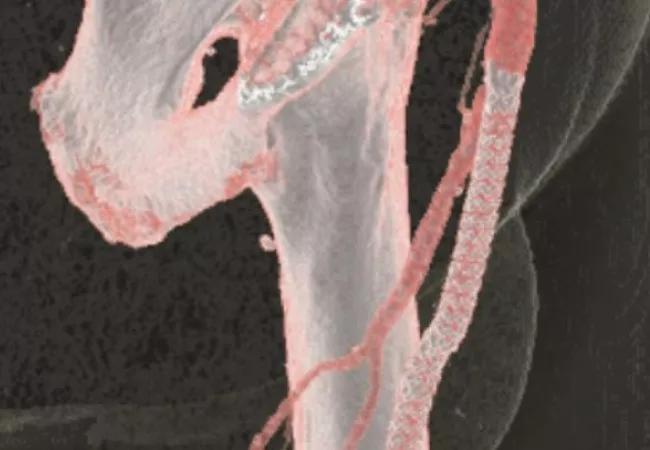
Image content: This image is available to view online.
View image online (https://assets.clevelandclinic.org/transform/e1b4db9d-31e6-4307-a061-982d068e9d1d/lyden-hero_jpg)
lyden hero
Long-segment femoropopliteal lesions may be treatable with a fully percutaneous bypass procedure, according to a subset analysis of the multicenter DETOUR I study presented at the VIVA 17 conference in Las Vegas in September 2017.
Advertisement
Cleveland Clinic is a non-profit academic medical center. Advertising on our site helps support our mission. We do not endorse non-Cleveland Clinic products or services. Policy
“Patients with long-segment femoropopliteal blockages — that is, longer than 25 cm — are in need of advanced alternatives to existing treatments,” says Cleveland Clinic Vascular Surgery Chairman Sean Lyden, MD, who presented the results in a late-breaking trials session. “While endovascular revascularization is effective in shorter lesions, its durability in longer segment blockages has not matched that of open surgery. Fully percutaneous bypass is designed to combine the durability advantages of surgical bypass with the minimally invasive advantages of a percutaneous procedure.”
The safety and effectiveness of such an approach was the focus of the study, which evaluated use of the Detour procedure, which employs the investigational Detour system technologies (Torus stent graft and Detour crossing device and snare) to provide fully percutaneous bypass of long-segment femoropopliteal artery blockages.
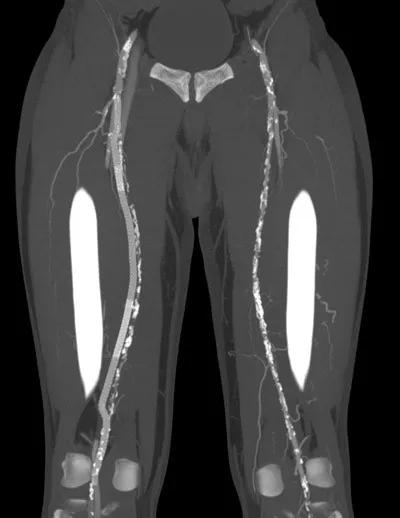
Image content: This image is available to view online.
View image online (https://assets.clevelandclinic.org/transform/86f5d479-c61c-4b70-8f8c-fc85bcf64382/lyden-inset_jpg)
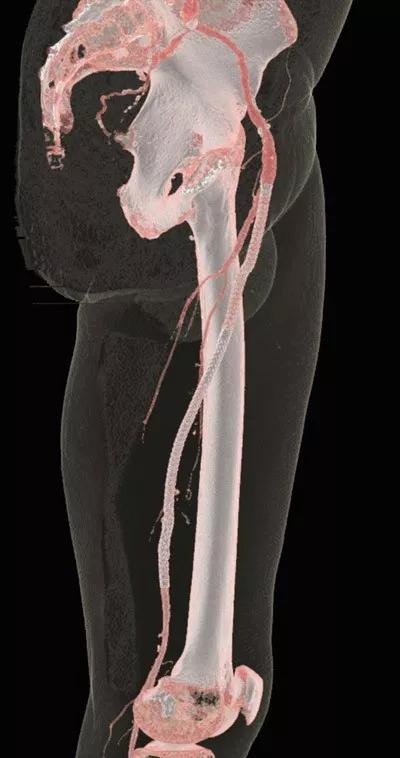
Image content: This image is available to view online.
View image online (https://assets.clevelandclinic.org/transform/c75cfa8e-b3b4-4634-bf2a-a8a642ae2847/lyden-inset-2_jpg)
Imaging studies from patients with long femoropopliteal blockages treated with the fully percutaneous Detour procedure.
DETOUR I — a prospective, nonrandomized, single-arm investigation — evaluated fully percutaneous femoropopliteal bypass in patients with blockages up to 45 cm (mean, 29.7 cm). The subset analysis of DETOUR I (n = 50) that was presented at VIVA 17 focused on extremely long blockages of 25 to 45 cm (mean, 33.8 cm). “This is one of the largest prospective series to evaluate the percutaneous treatment of extremely long femoropopliteal lesions,” Dr. Lyden notes.
Six-month results from these 50 patients indicated an ability to treat these long blockages with low rates of major adverse events and without significant impact on venous health, the investigators reported (see VIVA abstract here). Specific outcomes included the following:
Advertisement
“The outcomes we’re seeing in this subset analysis of the DETOUR I trial indicate that a fully percutaneous bypass procedure has potential to fill the traditional gap between the durability of open surgery and the reduced invasiveness of endovascular approaches in the setting of femoropopliteal blockages 25 to 45 cm long,” says Dr. Lyden. The ultimate hope would be the potential for shorter hospital stays, less extensive rehabilitation needs and a reduced risk of complications.
The company developing the Detour system announced that it expects the DETOUR II pivotal trial to begin by the end of 2017, with an eye toward eventual filing for U.S. regulatory clearance for clinical use.
Advertisement
Advertisement

A sampling of outcome and volume data from our Heart & Vascular Institute
Concomitant AF ablation and LAA occlusion strongly endorsed during elective heart surgery
Large retrospective study supports its addition to BAV repair toolbox at expert centers
Young age, solid tumor, high uptake on PET and KRAS mutation signal risk, suggest need for lobectomy
Surprise findings argue for caution about testosterone use in men at risk for fracture
Residual AR related to severe preoperative AR increases risk of progression, need for reoperation

Findings support emphasis on markers of frailty related to, but not dependent on, age
Provides option for patients previously deemed anatomically unsuitable
 Search