Locations:





Nurses study their impact on patient outcomes
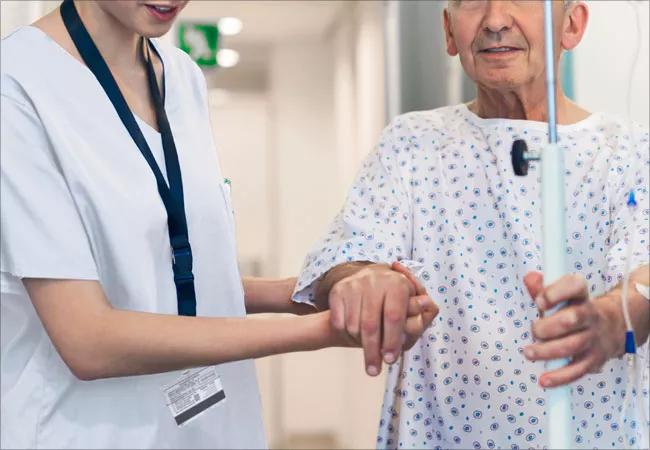
Image content: This image is available to view online.
View image online (https://assets.clevelandclinic.org/transform/6b732250-dbad-497f-80cb-1492c9ab0dbb/18-NUR-4081-researchMobile-650x450_jpg)
18-NUR-4081-researchMobile-650×450
When hospitals utilize mobility technicians, individuals hired to supplement the nursing staff with patient mobility and ambulation, patients may have improved outcomes. This was a finding from a study conducted by nurses on two medical surgical units at Cleveland Clinic’s Euclid Hospital.
Advertisement
Cleveland Clinic is a non-profit academic medical center. Advertising on our site helps support our mission. We do not endorse non-Cleveland Clinic products or services. Policy
“The study had some interesting findings related to falls and patient disposition,” says Nurse Manager Vickie Gardner, MSN, RN, at Cleveland Clinic Euclid Hospital. In the second half of the study, the research team found that patients with mobility technicians had a higher discharge to home versus other dispositions. The raw data also showed a higher fall rate among patients seen by mobility technicians. This raised new questions for the research team. Were there more falls because patients had increased mobility and they now were getting out of bed without calling for help?
Research has shown that prolonged immobilization of patients can lead to poor patient outcomes that are reflected in higher fall rates and increased length of stay. This led Gardner and her nursing colleagues to conduct their own study to examine whether employing dedicated mobility technicians focused on mobility and ambulation would improve patient outcomes.
The nursing research team applied for and received a $150,000 grant from Cleveland Clinic’s Risk Management Funding Group, which allowed them to hire and train 4.1 full-time equivalent personal care nursing assistants to become mobility technicians. Then, using a cross-over, interventional design, they deployed the technicians for alternating six-month periods on two medical-surgical units during 2015 and 2016.
The mobility technicians received a two-week specialized orientation focused on safe transfer techniques, range of motion exercises and accurate documentation in the medical record. The mobility technicians were scheduled from 7 a.m. to 7:30 p.m., seven days a week. They aided the nurses in promoting mobilization and active range of motion a minimum of three times during the day for each patient.
Advertisement
Gardner and her colleagues used electronic medical records to look at patient metrics concurrently and retrospectively, including pressure ulcers, catheter use, fall frequency, length of stay and readmission rates. Analysis of the data showed patients who received help from the mobility technicians were discharged home at a higher rate, 54 percent versus 49 percent, compared to patients on the usual care unit.
Although the fall rate seemed higher numerically on both units when mobility technicians were in use — after analysis, that fall rate was “not statistically significant.” After interviewing patients, Gardner learned many were eager to get out of bed after ambulating earlier with a mobility technician and were more willing to get out of bed without calling for assistance. There were no hospital acquired pressure ulcers and only one catheter associated urinary tract infection (CAUTI) event during the study timeframe, therefore, no formal statistical analyses of these measures were performed.
Gardner says more in-depth research is needed to identify significant metrics. Interviews with nursing staff and patients provided positive feedback and the desire to continue the mobility program. Patients reported that they appreciated the mobility technicians and that the encouragement and support they provided helped motivate them to get out of bed more often. The nursing staff also felt the additional support of the mobility technicians increased patient mobility and promoted awareness for the need to be active while in the hospital.
Advertisement
In addition to Gardner, the research team included Dawn Bailey, BSN, MAOM, RN, NEA-BC; Jackie Difiore, MSN, MHA, RN; and Esther Bernhofer, PhD, RN-BC
Advertisement
Advertisement

Nurses play key role in comprehensive lifetime treatment program
Customized bots improve speed, efficiency by streamlining daily clinical, clerical tasks

Nurses play pivotal role in patients’ ability to recover in the comfort of their own homes
New protocol reduces costs, increases patient and caregiver satisfaction

Advocating for patient safety is imperative in fast-paced surgical settings

M-Power program improves the perinatal experience for people who have survived abuse

Advice for those pursuing a WOC nursing career

Veteran nurse shares his experience as a caregiver and community volunteer
 Search