Locations:





Retrospective analysis finds “hypoxic and sleepy” subtype to confer greatest risk
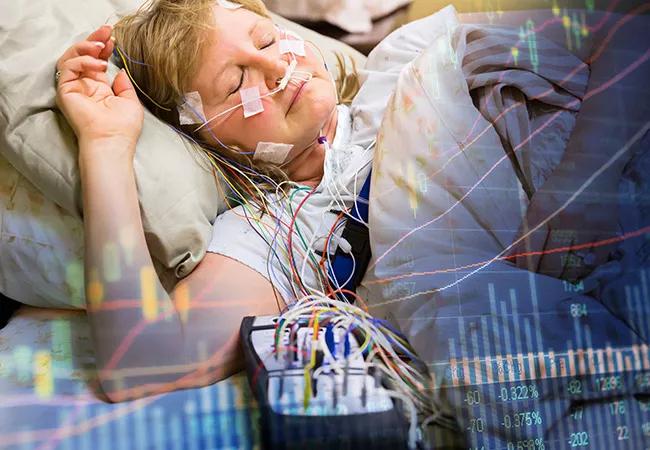
Image content: This image is available to view online.
View image online (https://assets.clevelandclinic.org/transform/c9757431-ed6e-4bdd-ad67-8d653bfa2d16/23-NEU-4054809_sleep-study_650x450_jpg)
23-NEU-4054809_sleep-study_650x450
Patients with hypoxia and sleepiness are at higher risk of five-year incident atrial fibrillation (AF) than those with the highest apnea-hypopnea index (AHI) and the highest arousal index. So finds a Cleveland Clinic retrospective analysis presented at the SLEEP 2023 meeting, which identified five clusters of symptoms and sleep study findings associated with various levels of AF risk.
Advertisement
Cleveland Clinic is a non-profit academic medical center. Advertising on our site helps support our mission. We do not endorse non-Cleveland Clinic products or services. Policy
“Our research shows that it is possible to identify patterns of sleep measures that are associated with a higher risk of developing AF,” says the study’s first author, Catherine Heinzinger, DO, of Cleveland Clinic’s Sleep Disorders Center. “That, in turn, can contribute to more accurate prediction modeling, allowing clinicians to identify patients at risk so they can proactively intervene.”
Evidence indicates that sleep disorders and AF are closely linked, yet how they interact is unclear. Consequently, cardiovascular risk stratification of patients with obstructive sleep apnea (OSA) remains challenging. Eighty-five percent of patients with AF are estimated to have OSA, and moderate to severe OSA is associated with a fourfold increased risk of AF.
Cluster analysis previously has been used to identify subtypes of patients with OSA who have a distinct combination of symptoms and comorbidities. The Cleveland Clinic study, however, is among the first to focus on sleep-based clusters associated with AF as a way to identify at-risk patients.
Dr. Heinzinger and colleagues analyzed data from more than 43,000 adults who underwent sleep studies at the Sleep Disorders Center from November 2004 to December 2015. The participants’ mean age was 52 years, and the majority were male (52%) and white (75%). The most common comorbidities were hypertension and hyperlipidemia (54% each), diabetes (21%) and coronary artery disease (13%).
All sleep studies involved at least three hours of diagnostic data; 74% were full night polysomnography and 26% were split night polysomnography.
Advertisement
To identify the clusters of symptoms and other factors, the researchers used latent class analysis of 23 symptoms, Epworth Sleepiness Scale (ESS) scores, and 24 measures of sleep-disordered breathing and sleep architecture from polysomnography and echocardiography reports. The primary outcome was five-year incident AF.
Cluster membership and time from a sleep study to AF diagnosis were assessed using Cox proportional hazards regression. The authors adjusted the models for age, sex, race, body mass index, coronary artery disease, heart failure, myocardial infarction, coronary artery bypass graft surgery, tobacco use, chronic obstructive pulmonary disease, anti-arrhythmic medication use and positive airway pressure (PAP) therapy use.
The researchers identified five sleep clusters by AF association:
Compared with the long sleep + high %REM cluster, which served as the reference group, AF risk was significantly elevated in three of the other groups:
Advertisement
While AF risk was 5% higher in the hypopneas group than in the reference group, the difference was not statistically significant.
“The hypoxic + sleepy subtype conferred the strongest AF risk with the highest degree of hypoxemia, maximum end-tidal CO2, and highest heart rate and ESS scores,” Dr. Heinzinger says. “Consistent with prior evidence of hypoxemia as a driver of AF and cardiovascular risk of the sleepy phenotype, this constellation of symptoms and physiologic alterations illustrates risk in the clinical setting, providing potential value as a risk prediction tool.”
While the analysis confirmed the researchers’ hypothesis that risk of five-year incident AF would differ based on discrete phenotypes of polysomnography- and symptom-based data, the results also held several surprises. “We did not expect that both REM latency and percentage of REM sleep would differentiate the clusters so well, that multiple awakenings would not be a good differentiator or that we would be able to define a cluster exclusively based on the number of hypopneas,” Dr. Heinzinger notes.
Among the strengths of the analysis are its large sample size and clinical cohort, careful consideration of confounders and the inclusion of PAP therapy as a time-varying covariate. Limitations are the study’s retrospective nature, which makes it impossible to infer causality, as well as residual confounders and the researchers’ inability to confirm participants’ adherence with PAP.
The authors’ next step is external validation of the results, which have clear clinical implications, given that more than 12 million Americans are projected to be diagnosed with AF by 2030.
Advertisement
“The key takeaway for clinicians is that hypoxia is a driver of AF risk, perhaps more so than the AHI,” says Dr. Heinzinger. “Clinicians should assess patients based on a profile of multiple measures taken from sleep studies and not just the frequency of respiratory events.”
Advertisement
Advertisement

New study advances understanding of patient-defined goals
Testing options and therapies are expanding for this poorly understood sleep disorder
Real-world claims data and tissue culture studies set the stage for randomized clinical testing
Digital subtraction angiography remains central to assessment of ‘benign’ PMSAH

Cleveland Clinic neuromuscular specialist shares insights on AI in his field and beyond
Findings challenge dogma that microglia are exclusively destructive regardless of location in brain
Neurology is especially well positioned for opportunities to enhance clinical care and medical training
New review distills insights from studies over the past decade
 Search