Locations:





Ask about social media's impact at well-child visits

Image content: This image is available to view online.
View image online (https://assets.clevelandclinic.org/transform/b3b8fca5-9cc0-4270-ad47-32b1a8374805/650x450-Brown-Falcone_jpg)
650×450 Brown-Falcone
By Charles Brown, DO, and Tatiana Falcone, MD
Advertisement
Cleveland Clinic is a non-profit academic medical center. Advertising on our site helps support our mission. We do not endorse non-Cleveland Clinic products or services. Policy
The Internet has blossomed into an integral part of society.
As an outgrowth of the Internet and the World Wide Web, social networking sites (SNS) serve as platforms to establish and maintain personal interactions. It is important that pediatric practitioners stay current about the different SNS our patients use.
The ever-changing nature of the online world makes it difficult to stay up to date regarding what SNS patients may be utilizing (Figure 1).
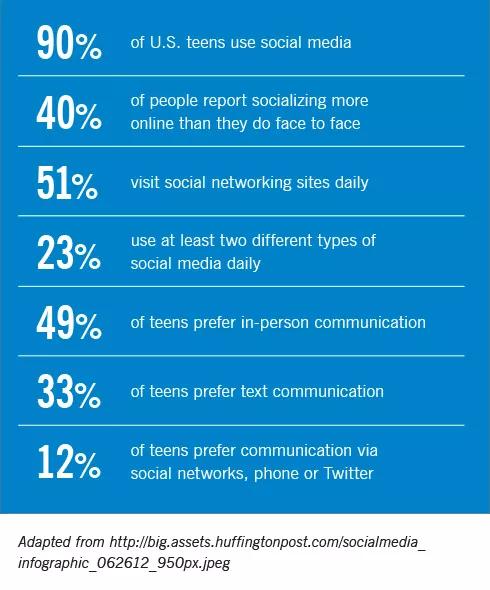
Image content: This image is available to view online.
View image online (https://assets.clevelandclinic.org/transform/f73bb5de-38b8-412a-a412-0fee9fd43636/Brown-Falcone-Fig1_jpg)
Figure 1. Teen social network sites fast facts.
In some instances, by the time we become aware of a site, its usage may have shifted, as with the case of Facebook’s declining adolescent usage.6 Of the numerous sites and applications, Figure 2 shows some of the more noteworthy.
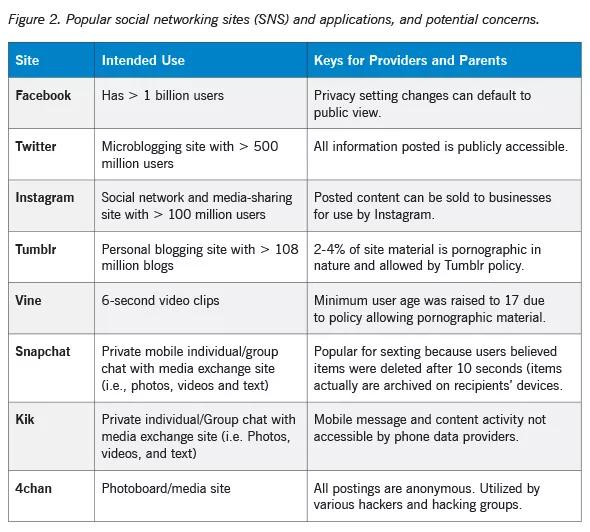
Image content: This image is available to view online.
View image online (https://assets.clevelandclinic.org/transform/349ea3f4-ac46-48c5-a6cf-5f4a2051fa79/Brown-Falcone-Fig2_jpg)
The Web has altered the way we look at relationships and psychological and psychosocial development. Use of SNS has been credited with helping adolescents:
Studies have evaluated how SNS impact social interaction. For instance, individuals with higher early adolescent positivity went on to have more friends in their online networks as adults.3 Also, a review of online profiles by blinded raters provided accurate assessments of individuals’ levels of extroversion, conscientiousness, openness and agreeableness.1
Advertisement
Additionally, a person’s positive and honest portrayal of him- or herself online has a positive relationship with the individual’s perceived support and social well-being.8 Steinfeld et al. found that people with more social connections are more likely to engage in positive behaviors, and that adolescents with low self-esteem could potentially benefit from social support via social networking sites.7 Moreno et al. explored Facebook friendships and reported that people with fewer than 300 friends could get positive support when posting negative comments, but people with more than 1,000 friends could get negative remarks when posting self-deprecating comments.4
The rapid changes in the social media landscape warrant continued evaluation of previous findings. For example, Kraut et al. discussed how Internet use was associated with loneliness and stress; however, other studies were unable to replicate this finding. The same group, in a later study that followed the sample for a longer period of time, found no relationship between Internet use and depression.
Individuals have been utilizing the Internet not just to create new social connections, but to learn about disorders and diseases that they or loved ones may be experiencing and to find support to address them.
Practitioners should be aware that online forums also have been created to provide negative support. A quick search reveals that pro-substance abuse (“Erowid”), pro-eating disorder (“Pro-ana”), pro-suicide and pro-self-harm sites exist, and these must be considered when exploring a patient’s online usage and behaviors. Asking parents about their child’s social media use is important and necessary.
Advertisement
Bullying is an unfortunate frequent source of stress for many children and teens. There is a strong relationship between bullying, cyberbullying and suicide. Studies have reported that as many as 90 percent of social media-using teens have witnessed and ignored mean behavior online, while 20 percent of surveyed teens said that their peers are mostly unkind to each other online.2
Dr. Brown recently completed a child and adolescent psychiatry fellowship at Cleveland Clinic.
Dr. Falcone is a child and adolescent psychiatrist at Cleveland Clinic and Assistant Professor of Medicine at Cleveland Clinic Lerner College of Medicine. She is the Principal Investigator for Project CARE (Coordination, Access, Resources, Education) 4 Epilepsy, a three-year Health Resources and Services Administration grant to enhance services, including mental health services, for children with epilepsy.
Advertisement
Advertisement
Advertisement

New study advances understanding of patient-defined goals

Testing options and therapies are expanding for this poorly understood sleep disorder

Real-world claims data and tissue culture studies set the stage for randomized clinical testing
Digital subtraction angiography remains central to assessment of ‘benign’ PMSAH

Cleveland Clinic neuromuscular specialist shares insights on AI in his field and beyond

Findings challenge dogma that microglia are exclusively destructive regardless of location in brain

Neurology is especially well positioned for opportunities to enhance clinical care and medical training

New review distills insights from studies over the past decade
 Search