Locations:





Study provides first clinical validation using 12-lead ECGs
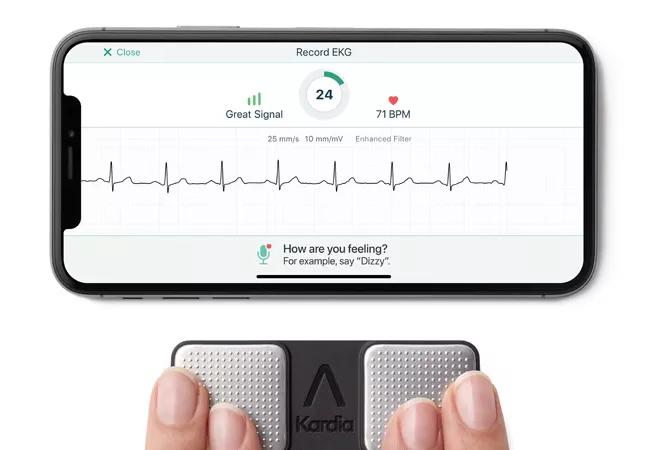
Image content: This image is available to view online.
View image online (https://assets.clevelandclinic.org/transform/6eacd82f-9819-453c-ba7a-1be6f0636f90/18-HRT-4861-Tarakji-Study-CQD_jpg)
18-HRT-4861-Tarakji-Study-CQD
A handheld smartphone-based device can be a helpful tool for heart rhythm assessment in patients with atrial fibrillation (AF), new Cleveland Clinic research finds.
Advertisement
Cleveland Clinic is a non-profit academic medical center. Advertising on our site helps support our mission. We do not endorse non-Cleveland Clinic products or services. Policy
The KardiaMobile Cardiac Monitor (KMCM) is a two-electrode cardiac rhythm recorder. The patient places two fingers on the strip for 30 seconds (see photo above), and it sends electrical signals via ultrasound waves to a smartphone’s microphone. An app displays the tracings visually and transmits the data to the cloud, where the treating physician can read the tracings remotely via a HIPAA-compliant internet site.
A feature newly added to the KMCM is an algorithm that automatically analyzes the rhythm and provides one of three results:
The latter category includes instances where the recording is less than 30 seconds, when there is too much noise, or when the calculated heart rate is less than 50 or more than 100 beats per minute and regular.
The KMCM, marketed by AliveCor®, is cleared by the U.S. Food and Drug Administration and can be purchased by patients directly without a prescription.
“The ability to record your own rhythm strip, directly visualize it and share it with your physician was fictional until a few years ago,” says Cleveland Clinic electrophysiologist Khaldoun Tarakji, MD, MPH. “We live in an era of unprecedented technology evolution. As a medical community, we have a duty to test new technologies, assess their accuracy and examine their ability to change outcomes.”
In a study just published in Heart Rhythm, Dr. Tarakji and colleagues tested the recently added diagnostic algorithm. They enrolled 52 consecutive Cleveland Clinic patients with AF who were admitted to the hospital for antiarrhythmic drug initiation. Serial 12-lead ECGs and KMCM recordings were conducted nearly simultaneously every 12 hours — two hours after each medication dose — totaling 225 paired recordings.
Advertisement
After exclusion of 62 recordings that the KMCM deemed “unclassified,” the automated KMCM algorithm was 96.6 percent sensitive and 94.1 percent specific for AF detection compared with physician-interpreted ECGs. “In other words, when the device commits to a diagnosis, the numbers are pretty good,” observes Dr. Tarakji, the study’s principal investigator.
And the visual KMCM recordings themselves were fairly comparable to those of the ECG: When physicians blinded to the algorithm results interpreted the device’s tracings, there was 100 percent sensitivity and 89.2 percent specificity for AF detection compared with the physician-interpreted 12-lead ECGs.
Dr. Tarakji notes that while the relatively high number of unclassified readings — 27.6 percent in this study — is admittedly an issue to be improved in future iterations, the tracings still proved informative. Among those 62 recordings, physician interpretation of the tracings was 100 percent sensitive and 79.5 percent specific for AF detection relative to 12-lead ECGs.
“Even the unclassified readings aren’t wasted,” he points out. “The tracings can still be interpreted.”
Reasons for an unclassified designation included a heart rate of less than 50 or more than 100 beats per minute (45.2 percent of cases), significant noise (27.4 percent) and a too-short (< 30 seconds) recording duration (9.7 percent). A cause was not determined in the remainder of cases.
“No matter how much you improve the device,” Dr. Tarakji notes, “if certain conditions are not met — for example, recording and holding still for 30 seconds — the algorithm will not be able to provide a diagnosis. It’s a reminder about the multiple elements involved in determining the use of a wearable device — the human factor is essential.”
Advertisement
Nearly all patients (93.6 percent) reported that they found the KMCM easy to use, and more than half (59.6 percent) said the device reduced their anxiety about having AF. Two-thirds (63.4 percent) wanted to continue using the KMCM after the study.
“Overall, the algorithm is not really a replacement for physician review, but it’s a first step,” says Dr. Tarakji. “And when it gives a diagnosis, we should take that seriously because it has very good sensitivity and specificity.”
This study was the first to analyze the algorithm’s accuracy, although a similar Cleveland Clinic study on the algorithm in a sister product from AliveCor, the KardiaBand™ smartwatch accessory, was published a few months sooner (J Am Coll Cardiol. 2018;71:2381-2388) and detailed in this earlier Consult QD post.
The advent of these types of disruptive mobile technologies — including a system that uses Bluetooth® to allow an iPhone app to wirelessly transmit data from a patient’s implanted cardiac device to a cellular network (profiled in this post) — will require new approaches to data management, Dr. Tarakji says.
“The resulting abundance of data could become noise if it doesn’t come with guidance about appropriate management of the information,” he cautions. “Our obligation is to provide, through proper clinical studies, guidance about the best use of these tools. As physicians, we should view these products as opportunities to provide better and more effective care for patients.”
Photo at top courtesy of AliveCor.
Advertisement
Advertisement

A sampling of outcome and volume data from our Heart & Vascular Institute
Concomitant AF ablation and LAA occlusion strongly endorsed during elective heart surgery
Large retrospective study supports its addition to BAV repair toolbox at expert centers
Young age, solid tumor, high uptake on PET and KRAS mutation signal risk, suggest need for lobectomy
Surprise findings argue for caution about testosterone use in men at risk for fracture
Residual AR related to severe preoperative AR increases risk of progression, need for reoperation

Findings support emphasis on markers of frailty related to, but not dependent on, age
Provides option for patients previously deemed anatomically unsuitable
 Search