Locations:





 Search
Cleveland Clinic surgeons share institutional experience
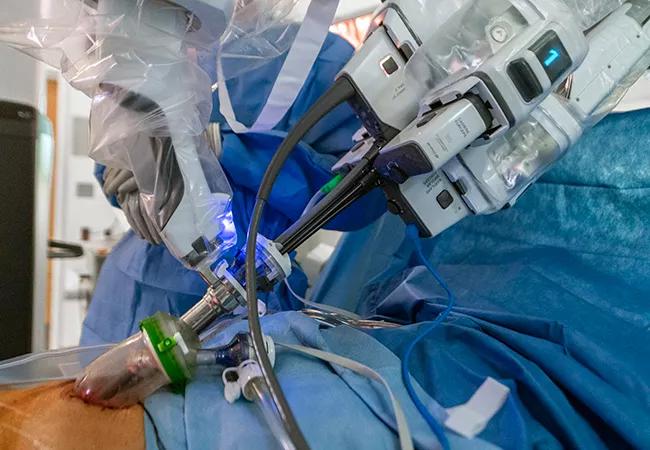
Image content: This image is available to view online.
View image online (https://assets.clevelandclinic.org/transform/57fcfa23-cbd0-40c3-875d-79b657eb5355/21-URL-2122709-650x450-1_jpg)
URL-Valleriano-1798462_12-20-19_Dr Kaouk in Surgery_MLC
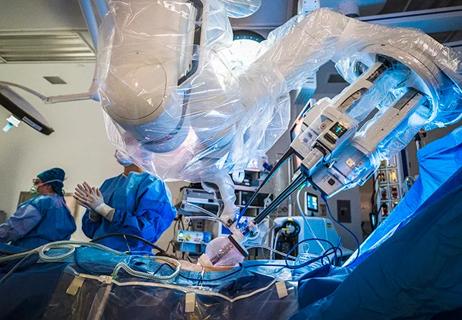
Cleveland Clinic made history in 2019 as the first hospital in the world to successfully perform a single-port (SP) robotic-assisted kidney transplant (RAKT). Nearly two years later, the surgical team leading these efforts is reporting more successful outcomes and early experiences in kidney transplant and autotransplant.
Advertisement
Cleveland Clinic is a non-profit academic medical center. Advertising on our site helps support our mission. We do not endorse non-Cleveland Clinic products or services. Policy
The initial experience for a series of cases is published in European Urology. The article highlights the application of the SP robot-assisted approach for kidney allotransplantation and autotransplantation demonstrating its safety and acceptability in indicated patients, as well as promising early outcomes.
This work, explains Alvin Wee, MD, MBA, Surgical Director of Renal Transplantation at Cleveland Clinic, was done in collaboration with Jihad Kaouk, MD, who leads the Center for Robotic and Image-Guided Surgery and Mohamed Eltemamy, MD, who is a staff member for both sections.
The SP approach allows access of all surgical instruments and the allograft or autograft, both removed with ex-vivo reconstructions and insertion back through one small abdominal incision. A small incision site not only minimizes risk associated with wound infections and other perioperative complications but also minimizes the surgical field, dissection and the number of incision points to the patient, resulting in less postoperative pain.
The team has now used the SP robot to complete 11 kidney transplants in patients with end-stage renal disease and four patients for whom kidney autotransplantation was indicated. In each of the cases, a 4-5 cm periumbilical incision was made to enable docking of the robot and insertion of the kidney graft.
One point to highlight — implantation of the allograft is done extraperitoneally; this is in contrast to other robotic transplantation where it is done intraperitoneally. This extraperitoneal approach mimics the standard open Gibson technique. It is more challenging as the field area is smaller, but it provides the advantage of staying extraperitoneal with minimal ileus and no bowel manipulation.
Advertisement
Dr. Wee says that outcomes have been excellent with 100% graft and patient survival.
The team took the same approach with renal autotransplantation, a kidney-salvaging procedure, that may be appropriate for patients with complex urologic conditions that compromise the kidney or ureter. The nephrectomy is done and extracted through the SP. The reconstruction and benching of the kidney is done ex-vivo before reinsertion.
The paper highlight three autotransplantation cases, showing how the technique can be used to facilitate excessive stone passage, resolve ureteral injury and chronic kidney pain, respectively. In each of these cases, the authors report, the procedures were completed successfully with unremarkable postoperative serum creatinine levels and good early outcomes.
The traditional open approach to renal autograft and allograft remains the standard of care, but emerging minimal invasive techniques have demonstrated better postoperative outcomes for select patients.
Dr. Wee concurs the team is taking a conservative approach to patient selection. Patients with a higher BMI or with certain anatomical challenges are typically better candidates. But, he is heartened by the results the team has seen this far.
He also says it’s a testament to the expertise and collaboration of his colleagues, like Drs. Kaouk and Eltemamy, who are committed to advancing minimally invasive techniques to treat renal and urologic conditions.
“Yes, our standard approaches for kidney transplant and autotransplant are already very good and effective, but our experience with the single-port robot has also been positive. We are optimistic that in well-equipped centers and for certain patients, it may be even better.”
Advertisement
Reference
Kaouk J, Eltemamy M, Aminsharifi A, Schwen Z, Wilson C, Abou Zeinab M, Garisto J, Lenfant L, Wee A. Initial Experience with Single-port Robotic-assisted Kidney Transplantation and Autotransplantation. Eur Urol. 2021 Mar 30:S0302-2838(21)00173-1. doi: 10.1016/j.eururo.2021.03.002. Epub ahead of print.
Advertisement
Advertisement

Clinicians should individualize dosing practices based on patient risk factors and preferences
Pioneering and refining the approach in pyeloplasty, nephrectomy and more
Fully-automated process uses preop CT, baseline GFR to estimate post-nephrectomy renal function

Could mean earlier treatment, but also could have negative effects

Unlike earlier pills, new drugs do not cause liver toxicity
Male factors play a role in about half of all infertility cases, yet men often are not evaluated
Surgeons choreograph nearly simultaneous procedures, sharing one robot between two patients

Identifying barriers in the renal genetic assessment of Black patients