Locations:





Nurse director shares Center’s success story
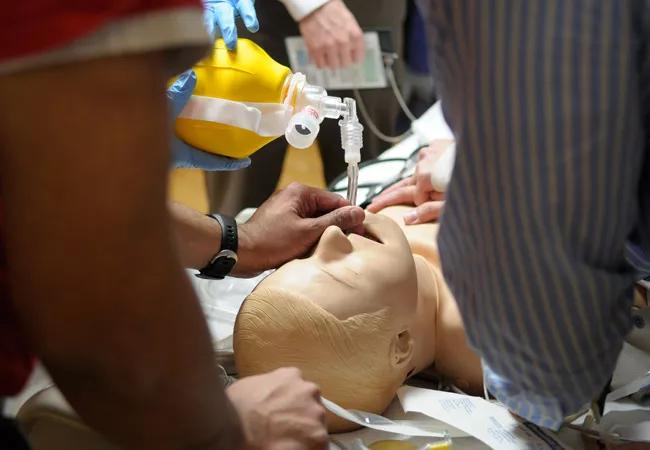
Image content: This image is available to view online.
View image online (https://assets.clevelandclinic.org/transform/85b839eb-0b4f-4290-9744-e54178b7778e/simulation_650x450_jpg)
simulation_650x450
In December, Cleveland Clinic’s Simulation and Advanced Skills Center earned accreditation through the Society for Simulation in Healthcare (SSH). SSH accreditation is a peer-reviewed, customized evaluation of healthcare simulation programs, examining the program’s processes and outcomes in five areas – assessment, core standards, research, teaching/education and systems integration.
Advertisement
Cleveland Clinic is a non-profit academic medical center. Advertising on our site helps support our mission. We do not endorse non-Cleveland Clinic products or services. Policy
“Earning SSH accreditation provided us quality assurance and standardization for our programs,” says Leslie Simko, MS, BSN, RN, CHSE, nursing director and administrator for the Simulation and Advanced Skills Center.
Image content: This image is available to view online.
View image online (https://assets.clevelandclinic.org/transform/19d2e399-634f-4bfd-aa6d-016879c6db89/Simko_150x180_jpg)
Leslie Simko, MS, BSN, RN, CHSE
The heart of Cleveland Clinic’s simulation activities – its 10,000-square-foot Simulation Center Dry Labs – opened in 2012, increasing the already existing simulation space to more than 20,000 square feet. Multidisciplinary caregiving teams in all medical specialties train on a variety of scenarios, from advanced acute ischemic stroke scenarios to septic shock. A common theme throughout any training is the importance of communication.
“When you’re in a healthcare environment, you are not alone,” says Simko. “You have to rely on your team to identify problems and provide quality care for the patient. There are reasons we have experts in each medical specialty, but they need to learn to communicate and provide good hand-off to other specialty teams.” All of the Center’s simulated scenarios utilize techniques that integrate protocols for patient hand-offs and interdisciplinary communication. They incorporate elements of knowledge sharing, closed-loop and professional communication.
One example is the Center’s monthly multidisciplinary “Mock Code.” The primary participants are physician residents preparing for their ICU rotation, nurses from different practice areas, respiratory therapists and patient care assistants. Team members work together to manage a patient crisis situation.
Advertisement
“This environment creates communication challenges, much like working through a code in a real-life situation,” Simko says. “During a patient care emergency, the nurse may be faced with working with an unfamiliar team of providers. The goal is for them to experience a crisis situation without the risk of harming a patient.”
By using formal debriefing that includes watching a video of the event, participants can observe and differentiate between effective and ineffective communication techniques. This provides an opportunity for the learner to reflect on their current communication style. Additionally, these events serve as a change agent for improved team communication, resulting in improved patient outcomes.
“Did the nurse repeat the order back to the physician? Was the order carried out and stated that it was completed in the end? This is where breaks in communication frequently occur, making a focus on closed-loop communication so important,” explains Simko. “Often, each person responding assumes the other is doing their job in a crisis. The interdisciplinary simulations reinforce the importance of clearly defining individual’s roles and responsibilities during a crisis.”
The number of learners at the Simulation and Advanced Skills Center has risen each year, with more than 31,800 participants in 2015. They train at several locations aside from the Simulation Center Dry Labs, including a task training lab, difficult airway lab and in-situ (patient care environment) training throughout the Cleveland Clinic healthcare system. The Center also has a mobile ICU simulation team (MIST) that offers training on everything from cardiogenic shock to increased intracranial pressure.
Advertisement
Working toward SSH accreditation helped the Center ensure that all of its programs follow standard procedures to achieve desired outcomes. Through the process, it made several improvements. For instance, the Center created a curriculum template that all the programs could use and a web-based database to collect information on its learners and classes.
Overall, earning SSH accreditation demonstrates a level of excellence at the Simulation and Advanced Skills Center: It is confirmation of the Center’s commitment to multidisciplinary training of caregivers and strengthening of patient safety.
Advertisement
Advertisement
Nurses play key role in comprehensive lifetime treatment program
Customized bots improve speed, efficiency by streamlining daily clinical, clerical tasks
Nurses play pivotal role in patients’ ability to recover in the comfort of their own homes
New protocol reduces costs, increases patient and caregiver satisfaction
Advocating for patient safety is imperative in fast-paced surgical settings
M-Power program improves the perinatal experience for people who have survived abuse
Advice for those pursuing a WOC nursing career
Veteran nurse shares his experience as a caregiver and community volunteer
 Search