Locations:





Thoughts on the 2015 ACR Workforce Study

Image content: This image is available to view online.
View image online (https://assets.clevelandclinic.org/transform/d04eb670-1278-4157-bb1a-cd432f909e92/16-RHE-2763-Deal-Hero-Image-650x450pxl_jpg)
16-RHE-2763-Deal-Hero-Image-650x450pxl
Advertisement
Cleveland Clinic is a non-profit academic medical center. Advertising on our site helps support our mission. We do not endorse non-Cleveland Clinic products or services. Policy
If projections are correct, demand for rheumatologists will more than double in the next 15 years. By 2030 the supply of rheumatologists will fall by 31 percent and demand will increase by 138 percent. That’s an excess demand of over 4,500 rheumatologists by 2030. We would need to add an additional 350 adult fellowship graduates each year for the next 13 years just to meet that demand.
Under the guidance of Daniel Battafarano, DO, of San Antonio Military Medical Center, and the American College of Rheumatology (ACR) Workforce Committee, the 2015 ACR Workforce Study (WFS) was presented at the 2016 ACR annual meeting. Workforce studies are important to assess the current and future state of the rheumatology workforce and to provide data for recommendations and planning.
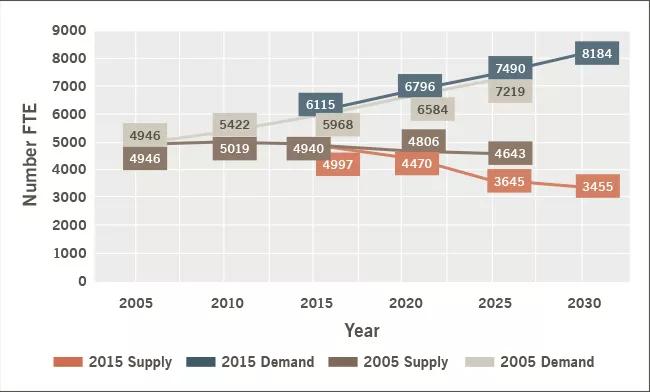
Image content: This image is available to view online.
View image online (https://assets.clevelandclinic.org/transform/e5e4eec6-c05d-4d4c-84c8-2d25901ddefc/16-RHE-2763-Deal-Inset-Graph-01-650-pxls-width_jpg)
Comparison of supply and demand of adult rheumatology workforce
As a committee member, I studied at the effects of age and gender on the rheumatology workforce. The data shows that the rheumatology workforce in 2030 will be predominantly millennial (> 50 percent) and women (59 percent). Both millennial males and females see fewer patients compared with physicians in the 2005 WFS. There are many reasons for this including emphasis on work/life balance and time out of the workforce for family. In the survey portion of the WFS, 18 percent of current fellows report planning part-time employment and of these 90 percent were women.
Add these factors to those that increase demand, such as increases in healthcare utilization, access to care and per capita income as well the aging of the population, and we are approaching a critical shortage of providers qualified to diagnose and treat rheumatic diseases.
Advertisement
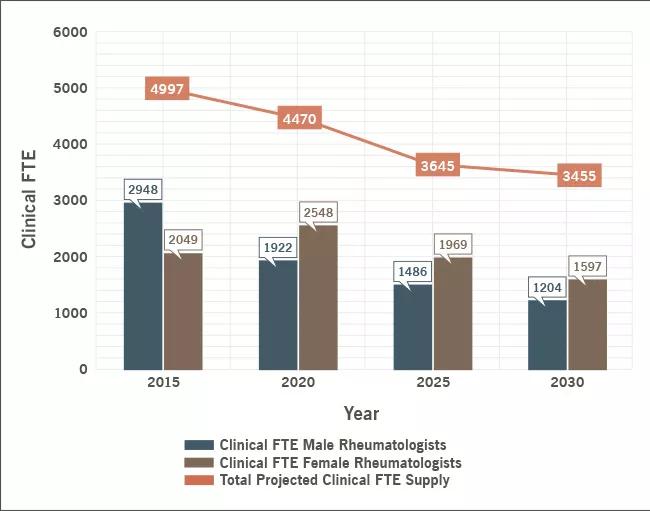
Image content: This image is available to view online.
View image online (https://assets.clevelandclinic.org/transform/cfe48bd9-5a69-4d2e-8992-b70c16c9bfc7/16-RHE-2763-Deal-Inset-Graph-02-650pxl-width_jpg)
Projected clinical FTE by gender 2015-2030
While no projections and modeling are perfect, the 2005 WFS was largely accurate in its supply and demand predictions; with improved methodologies, the 2015 WFS should reliably predict future supply and demand.
Our undeniable challenges are patient access, recruitment into rheumatology and support for the existing workforce. We must continue to ensure that our fellowship slots are full. The ACR and the Rheumatology Research Foundation increased support for fellowship training after the 2005 WFS. However, we cannot train our way out of the impending shortage. Advanced practice clinicians will need to be recruited into rheumatology, although that is a challenge since we compete against all medical and surgical specialties for their services. Increasing the number of pediatric rheumatologists is also a challenge. The ACR has advocated for legislation for years that would pay off student loan debt for pediatricians as an incentive to go into pediatric rheumatology.
Practice redesign will be critical; we must work more efficiently, utilizing advanced practice clinicians, and we will need to make tough choices about who we should see based on disease category.
The problems we face are simple and straightforward — we do not have enough rheumatologists to meet demand, and the problem will only intensify as time advances. The solutions are complex and require the kind of volunteer work in advocacy, training, mentoring and recruitment that we do through professional organizations, often on our own time and after our other work is done.
Advertisement
Dr. Deal is Head of the Center for Osteoporosis and Metabolic Bone Disease.
Advertisement
Advertisement
Treatment strategies require understanding of pathomechanisms
Education, prevention strategies and monitoring serves this at-risk group

Treatment for scleroderma can sometimes cause esophageal symptoms
Lupus Clinic providers collaborate to advance treatment and understanding

Older Psoriasis Patients May Experience Quicker Transition

Cleveland Clinic’s Rheumatic Lung Disease program treats patients with complex conditions
Symptoms complement one another

E-coaching program is tailored for those with the disease
 Search