Locations:





Study raises prospect of ‘widening the net’ for prophylaxis against endocarditis
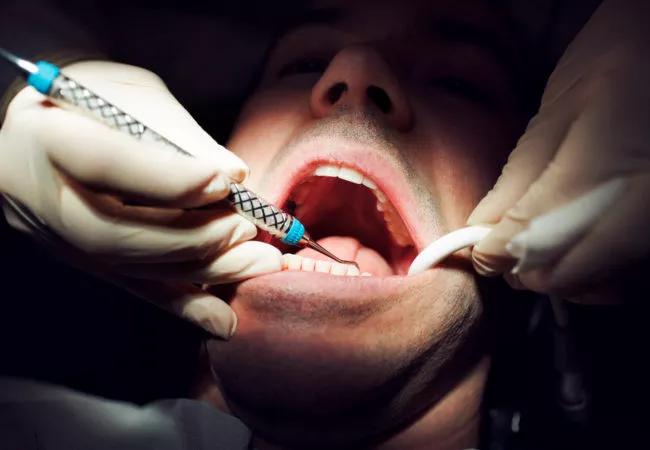
Image content: This image is available to view online.
View image online (https://assets.clevelandclinic.org/transform/620bfd05-129d-44f5-aed2-dae7c91c1f59/18-HRT-4839-Dental-procedure-650x450_jpg)
19-ORT-1126
Currently, antibiotic prophylaxis against infective endocarditis (IE) is generally not recommended under practice guidelines for patients with a bicuspid aortic valve (BAV) or mitral valve prolapse (MVP) who are undergoing a dental procedure.
Advertisement
Cleveland Clinic is a non-profit academic medical center. Advertising on our site helps support our mission. We do not endorse non-Cleveland Clinic products or services. Policy
But an analysis of more than 3,000 patients with confirmed IE at 31 Spanish hospitals, published recently in the Journal of the American College of Cardiology (2018;71:2731-2740), concluded that patients with BAV or MVP have a clinical profile similar to other high-risk patients who should receive antibiotic prophylaxis per current guidelines — and that BAV or MVP may actually confer higher risk from dental procedures. An accompanying editorial asks whether it’s time to “widen the net” and provide antibiotic coverage before dental procedures for patients with these valve conditions.
“Not so fast,” says Steven Gordon, MD, Chair of Cleveland Clinic’s Department of Infectious Disease. “The Spanish study has generated interest but doesn’t provide enough evidence to change guidelines.”
Prior to current guidelines, antibiotic prophylaxis against IE had been advocated before dental procedures in patients with certain cardiac conditions for more than 50 years, based on theoretical arguments, observational reports and animal studies. The justification was that bacteria introduced into the bloodstream through the gums predisposed patients with abnormal valves to accumulate bacterial growth on the sticky valve surfaces and develop IE.
But there are several holes in this reasoning, according to Dr. Gordon. “Only a randomized controlled study would provide definitive evidence of causation, and that’s difficult to do in studies of dental prophylaxis and IE, for a variety of reasons,” he says, noting that the Spanish study was not a randomized controlled trial.
Advertisement
In 2007, the American Heart Association issued a guideline in Circulation for preventing IE, limiting recommendations for antibiotic prophylaxis for cardiac conditions to a very few circumstances, including a prosthetic cardiac valve, previous IE, specific instances of congenital heart disease, and development of cardiac valvulopathy in a heart transplant recipient. Guidelines from European societies published in 2009 in the European Heart Journal followed suit with similar recommendations.
The recent study assessed 3,208 patients in a Spanish registry who developed IE between 2008 and 2016. Of this group, 1,982 patients were deemed of low or moderate risk according to current guidelines. Of these, 54 had BAV and 89 had MVP. The researchers found that the incidence of viridans group streptococci IE (indicating likely odontologic origin) was higher in these patients than in the other patients with IE. Furthermore, these patients tended to have an aggressive clinical course of IE with more intracardiac complications, more closely resembling high-risk patients than the low-/moderate-risk patients.
It is difficult to assess the role of antibiotic prophylaxis in preventing cases of IE in this study, Dr. Gordon notes, because no information was provided on either dental procedures or prophylaxis for the study patients. He says it’s also not clear how many patients knew they had BAV or MVP before their diagnosis, “and lack of awareness of the diagnosis would obviate any preventable role of antibiotics before dental procedures in these patients.”
Advertisement
Moreover, it’s still an open question whether antibiotic prophylaxis would have helped the patients in the Spanish study, adds Brian Griffin, MD, Section Head of Cardiovascular Imaging at Cleveland Clinic.
“No one has really shown how protective antibiotic prophylaxis is against developing IE,” Dr. Griffin says. “Antibiotics are not 100 percent effective, and bacteremias can arise randomly from normal daily activities, not just dental procedures.”
Gosta Pettersson, MD, PhD, Vice Chairman of Cleveland Clinic’s Department of Thoracic and Cardiovascular Surgery, adds that the dangers of antibiotic overuse — including resistance and the rise of superinfections — must be part of the equation.
“I come from Sweden, where we do not have a tradition of giving antibiotics ‘just in case,’” he says. “We must look carefully at the evidence before recommending additional antibiotic use in healthy patients.”
Dr. Pettersson notes that Cleveland Clinic physicians — who operate on two or three patients with IE every week — emphasize education as an important countermeasure to IE. “We educate the patients we operate on about the risk of endocarditis and its symptoms and signs,” he says. He and his colleagues also reach out to primary care doctors to increase awareness of risks to patients with cardiac valve abnormalities and help them learn to quickly recognize signs of infection and inform other providers if they have a high-risk patient.
“We still ask patients for ‘dental clearance’ before valve surgeries and emphasize to patients that dental hygiene is critical to avoid gingivitis,” he says. “Seeing a dentist regularly is probably more important for our patients than using antibiotics before every dental visit.”
Advertisement
Drs. Gordon, Griffin and Pettersson all agree that the 2007 guidelines should be followed. They also note that doctors can exercise discretion in their clinical practice: For patients who have other reasons for increased risk, antibiotic prophylaxis may be justifiable.
Recognizing that the guidelines have not been revised for more than a decade now, Dr. Griffin says: “If there’s a lot of new evidence, maybe it’s time for committees to review the guidelines. Until then, the 2007 guidelines remain the standard of care.”
Drs. Pettersson, Griffin and Gordon all served as members of the American Association for Thoracic Surgery’s Consensus Guidelines Committee for the Surgical Treatment of Infective Endocarditis. The executive summary of those guidelines was published last year in the Journal of Thoracic and Cardiovascular Surgery (2017;153:1241-1258).
Advertisement
Advertisement

A sampling of outcome and volume data from our Heart & Vascular Institute
Concomitant AF ablation and LAA occlusion strongly endorsed during elective heart surgery

Large retrospective study supports its addition to BAV repair toolbox at expert centers

Young age, solid tumor, high uptake on PET and KRAS mutation signal risk, suggest need for lobectomy

Surprise findings argue for caution about testosterone use in men at risk for fracture
Residual AR related to severe preoperative AR increases risk of progression, need for reoperation

Findings support emphasis on markers of frailty related to, but not dependent on, age

Provides option for patients previously deemed anatomically unsuitable
 Search