Locations:





Largest study to date underscores mental status, etiology, epileptiform patterns
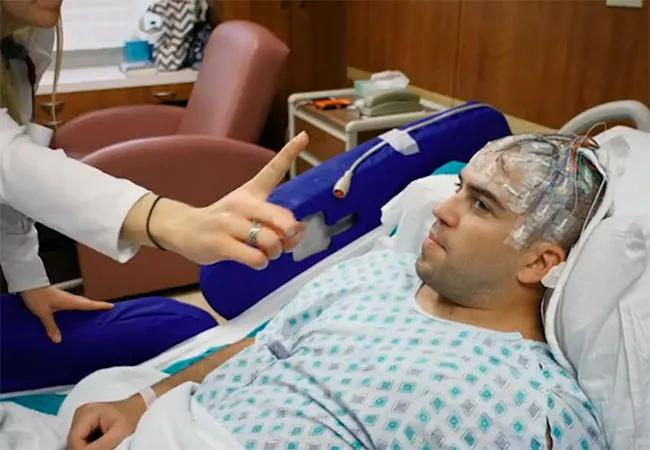
Image content: This image is available to view online.
View image online (https://assets.clevelandclinic.org/transform/73f00b02-44d2-4cd8-bc8c-38683b4052d3/18-NEU-899-Newey-cEEG-Study-650x450_jpg)
18-NEU-899-Newey-cEEG-Study-650×450
Among critically ill patients undergoing continuous electroencephalographic (cEEG) monitoring, mental status, the primary etiology for cEEG monitoring and epileptiform patterns are predictive of seizure risk and may help guide targeting of cEEG monitoring.
Advertisement
Cleveland Clinic is a non-profit academic medical center. Advertising on our site helps support our mission. We do not endorse non-Cleveland Clinic products or services. Policy
That’s the conclusion of the largest study to date of a cohort of consecutive critically ill patients monitored with cEEG, reported by Cleveland Clinic researchers in the Journal of Clinical Neurophysiology (2018 Apr 17 [Epub ahead of print]).
The retrospective investigation found the following:
“Acute seizures in critically ill patients have been associated with worse clinical outcomes,” says the study’s lead author, Christopher Newey, DO, MS, a staff physician in Cleveland Clinic’s Cerebrovascular Center and Epilepsy Center. “Because clinical suspicion is not always correct, cEEG monitoring is needed, but limitations in equipment and support staff make targeted monitoring increasingly important. Our findings suggest that we can better target the patients at highest seizure risk based on mental status, etiology and cEEG patterns.”
Advertisement
The study included all critically ill adults monitored with cEEG at Cleveland Clinic over a 24-month period — 1,123 patients in total. Of these, 215 patients (19.1 percent) had a seizure recorded on cEEG, and 89.3 percent of those seizures were nonconvulsive.
These findings closely parallel those from what was previously the largest cohort study of this type, by Claassen and colleagues in 2004, which reported seizures in 19 percent of cEEG-monitored critically ill patients, of which 91.8 percent were nonconvulsive seizures. That study also found coma and lateralized periodic discharges to be associated with heightened seizure risk, and it found a number of etiologies to be associated with seizure rates similar to those in the new Cleveland Clinic study.
“These areas of concordance with this earlier study bolster confidence in the applicability of our findings to other academic centers with high-acuity critical care patients,” notes Cleveland Clinic epileptologist Stephen Hantus, MD, senior author of the current study.
The researchers found that, when present, seizures were detected within 24 hours of the start of cEEG monitoring in 92 percent of patients. The question of optimal duration of cEEG monitoring was the focus of a more recent study presented by Dr. Hantus at the American Academy of Neurology’s 2018 annual meeting, as detailed in a prior Consult QD post.
That’s just one of several avenues of ongoing or future Cleveland Clinic research in this area. “Our next step is to determine whether patient acuity predisposes to seizure risk among critically ill patients,” says Dr. Newey. “Ultimately, our goal is to create an algorithm to identify those patients at highest seizure risk prior to cEEG hookup and then create a separate algorithm to determine patients’ daily seizure risk based on EEG data.”
Advertisement
He adds that the clinical implications for neurocritical care could be substantial. “We hope this can help with triaging resources, identifying at-risk patients earlier and providing guidance on patient monitoring to other clinicians,” he concludes.
Advertisement
Advertisement

New study advances understanding of patient-defined goals
Testing options and therapies are expanding for this poorly understood sleep disorder
Real-world claims data and tissue culture studies set the stage for randomized clinical testing
Digital subtraction angiography remains central to assessment of ‘benign’ PMSAH

Cleveland Clinic neuromuscular specialist shares insights on AI in his field and beyond
Findings challenge dogma that microglia are exclusively destructive regardless of location in brain
Neurology is especially well positioned for opportunities to enhance clinical care and medical training
New review distills insights from studies over the past decade
 Search