Locations:





First comparative study of shared vs. individual appointments

Image content: This image is available to view online.
View image online (https://assets.clevelandclinic.org/transform/1fa07acc-9b5a-4497-b9a3-d0b36b1b01a2/16-NEU-768-Gonsalves-650x450_jpg)
16-NEU-768-Gonsalves-650×450
Shared medical appointments have been shown to produce patient outcomes at least as good as those with individual medical appointments for diabetes and other chronic diseases, but what about their effectiveness for depression and anxiety disorders in women?
Advertisement
Cleveland Clinic is a non-profit academic medical center. Advertising on our site helps support our mission. We do not endorse non-Cleveland Clinic products or services. Policy
That was a question psychiatrist Lilian Gonsalves, MD, and her Cleveland Clinic colleagues could find no answer to in the published literature, so they conducted the first known comparative study of this issue and presented findings as a poster at the annual meeting of the Academy of Psychosomatic Medicine in late 2015.
Cleveland Clinic’s Center for Behavioral Health has offered shared medical appointments (SMAs) — a series of one-on-one encounters with patients in a group setting — as an alternative to individual medical appointments for women with depression and anxiety disorders since 2003 (see Figure).
“Although SMAs are not attractive to all patients with these conditions, the SMA model offers advantages in terms of peer support and the ability to schedule appointments sooner, along with greater efficiency for the healthcare system,” explains Dr. Gonsalves. “While most of our SMA participants have long reported high levels of satisfaction with the model, no analysis of patient outcomes using validated assessments of depression and anxiety symptoms had been done.”
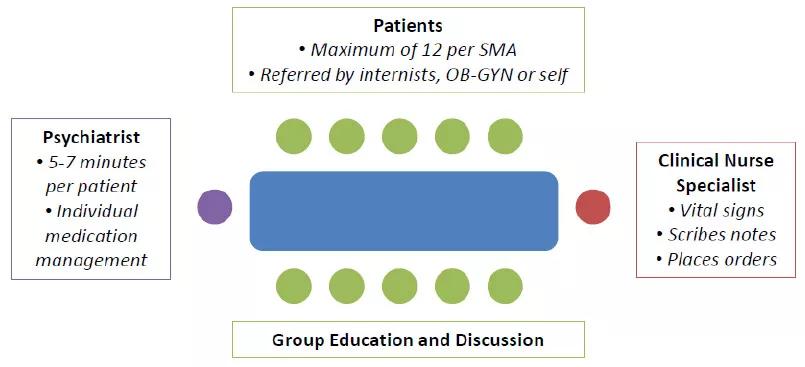
Image content: This image is available to view online.
View image online (https://assets.clevelandclinic.org/transform/406f0179-80bf-405d-9af8-1513f30410a0/16-NEU-768_inset_jpg)
Figure. Pictorial of the essentials of Cleveland Clinic’s shared medical appointments (SMAs) for women with depression and anxiety disorders.
To fill that gap, Dr. Gonsalves and colleagues designed a comparative analysis to test the hypothesis that change scores on two established mental health instruments over the course of a year of treatment would be noninferior or better among women attending SMAs relative to women treated via individual medical appointments. The two scales used were the nine-item Patient Health Questionnaire (PHQ-9) for depression and the seven-item Generalized Anxiety Disorder assessment (GAD-7).
Advertisement
The study involved 95 women (mean age, 44.9 ± 13.0 years) with depression or anxiety treated at Cleveland Clinic’s Center for Behavioral Health for at least one year following initial evaluation, either by attending SMAs (n = 62) or through individual appointments (n = 33). Women who attended both SMAs and individual appointments in the year following initial evaluation were excluded.
The two groups were generally comparable in patient and demographic characteristics, including the proportion of patients with depression (about three-quarters) versus anxiety disorder (about one-quarter). Notable differences were in the median number of visits during the study period (13 in the SMA group versus 8 in the individual appointment group) and the prevalence of a bipolar disorder diagnosis (11 percent of the SMA group versus 0 in the individual appointment group). Although not assessed statistically, use of neuropsychiatric medications was similar between groups, with comparable proportions of patients in each group receiving the most commonly used drug classes.
All study participants completed the PHQ-9 and GAD-7 instruments at each appointment, and scores were retrospectively reviewed along with demographic and psychiatric data from patient charts.
Key results included the following:
Advertisement
“These results suggest that SMAs are at least as effective as individual appointments in the management of depression and anxiety symptoms in women,” says co-investigator Katherine Taljan, MD, a 2016 graduate of Cleveland Clinic Lerner College of Medicine who presented the findings with Dr. Gonsalves. A full-length study report is in development for peer-reviewed publication.
The researchers pointed out the following study limitations:
“Further research involving a variety of providers and more diverse patient populations is needed to provide more comprehensive understanding of the relative effectiveness of SMAs and individual medical appointments in psychiatry,” Dr. Gonsalves notes.
Advertisement
Advertisement

New study advances understanding of patient-defined goals

Testing options and therapies are expanding for this poorly understood sleep disorder

Real-world claims data and tissue culture studies set the stage for randomized clinical testing
Digital subtraction angiography remains central to assessment of ‘benign’ PMSAH

Cleveland Clinic neuromuscular specialist shares insights on AI in his field and beyond

Findings challenge dogma that microglia are exclusively destructive regardless of location in brain

Neurology is especially well positioned for opportunities to enhance clinical care and medical training

New review distills insights from studies over the past decade
 Search